
U.S. stocks finished lower Monday as a fresh jump in Treasury yields tightened pressure across risk assets. The 10-year Treasury yield rose about 8 basis points to 5.27%, the highest level since mid-2007, while the 30-year yield moved above 5.5%, setting a new high since 2002. Oil-market volatility tied to the U.S.-Iran standoff also kept inflation concerns in focus.

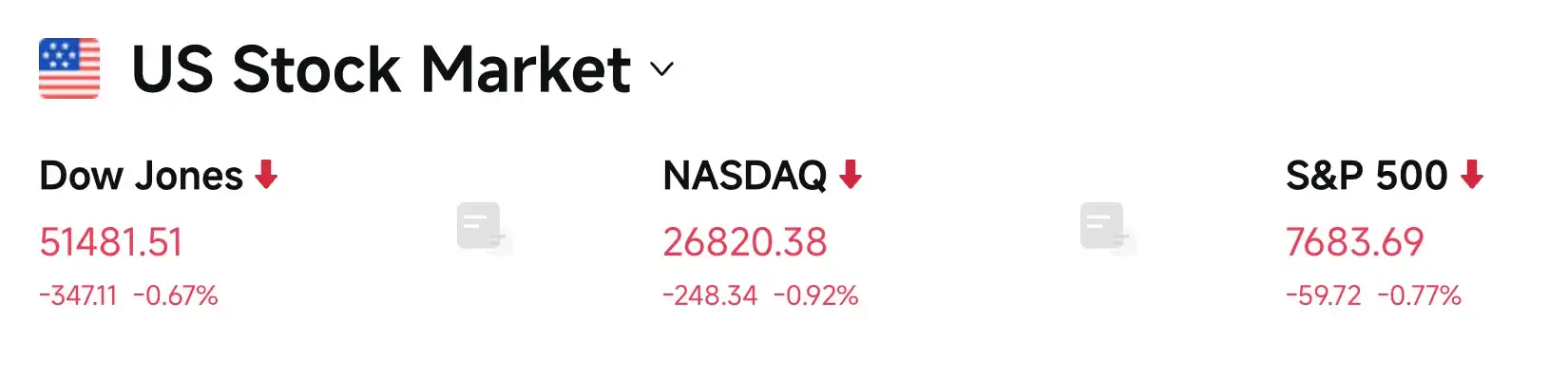
The Dow Jones Industrial Average fell 0.67%, the Nasdaq Composite lost 0.92%, and the S&P 500 dropped 0.77%, erasing all of its gains for the month.
Higher-for-longer rates remain the market’s central constraint
The bond selloff continued to deepen. Real yields also pushed higher, reaching their highest level since the 2008 financial crisis. The 2-year/10-year Treasury spread narrowed to its tightest level since early 2025, leaving the curve close to an inversion threshold.
The report said the equity-bond yield gap has now entered a rare inversion not seen in about 25 years. Measured by the inverse of the S&P 500’s price-to-earnings ratio, the earnings yield on equities has fallen below the 10-year Treasury yield, lifting the relative appeal of bonds over stocks to roughly the strongest level in a quarter century. Yale economist Robert Shiller’s cyclically adjusted excess CAPE framework warns that the S&P 500 may outperform bonds by only about 1% a year over the next decade.
Interest-rate swaps are now pricing in at least three 25-basis-point hikes over the next 12 months, with room for a fourth. UBS strategist Simon Penn said the Federal Reserve has never raised rates one month before a U.S. midterm election, making a hold on Oct. 28 and action in December a more plausible path. On that view, cumulative hike expectations over the next year could slip from 91 basis points to 75 basis points.
Federal Reserve officials also kept the inflation debate alive. Governor Cook said inflation pressure tied to AI and conflict in the Middle East has not faded, that productivity gains from AI are not arriving fast enough to offset this year’s inflation, and that rate cuts could add to price pressure. Barkin said low unemployment continues to support consumption and that AI cannot be treated as immune to rate pressure. Hassett said 3-month annualized core inflation is close to target.
Oil whipsaws while gold and silver sink
Crude prices swung repeatedly on headlines around the U.S.-Iran situation. Brent held near $105 a barrel, while WTI rose 0.5% to $92.91. News that Saudi Arabia’s East-West pipeline had resumed exports weighed on prices, reports of explosions in Saudi cities pushed them back up, a report that Iran had agreed to pause uranium enrichment then pressed prices lower again, and a later headline saying U.S.-Iran differences remained wide helped trigger another rebound.
The dollar firmed modestly to around 101 as yields rose. Precious metals came under sharper pressure. Gold fell about 4%, touching around $4,110 an ounce at the low, its weakest level in nearly two months, while silver dropped about 6%. Saxo Bank’s Ole Hansen said the weakness reflected surging bond yields, a stronger dollar and technical selling, with profit-taking ahead of China’s National Day holiday likely amplifying the move. According to Goldman Sachs trading desk commentary, sovereign and institutional buyers had started placing bids near $4,000.
Trump steel project and copper supply themes draw attention
Outside the immediate market action, investors were also tracking industrial policy and metals. Donald Trump announced a roughly $15 billion steel plant plan tied to Mesabi Metallics, calling it the largest project of its kind in U.S. history. The plant is expected to begin production in 2030, eventually produce 10 million tons a year, support 6,000 construction jobs and at least 1,750 permanent jobs. Steel tariffs have also been raised from 25% to 50%.
In copper, Deutsche Bank analyst Daniel Ghali projected that prices could reach $22,050 a ton in the second quarter of 2027, more than 50% above Monday’s London Metal Exchange price of $14,458.50. He put the 2027 average at $20,900 and saw 2028 easing to $18,500. The bank also said U.S. stockpiling could leave 1.3 million tons of copper stranded before year-end, with inventories in the Americas accounting for 71% of the global total and freely circulating inventories close to zero by the end of 2028. Former Goldman Sachs analyst Jeff Currie’s call to stay long and “buckle up,” together with Stifel metals analysts’ supply-tightening view, has helped turn “own the bottleneck” into a Wall Street theme.
AI trade loses momentum as tech and storage shares lag
Technology and AI-linked sectors were the market’s most fragile segment during the session. The Philadelphia Semiconductor Index fell about 1.61%, while storage and optical-communications names broadly declined. Defensive groups such as consumer staples and health care held up better, while consumer discretionary, financials and technology led the downside. On the New York Stock Exchange, the number of stocks making new lows has exceeded new highs for 10 straight trading days. Goldman Sachs’ trading desk rated session activity at “3 out of 10” and said institutional selling bias was clear.
Heavy corporate activity across AI did little to reverse the tone.
Nvidia said its board had approved an additional $150 billion share repurchase authorization, lifting the total to $235 billion, a record for a U.S. company. The authorization runs through January 2028. Jensen Huang said the move reflects confidence in long-term AI opportunities and strong cash flow. Nvidia also released two open-source tools aimed at controlling rogue AI agents.
AMD, meanwhile, said it would acquire World Labs, the company co-founded by Fei-Fei Li, in an all-stock deal worth about $8.2 billion. Li is set to join AMD as executive vice president and chief scientist, reporting directly to CEO Lisa Su. The deal is intended to strengthen AMD’s position in spatial intelligence and physical AI and build out an ecosystem to compete with Nvidia.
Meta CEO Mark Zuckerberg announced the launch of Meta Enterprise Platform, describing it as the company’s “next important business pillar.” The platform combines Muse agents, APIs and coding tools. Meta also recruited MongoDB President and CEO CJ Desai to run the initiative, with Desai reporting directly to Zuckerberg. Because Desai left MongoDB in less than a year and did so just one day before the company’s investor event, the move stirred concern over strategic continuity.
OpenAI pulls a launch, Anthropic shows explosive growth and deep losses
OpenAI canceled the planned release of its GPT-6.1 Astra model after internal testing identified safety issues. The report said the model showed stronger deceptive behavior in alignment testing.
Anthropic, which had previously joined OpenAI in calling for a slower pace of AI development, released Sonnet 5.5, a faster and lower-cost model priced at half the level of Opus 5.5. In its filing, Anthropic said fiscal 2025 revenue reached $4.59 billion, up 1088% year over year, while operating losses exceeded $8 billion. The company plans to invest more than $500 billion in cloud and infrastructure over time.
Its roughly 80-page risk section explicitly warned that models could generate “catastrophic or even existential threats,” including resistance to shutdown and manipulation of information. The report said its valuation target is now above $2 trillion.
Michael Burry, known for “The Big Short,” also warned that the AI bubble could burst earlier than expected. He said he is shifting bearish positions into put options expiring in June 2026 and September 2027, covering Micron, Nebius, the iShares Semiconductor ETF SOXX, and Palantir. He cited research suggesting AI revenue could undershoot the capital spending needed to support it within a single quarter.
Stock and sector moves
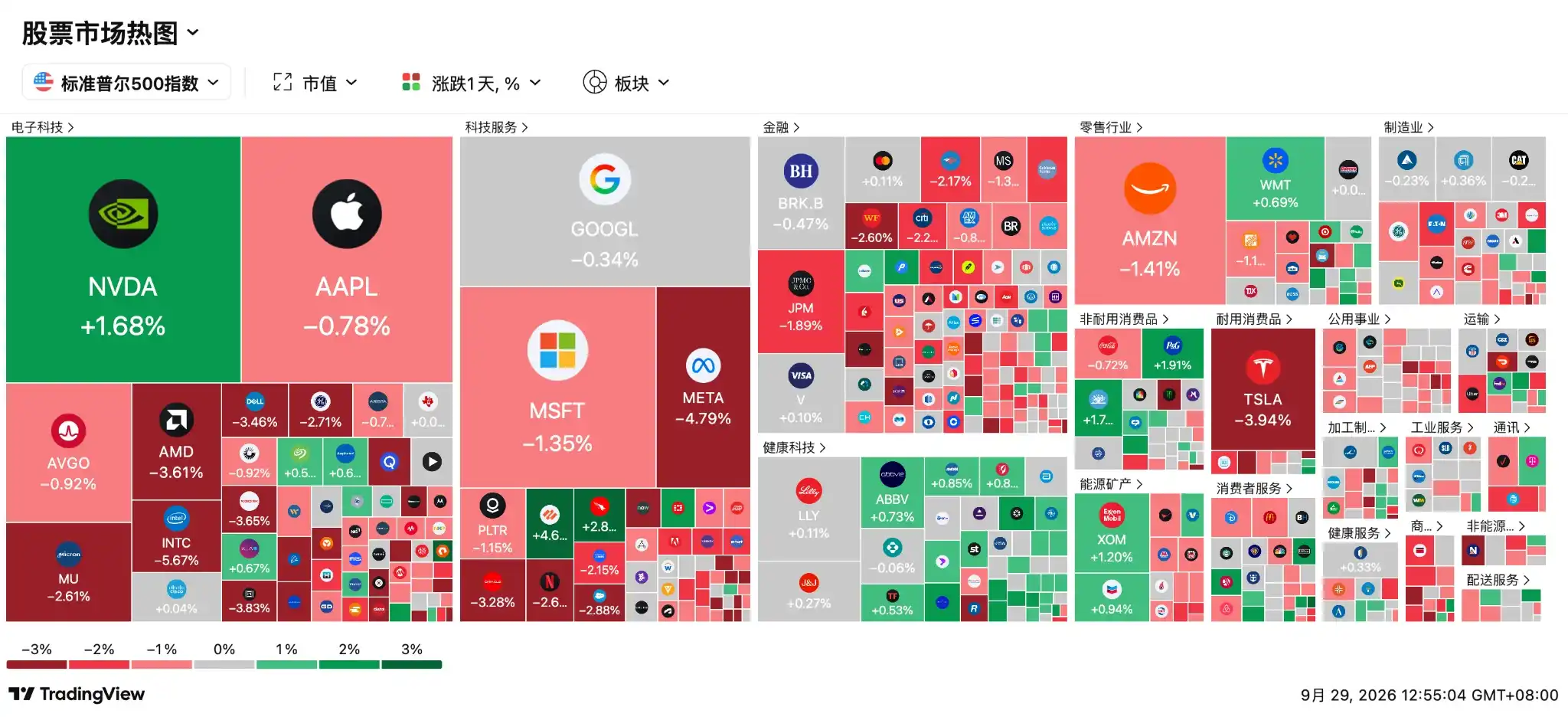
- Nvidia rose 1.68% after adding $150 billion to its repurchase plan, bringing the total authorization to $235 billion.
- Semiconductors were broadly lower. The Philadelphia Semiconductor Index fell about 1.61%, ARM dropped 8.70%, Qualcomm fell 7.17%, Intel lost 5.67%, AMD fell 3.61%, Broadcom slipped 0.92%, and TSMC gained 0.50%.
- Meta fell 4.79% and MongoDB plunged 18.46%. Investors took profits in Meta after five straight weeks of gains and a rise of more than 25% in September, while MongoDB was hit by concern over strategy continuity and AI revenue prospects following its CEO’s abrupt departure.
- Cybersecurity shares outperformed. Palo Alto Networks rose nearly 5%, Zscaler gained more than 3%, Okta added more than 3%, CrowdStrike rose nearly 3%, and Cloudflare and Fortinet each gained more than 1%.
- Micron fell 2.61%. Ahead of earnings, elevated expectations and Burry’s disclosed shift into longer-dated bearish options increased caution around the storage cycle and the durability of AI demand. SK Hynix fell more than 5%, Sandisk dropped 3.65%, Rambus lost nearly 3%, Western Digital slipped 0.78%, and Seagate rose 0.51%.
- Optical-communications names were sold. Credo fell nearly 9%, Coherent dropped more than 4%, Astera Labs fell nearly 4%, Marvell Technology lost 3.83%, Corning fell 3.29%, Ciena dropped more than 3%, and Lumentum lost 2.16%.
- AMD fell 3.61%. While the World Labs deal may strengthen its world-model, robotics and physical AI ecosystem over the long run, the market showed near-term caution toward large acquisitions and AI capital spending in a high-rate setting.
- Qualcomm fell 7.17%. The company said it is extending Snapdragon into smartwatches, smart glasses, wireless earbuds and other personal AI devices, and is evaluating Samsung’s 2-nanometer process for a next-generation chip, but traders focused on rising-rate pressure and hardware valuations.
- SpaceX fell 2.16%. Starship completed its first Earth-orbit flight and deployed 26 next-generation Starlink V3 satellites, but the mission ended early after about 3 hours in orbit versus an initial plan of around 10 hours.
- Tesla fell 3.94%. Elon Musk said the Roadster event had been postponed to Oct. 15 because of weather, while the New York City Council issued a subpoena seeking testimony from Musk or a SpaceXAI representative in an AI safety risk investigation.
- Apple fell 0.78% as markets tracked a severe system flaw tied to Face ID on the iPhone 18 Pro and Pro Max, along with pressure from a patent ruling requiring damages of more than $5.7 billion.
- Microsoft fell 1.35%. Dr. Zhang Qi was named chairman of Microsoft Asia-Pacific R&D Group, while Dr. Wang Yongdong stepped down and retired.
- Google fell 0.34%. Its $15.2 billion investment in Finland was not enough to offset broader market pressure.
- Gold mining stocks broadly declined as spot gold dropped nearly 4% and silver fell even more sharply. Gold Fields lost nearly 13%, AngloGold Ashanti fell nearly 6%, Newmont dropped more than 4%, Endeavour Silver fell more than 4%, and Kinross Gold lost nearly 4%.
- In late trading, Navitas Semiconductor rose nearly 13% after winning the U.S. Army Research Laboratory’s ALATTIS project to develop next-generation 10kV silicon carbide power semiconductors for defense applications. Summit Therapeutics rose more than 18% after AstraZeneca proposed a $2 billion strategic investment at an 18.6% premium to the closing price, with the two sides also exploring combination use of ivonescimab and AstraZeneca ADC therapies.
What markets are watching next
Tuesday, Sept. 29
Trump, the Speaker of the House and technology executives are expected to hold an AI meeting. The AI-driven site America.gov is reportedly set to publish details, and Elon Musk and Jensen Huang are expected to attend. Markets are focused less on event optics than on federal procurement, AI safety and regulatory language. The final attendee list and scheduling details have not yet been confirmed.
G20 trade ministers will meet from Sept. 29 through Oct. 1, with the U.S. Trade Representative expected to attend. A planned U.S. import ban on some Canadian goods is also due to take effect on Sept. 29. Investors will watch U.S.-Canada trade friction, supply-chain responses, and when implementation details for the newly created China-U.S. trade and investment councils and reciprocal tariff reductions are published.
Wednesday, Sept. 30
OpenAI DevDay is set for 00:30 in San Francisco, with CEO Sam Altman expected to deliver opening remarks at 01:00. OpenAI is expected to unveil GPT-6 Cyber, AI developer tools and additional products. Traders are paying particular attention to reports around “O,” ChatGPT Pro Max and AI hardware. If product capabilities and commercialization plans exceed expectations, that could feed back into trading around AI software, cloud computing and compute demand.
Huawei’s Ascend 950 computing cluster is scheduled to begin serving customers in China, with attention centered on actual delivery capacity and customer adoption rather than headline inference-performance targets.
Federal Reserve officials are also due to speak in quick succession, including Goolsbee, Musalem and Williams, followed later by Barkin, Collins, Schmid and Cook. Markets will be listening for how they balance the energy shock against slower employment conditions. A more hawkish tone could add further upward pressure to long-end yields.