
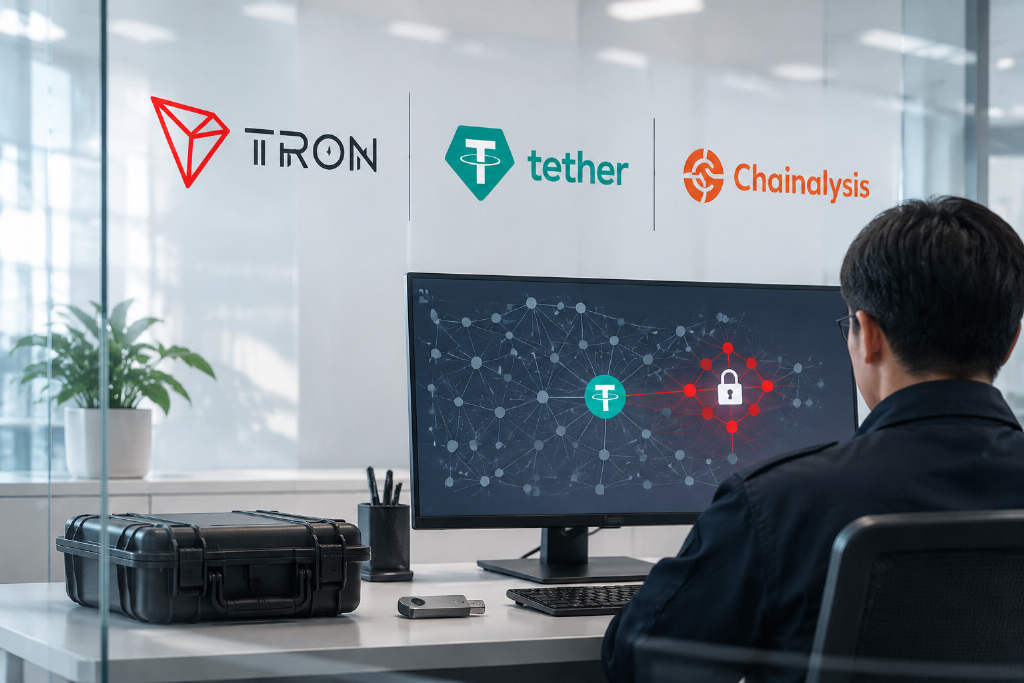
Tron, Tether and blockchain analytics firm Chainalysis have launched the Digital Crime Task Force, a joint operation focused on illicit activity involving Tether’s USDT on the Tron blockchain. The group says it will identify suspicious activity and surface it to law enforcement before criminals can move their funds. The announcement came only weeks after a nearly identical alliance, built with a different analytics partner, quietly fell apart.
The task force was announced Wednesday. Its stated approach is to move crypto-crime investigations from a reactive model to a proactive one. Rather than waiting for a victim to report a crime or for an investigator to flag tainted funds, the group says it will trace criminal networks in advance and coordinate asset freezes. Chainalysis will contribute its intelligence and AI-powered investigative tools. Police will also be able to submit tips and requests to freeze assets.
「Criminals are using AI to move faster than ever, and waiting for a victim to report a crime is no longer good enough,」Tether CEO Paolo Ardoino said. He added that Tether has frozen more than $7 billion tied to illicit activity while working with more than 360 law enforcement agencies across 73 countries.
Tron founder Justin Sun presented the operation as a way to protect the millions of people who rely on USDT. More than $94 billion of the stablecoin circulates on Tron.
A replacement for the T3 Financial Crime Unit
The new alliance replaces a similar operation previously run by Tron and Tether. The companies formed the T3 Financial Crime Unit with rival analytics firm TRM Labs in 2024, and Binance later joined the group. Together, the members froze more than $450 million in tainted assets.
Bloomberg reported earlier this month that T3 was quietly disbanded in late August. People familiar with the matter cited slow response times and a lack of coordination among the members. News of the group’s collapse became public only days before the record $6.4 billion Binance hack.
Replacing TRM Labs with Chainalysis is a pointed change because the two firms are fierce competitors. Chainalysis has sued the U.S. government over an Immigration and Customs Enforcement, or ICE, contract awarded to TRM without competitive bidding. The dispute highlights the rivalry now running through the crypto industry’s crime-fighting infrastructure.
Broad list of targeted threats
The task force said it will target a broad range of threats, including romance scams, investment scams, stolen funds, terrorist financing, North Korean cyber operations, cartel money laundering and child-exploitation material.
The group also linked the initiative to a coming era in which autonomous AI agents transact onchain. It warned that those systems could open new avenues for criminal exploitation.



