
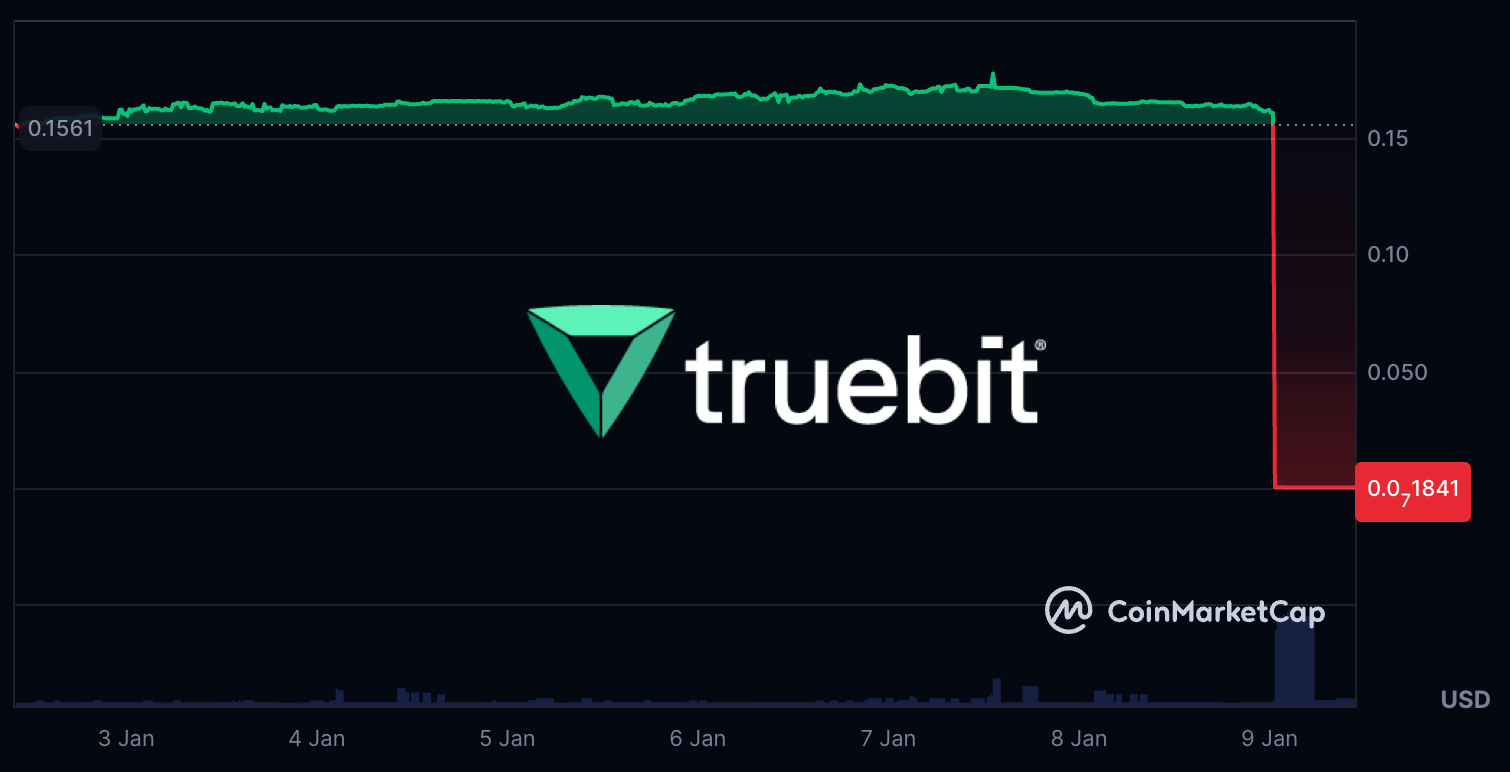
Blockchain compute scaling protocol TrueBit confirmed a security incident in the early hours of July 23, with 8,535 Ether (ETH) — worth approximately $26 million at current market prices — illicitly transferred out. The news triggered an immediate collapse of the protocol's native token TRU, which plummeted from $0.12 to under $0.001 within minutes, a decline of over 99.99% that effectively zeroed the asset.
Exploit Details and Fund Movements
On-chain data reveals that the attacker used a series of automated transactions to split the stolen ETH across multiple wallets, then quickly routed portions to various exchanges and mixing services. Security experts widely attribute the breach to a logic error in an early TrueBit contract, which had not been covered by subsequent security audits. The flaw allowed the attacker to bypass normal verification and trigger withdrawals.
TrueBit's team issued an urgent warning for users to stop interacting with affected contracts and cooperate with the investigation. As of now, the stolen funds have not been recovered.
Background: TrueBit's Role in Scaling
TrueBit is a protocol designed to scale blockchain computation, addressing high gas fees and inefficiency on public chains like Ethereum. Its core mechanism enables smart contracts to offload heavy computations off-chain and verify correctness through a "verification game," drastically reducing on-chain costs. First proposed in 2017, TrueBit was once considered a pioneer in Layer-2 scaling solutions. In recent years, its focus shifted toward verification layers—for example, TrueBit Verify, which aims to integrate cross-chain data and workflow verification for tokenized assets.
The hack has dealt a severe blow to TrueBit's on-chain assets and market reputation, making recovery uncertain.