
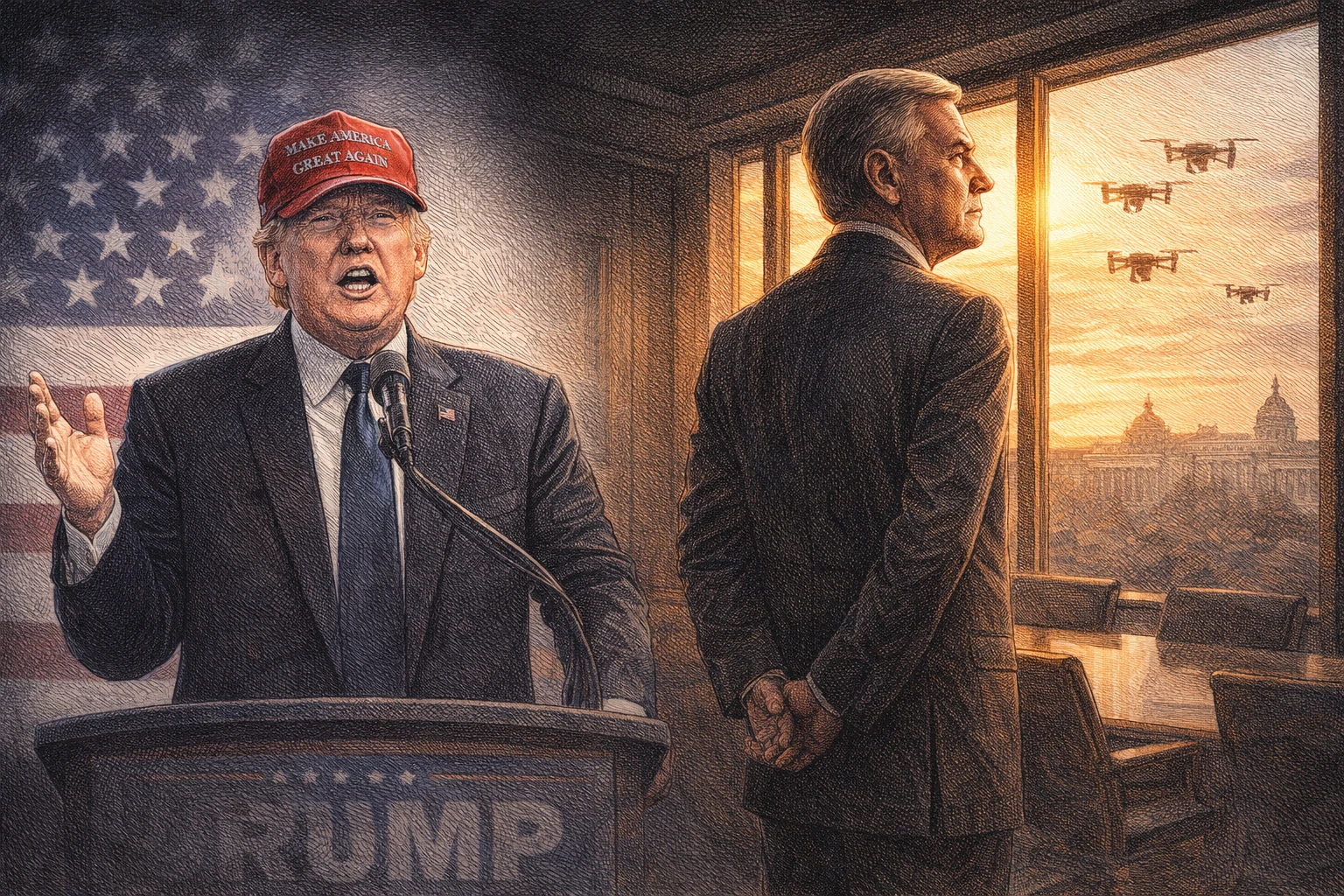
The Trump administration is reportedly in talks to back several U.S. drone makers through the Pentagon’s Office of Strategic Capital, using a mix of debt and equity financing. According to The Wall Street Journal, the approach would go beyond procurement contracts and could leave the government holding direct stakes in private companies. The report sparked a sharp move in drone-related stocks, with Unusual Machines (UMAC) rising nearly 70% intraday, Red Cat Holdings (RCAT) up about 57%, and Ondas Holdings (ONDS) gaining roughly 27%.
UMAC draws attention as Donald Trump Jr. holds shares
UMAC quickly became the focal point. Donald Trump Jr. sits on the company’s advisory board and owns about 330,000 shares of UMAC, according to the report. The list of companies under Pentagon consideration also includes Powerus, formerly Aureus Greenway, a drone company backed by Trump’s two sons. The move suggests the Pentagon sees direct capital support as necessary, rather than relying only on purchase orders to expand production.
Production gap sits at the center of the talks
The supply problem is straightforward. U.S. drone manufacturing capacity is estimated at about 100,000 units per year, while the Pentagon’s “Drone Dominance” plan calls for 300,000 low-cost attack drones by the end of 2027. The report said more than $70 billion was allocated for that effort in the fiscal 2027 budget, and Trump described it as a presidential priority.
The comparison with Ukraine is stark. Ukraine’s drone output in 2024 was reported at about 4 million units. On that basis, current U.S. production is still below 2.5% of that level.
More companies are involved, with up to $200 billion planned over three years
The companies mentioned in the report also include Sequoia-backed Neros Technologies and Performance Drone Works, which has already secured an Army reconnaissance contract. Neros currently produces around 2,000 drones per day and is building a 250,000-square-foot facility in Torrance, California, called Project Millennium, with a target of 1 million drones annually.
The Office of Strategic Capital is said to be planning as much as $200 billion in debt and equity deployment over three years to support critical national security supply chains. If carried out as described, it would rank among the largest instances of U.S. government equity ownership in private companies. Another constraint remains in place: eight months after the DJI ban took effect, FAA data cited in the report showed that 96% of drones operating in U.S. airspace still come from DJI.