
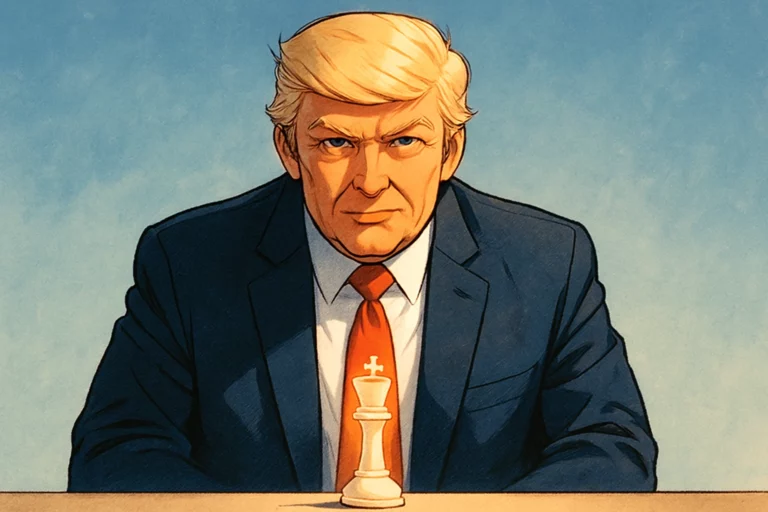
As tensions with Iran escalate, a detailed analysis by the Kobeissi Letter reveals a consistent pattern in President Trump's approach to geopolitical and trade conflicts. Since taking office in January 2025, Trump has repeatedly followed a playbook: start with public threats, escalate gradually, and eventually return to the negotiation table. For financial markets, the real question is how severely the worst-case scenario gets priced in, and how quickly prices reverse when uncertainty fades.
Phase 1: Public Pressure Sets the Tone
Almost every conflict begins with verbal escalation. Trump posts on Truth Social about a "massive Armada heading to Iran" or threatens to "close the airspace over Venezuela" weeks before any military action. The goal is to create a sense of imminent risk and force the counterparty to make a deal. In trade wars, similar language precedes tariff announcements.
Phase 2: Visible Deployment Hardens the Threat
When words alone don't work, Trump backs them up with tangible moves. This includes military redeployments, joint exercises, or formal investigations. The Intel case is a prime example: Trump publicly called for the CEO's resignation, then announced a government acquisition of 10% of the company, which yielded an 80% gain in two months. The objective remains a deal.
Phase 3: Friday Night Strikes
Trump consistently times major announcements after Friday's market close — allowing a weekend for digestion and reducing intraday panic. The list includes the joint US-Israel airstrike on Iran (Feb 28), threats of 100% tariffs on China, and the closure of Venezuelan airspace. If no de-escalation appears over the weekend, the conflict enters the next phase.
Phase 4: Risk Premium Spreads Across Assets
When futures open Sunday at 6 PM ET, assets react sharply. Yet markets often initially expect a quick deal, so some of the move reverses. For example, on March 2, WTI crude gave back about 70% of its initial gain. But the next day oil hit new highs and stocks sank again, confirming the conflict was not fading.
Phase 5: Signaling a "Forever War"
Just when investors expect Trump to back down, he doubles down. On March 2, he said "war can go on forever" and claimed the US has "unlimited" advanced weapons. This is a negotiating tactic: making the opponent believe the pain will persist. In reality, a long war conflicts with Trump's core goals of low inflation, low gasoline prices, and being a "peace president".
Phase 6: Markets Price in Protracted Conflict
Brent crude rises above $85/barrel, the S&P 500 gives up all its YTD gains, and the Dow drops about 1,100 points in a single day. The market moves from assuming a short skirmish to factoring in supply chain risks, higher insurance costs, and potential disruption of the Strait of Hormuz. This "third dip" is where smart money begins to look for overreaction.
Phase 7: Conditional De-escalation Signals
After sufficient risk premium builds, Trump starts floating "conditional" talks. In April 2025, the tariff pause followed a spike in 10-year Treasury yields. For Iran, triggers could include a change in Iranian leadership or a major economic stress point. Language shifts from "strike" to "framework agreement" or "negotiations".
Phase 8: The Market-Political Feedback Loop
JPMorgan estimates closing the Strait of Hormuz could push oil to $120–130/bbl, raising US CPI inflation to ~5%. If oil holds above $90, equities fall >5%, and gasoline prices rise >10%, the political cost becomes too high for Trump during a midterm election year. That raises the probability of a deal.
Phase 9: Deal Announcement and Narrative Framing
Every major confrontation ends with a deal — whether with China, the EU, India, or Intel. The narrative is always "maximum pressure forced concessions." In the Iran context, if the regime does not collapse, expect a ceasefire tied to nuclear concessions or a regional security arrangement.
Phase 10: Violent Repricing and Victory Lap
Once a credible framework emerges, markets reverse sharply. Defensive positions built during the crisis are unwound rapidly, driving oil down and equities up. The rally is not about fundamentals improving but about tail risks being removed. Gold and silver recently dropped ~20% in 24 hours, signaling extreme fear — often a precursor to a smart-money entry.