
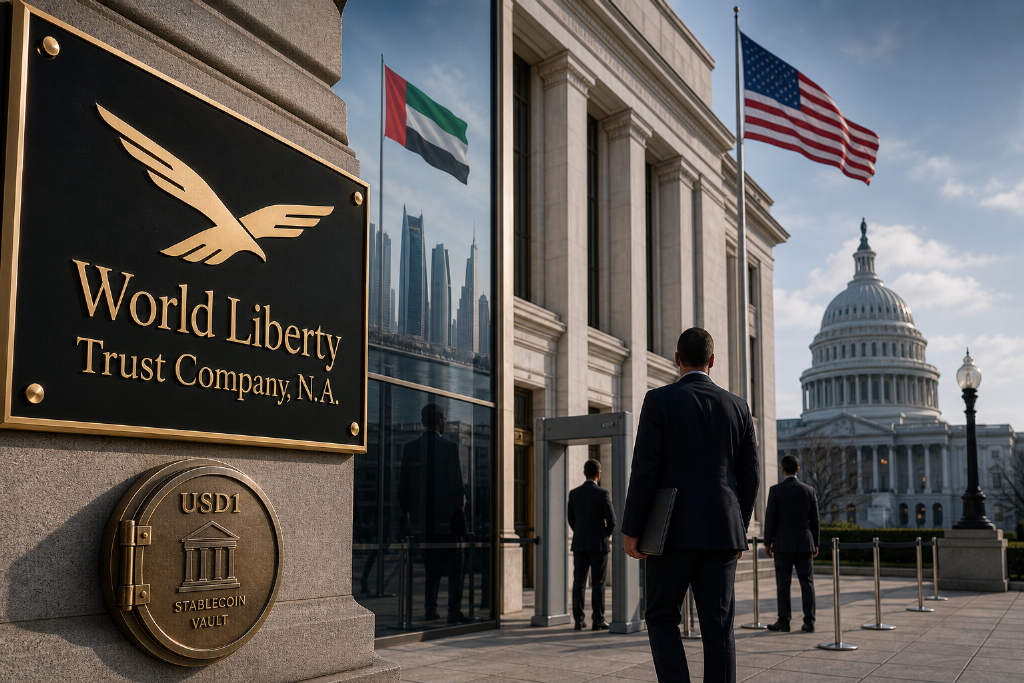
The U.S. Office of the Comptroller of the Currency, or OCC, granted preliminary conditional approval on Aug. 14 for World Liberty Trust Company, N.A. (WLTC), a proposed national trust bank that is expected to take over issuance, redemption, and reserve asset management for the USD1 stablecoin.
Two weeks later, the focus moved from what the bank plans to do to who is funding it. On Aug. 27, The Wall Street Journal reported, citing people familiar with the matter, that Sheikh Tahnoon bin Zayed al Nahyan and co-investors hold 49% of WLTC Holdings through StringZ Holding RSC, while a Trump family-linked entity holds another 38%.
OCC records confirm the structure, not the precise ownership split
The 49% and 38% figures came from The Wall Street Journal’s sourcing. OCC materials do not publicly disclose the exact ownership percentages of each shareholder.
Still, the OCC documents confirm two key points. First, the proposed WLTC would be wholly owned by WLTC Holdings LLC, a Delaware company. WLTC is the applicant for the national trust bank charter, while WLTC Holdings sits above it as the holding company through which investors would hold indirect interests in the bank.
Second, StringZ Holding RSC (DE) LLC, DT Marks SC LLC, and AMGUS, LLC each have indirect investments tied to the proposed bank and submitted passive investment commitments to the OCC.
That leaves a two-layer structure at minimum: WLTC would apply for the charter and operate the bank, while WLTC Holdings would own WLTC and hold the shareholders’ investment interests.
One Abu Dhabi royal, two separate investment vehicles
Sheikh Tahnoon bin Zayed al Nahyan is the brother of UAE President Mohammed bin Zayed al Nahyan. He serves as deputy ruler of Abu Dhabi and national security adviser of the United Arab Emirates. He also chairs MGX, AI group G42, the Abu Dhabi Investment Authority (ADIA), and First Abu Dhabi Bank.
His business ties to World Liberty Financial go back to before Donald Trump’s second inauguration. Earlier this year, The Wall Street Journal reported that Aryam Investment 1, an Abu Dhabi investment vehicle backed by Tahnoon, spent $500 million in January 2025 to acquire a 49% stake in World Liberty Financial. Of the initial $250 million payment, about $187 million went to entities controlled by the Trump family, and at least $31 million went to entities linked to the Witkoff family.
The Witkoff family comes from the U.S. real estate business. Steve Witkoff, founder of Witkoff Group and the Trump administration’s current U.S. special envoy to the Middle East and special envoy for peace missions, was involved in the early founding of World Liberty Financial. Project documents describe him as an "emeritus co-founder" after he entered government. His sons, Zach Witkoff and Alex Witkoff, are both co-founders of World Liberty Financial, and Zach Witkoff is now the company’s CEO.
According to a World Liberty Financial announcement, Zach Witkoff will also serve as chairman of the WLTC board.
The bank investment uses a different entity, StringZ. In other words, Aryam Investment 1 was the vehicle used in the earlier World Liberty Financial equity deal, while StringZ is being used to hold interests tied to the WLTC bank holding company. Both are backed by the same Abu Dhabi royal, but they are not the same legal entity.
What the passive investment commitments restrict
The full name used in the OCC file is StringZ Holding RSC (DE) LLC. An OCC attachment shows that StringZ’s passive investment commitment was signed by company manager Hamad Khlfan Ali Matar Alshamsi.
DT Marks SC LLC, which appears alongside StringZ in the OCC filing, is an investment entity linked to the Trump family. Its passive investment commitment was signed by Eric F. Trump in his capacity as president, directly tying DT Marks SC to Eric Trump’s management role.
The filings also require a distinction between two similarly named entities. DT Marks SC LLC appears in the WLTC bank approval materials and is a direct or indirect investor in the proposed bank or its holding company. DT Marks DEFI LLC appeared in earlier legal disclosures for World Liberty Financial, where it held about 38% of WLF Holdco LLC and had certain economic rights tied to WLFI tokens and the protocol.
Both entities are linked to the Trump family, but they relate to different structures: one for the bank investment, the other for World Liberty Financial’s existing business.
The commitments submitted by StringZ, DT Marks SC, and AMGUS are broadly the same. None of the three companies may seek board seats, obtain material nonpublic information, or influence pricing, personnel, investment decisions, or operating policies at the bank.
If any of them acquires 10% or more of a class of voting shares, any voting power above 9.9% must be delegated to bank management.
The arrangement separates economic exposure from operating control. Even if The Wall Street Journal’s reported 49% stake is accurate, StringZ would not be able to exercise voting rights on the same scale, appoint directors directly, or step into day-to-day bank management. The passive investment commitments restrict control, but they do not automatically strip investors of the economic upside tied to share ownership and asset appreciation.
WLTC would not operate like a standard commercial bank
World Liberty Trust Company, N.A. is proposed as a very different type of bank from a conventional commercial lender.
Under the OCC approval letter, WLTC would be a limited-purpose national trust bank without Federal Deposit Insurance Corp. (FDIC) deposit insurance. Its business plan centers on stablecoin and digital asset services rather than traditional retail lending and deposit-taking. WLTC also does not currently plan to apply for a Federal Reserve master account and has committed that it will not issue, custody, or trade the WLFI governance token.
If it receives final approval and opens, WLTC plans to carry out three core businesses:
- issue and redeem USD1 for institutional customers across the United States, while managing USD1 reserve assets;
- custody digital assets for institutional clients in a fiduciary capacity;
- provide conversion services between approved stablecoins and USD1 for custody clients.
At present, BitGo Bank & Trust is the exclusive issuer and custodian of USD1. WLTC plans to assume USD1 reserve assets and related liabilities after launch, bringing issuance, redemption, reserve management, and institutional custody under one trust bank supervised directly by the OCC.
Approval is preliminary and conditional
WLTC cannot open yet. What the OCC issued was preliminary conditional approval, and the agency retained the right to modify, suspend, or revoke that decision before final approval.
WLTC must maintain at least $20 million in Tier 1 capital, establish compliant anti-money laundering, sanctions screening, and customer information security systems, submit a complete information systems and operating architecture package, and pass a pre-opening examination before it can receive final approval.
If WLTC fails to raise the required capital within 12 months of the preliminary approval, or fails to commence operations within 18 months, the approval will in principle lapse. World Liberty Financial also described the OCC action as one step in a multi-stage bank licensing process.
USD1, Binance, and conflict-of-interest scrutiny
Tahnoon-backed ties to World Liberty Financial also extend to Binance through USD1.
In March 2025, MGX, chaired by Tahnoon, announced a $2 billion investment in Binance for a minority stake. MGX said only that the deal was settled in stablecoins and did not name the token at the time. On May 1, 2025, World Liberty Financial co-founder Zach Witkoff said at Token2049 in Dubai that the stablecoin used in the transaction was USD1, which had launched only shortly before. Bloomberg later reported the disclosure.
The transaction quickly expanded USD1 circulation and brought heavier scrutiny to the overlap between Abu Dhabi capital, Trump family economic interests, and U.S. crypto policy.
U.S. Senator Elizabeth Warren and others later asked MGX, Binance, and World Liberty Financial to provide communications records. They also called on the OCC to pause its review of World Liberty Financial’s bank charter until Trump and his family exited related economic interests.
In its approval materials, the OCC addressed comments urging the agency to pause or reject the application, but still granted preliminary conditional approval. The filing said career OCC staff reviewed the application under established procedures and applicable statutory, regulatory, and policy standards.
On concerns involving WLFI token purchases, potential conflicts of interest, and the U.S. Constitution’s Emoluments Clause, the OCC said those issues fall outside the scope of this charter review because neither World Liberty Financial nor its foreign investors are applicants in the bank charter process. The OCC also said that whether the Committee on Foreign Investment in the United States, or CFIUS, should review World Liberty Financial’s ownership and foreign investment is outside the scope of this licensing review. Other policy concerns, it said, were not enough to justify denial.
According to The Block, the White House denied that the transactions created a conflict of interest.
Three issues remain in focus
The next points to watch are whether the OCC issues final approval for the bank to open, whether WLTC discloses a fuller shareholder roster, and how WLTC will report related-party transactions, shareholder returns, and potential conflicts once USD1 reserve assets move from BitGo to the new bank.
The bank charter can define how WLTC operates and limit how shareholders exercise control. It does not, by itself, erase questions around those investors while the investment relationships remain only partly disclosed.