
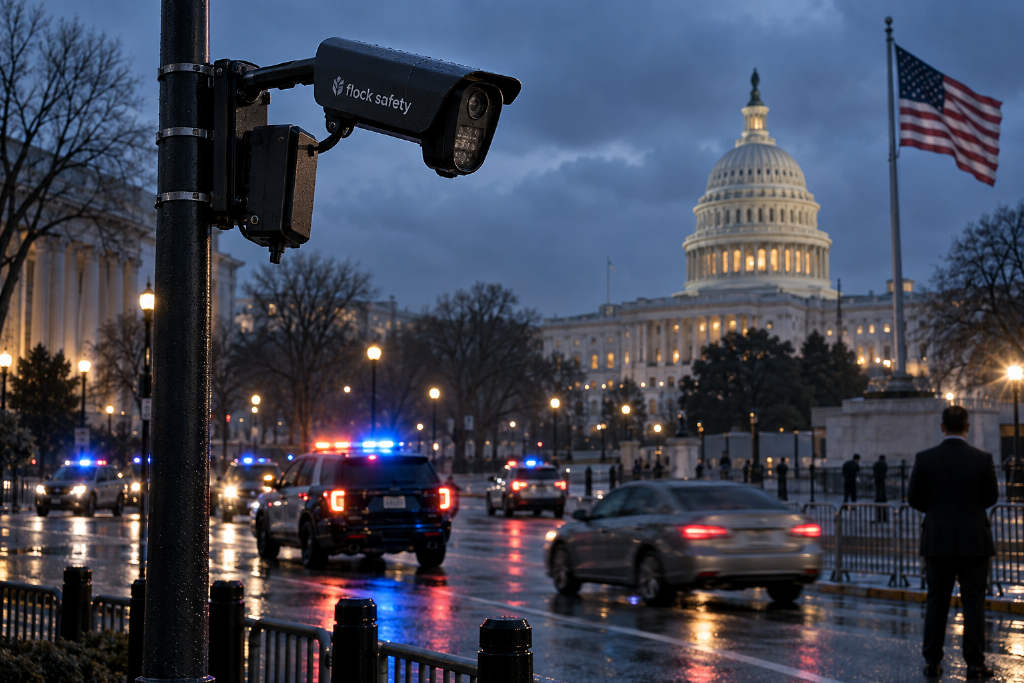
President Donald Trump said Sunday that he likes Flock Safety’s AI-powered surveillance cameras, ending months of hesitation around a technology that has split Democrats and Republicans alike.
Speaking to reporters aboard Air Force One while returning from Ireland to Joint Base Andrews, Trump was asked whether he would support the automated license plate readers that police departments say have helped solve cases across the country. “Yeah, I sort of like them because of that, because of law enforcement,” he said.
He also acknowledged that the issue is contested. Trump said “some people” view the cameras as “an infringement” on privacy. When a reporter replied that Flock’s network “helps catch a lot of criminals,” Trump repeated his position: “I like them.”
How Flock’s system works
Flock markets a simple model. Fixed cameras mounted on poles photograph passing vehicles and use computer vision to log the make, model, color, and distinctive features, including bumper stickers and roof racks.
The company has installed more than 120,000 cameras across more than 6,000 U.S. communities and scans roughly 20 billion vehicles every month.
Police departments say the searchable network helps recover stolen cars and find missing people. Critics say the same system can assemble movement records on people who have never been suspected of a crime.
Pressure intensified last month
The clash between law enforcement use and privacy concerns sharpened last month after Wired reported that Flock had been building an AI tool capable of identifying and tracking drivers without capturing a name or a license plate.
The software was first called Nightshift and has since been renamed Flock OS Investigate. According to the report, it included 69 preset prompts that let officers search for vehicles by movement pattern alone. One of those prompts flags a car’s “associates” by checking which other vehicles appear at the same cameras within a two-minute window.
Congressional and local backlash
Sen. Josh Hawley, who chairs the Senate Judiciary Subcommittee on Crime and Counterterrorism, opened a formal investigation into Flock’s data practices in late August. He later widened that inquiry to include rival surveillance vendors Motorola Solutions, Verkada, and Axon.
Sen. Bernie Sanders has pledged separate legislation aimed at limiting the network. Rep. Thomas Massie is backing a bill that would cut federal funding to agencies that deploy the cameras. The backlash on Capitol Hill was underway well before Trump made his position clear.
At the state and local level, Texas Gov. Greg Abbott ordered state agencies in late August to halt funding for Flock cameras. In July, the Los Angeles Police Department suspended its Flock contract over data-sharing and security concerns.
Trump’s remarks place him against that broader direction and put him at odds with some Republicans leading the congressional pushback.
On the same flight, Trump brushed off AI safety warnings
The exchange about Flock came during the same in-flight conversation in which reporters asked Trump about artificial intelligence safety, an area where his tone was noticeably sharper.
Anthropic CEO Dario Amodei had published an essay the day before calling on the industry to slow down so safety work could catch up. OpenAI CEO Sam Altman made a similar case for pacing development. The report said those warnings were followed by a stock market drop as Monday trading began.
Asked whether he had heard those warnings directly, Trump did not engage with the substance of them. “I’m not downplaying,” he said, “but it’s going to be more good than bad, but by a lot.”
He added: “Whoever wins AI, and we’re leading by a lot. Whoever wins AI, wins.” Trump has used that line before when dismissing regulatory pressure. He described calls for tighter guardrails as coming from “negative forces” sounding alarms about things that “won’t happen.” Asked directly whether he personally uses AI, Trump said that he does, without explaining how.
A clearer stance than in August
Trump had previously avoided taking a firm public position on Flock. When asked about the company in August, he said the administration was still studying the issue and weighing the “pros and cons” before deciding where it stood.
Sunday’s remarks were the first time he openly stated a personal view. They came just days after the September 8 deadline Hawley had set for Flock to turn over internal documents.