
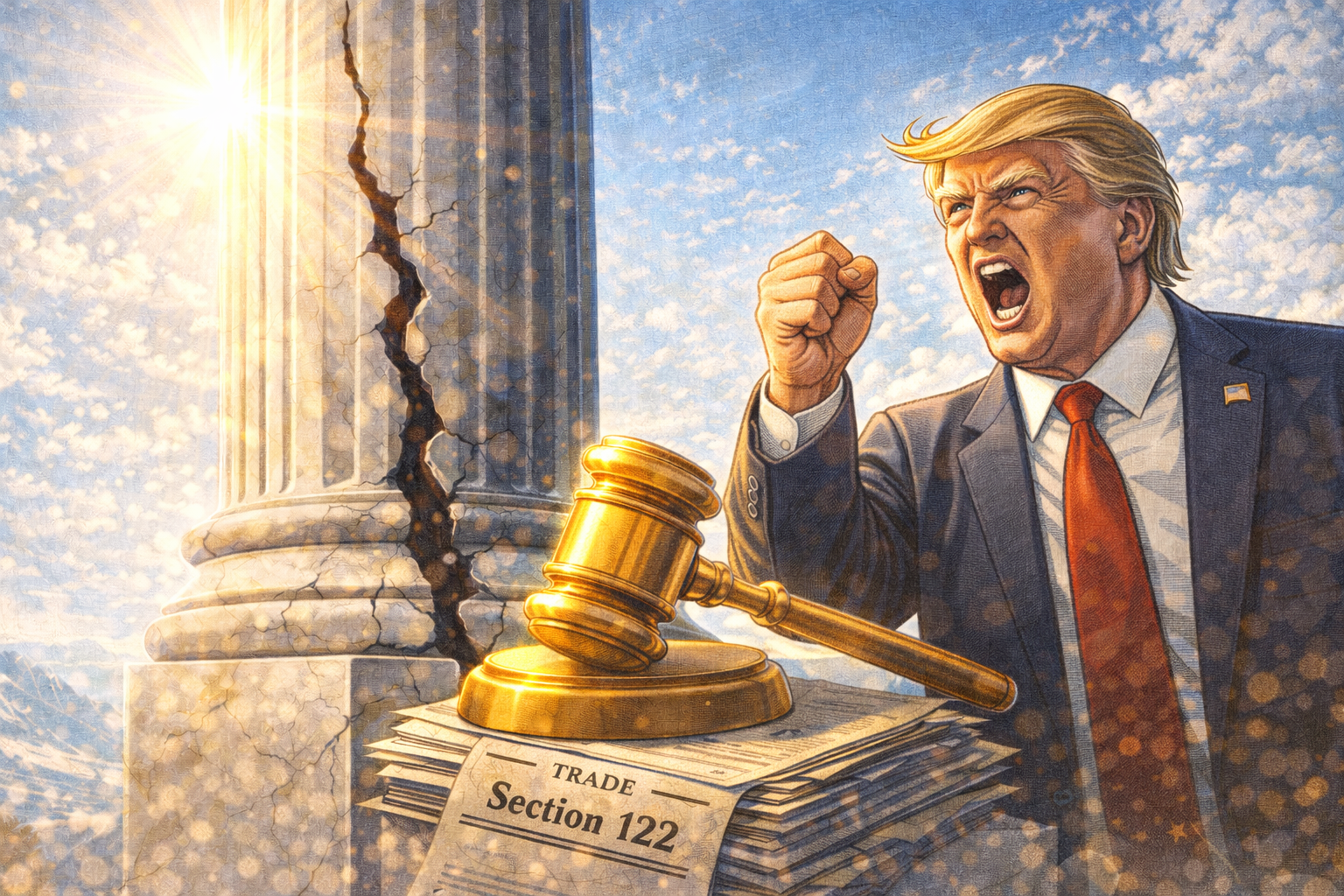
The U.S. Supreme Court ruled 6-3 that the International Emergency Economic Powers Act, or IEEPA, does not give the president unilateral authority to impose tariffs. Within hours of that decision, Donald Trump signed an executive order invoking Section 122 of the Trade Act of 1974 to add a 10% global tariff for 150 days.
Chief Justice Roberts wrote that IEEPA contains no reference to tariffs or duties, and that no previous president had read the law as granting such power. The immediate consequence is significant: tariffs collected by U.S. Customs under IEEPA since 2025 are now treated as unlawful. The report said the total could reach $175 billion, opening the door for importers to seek refunds.
Section 122 becomes the administration’s temporary fallback
The White House said the new measure will take effect at 12:00 a.m. on the 24th. Some food products, critical minerals, and goods already covered by other tariffs unaffected by the court ruling are excluded. Section 122 was designed for balance-of-payments crises and allows a temporary tariff of up to 15%, but only for 150 days unless Congress votes to extend it.
That gives Trump a replacement legal basis, but only for a limited period. Under the current timetable, the option lasts no later than the end of July. Treasury Secretary Bessent said that, combined with authorities under Sections 122, 232, and 301, tariff revenue in 2026 would be “almost unaffected.”
Refund risk and legal uncertainty move to the center
Two pressure points are now in view. The first is refunds. According to the report, importers generally have 180 days after liquidation of goods to file challenges. Legal observers cited by CNBC expect a wave of refund claims in the coming months, with the Court of International Trade overseeing the process. That could turn into a major fiscal burden for the U.S. Treasury.
The second is whether Section 122 itself can hold up. Outside analysis noted that no president has actually used the provision before, so its legal strength has not been tested in court. The statute also requires tariffs to be applied uniformly across countries, making Trump’s preferred approach of using different tariff rates for different trading partners much harder to execute.
The tariff arsenal remains, but with tighter limits
The court did not eliminate all tariff tools. What it blocked was the use of a national emergency claim under IEEPA as a broad route around Congress. Other authorities still exist, though each comes with constraints: Section 122 expires quickly, Section 232 must rest on national security grounds, and Section 301 requires an investigative process.
The next phase will turn on three questions: how large the refund bill becomes, whether Trump can persuade Congress to extend or lock in the temporary tariffs within the 150-day window, and whether expanded use of Sections 232 and 301 triggers fresh trade friction. The tariff fight is still active, but the dispute has shifted toward law and procedure.