
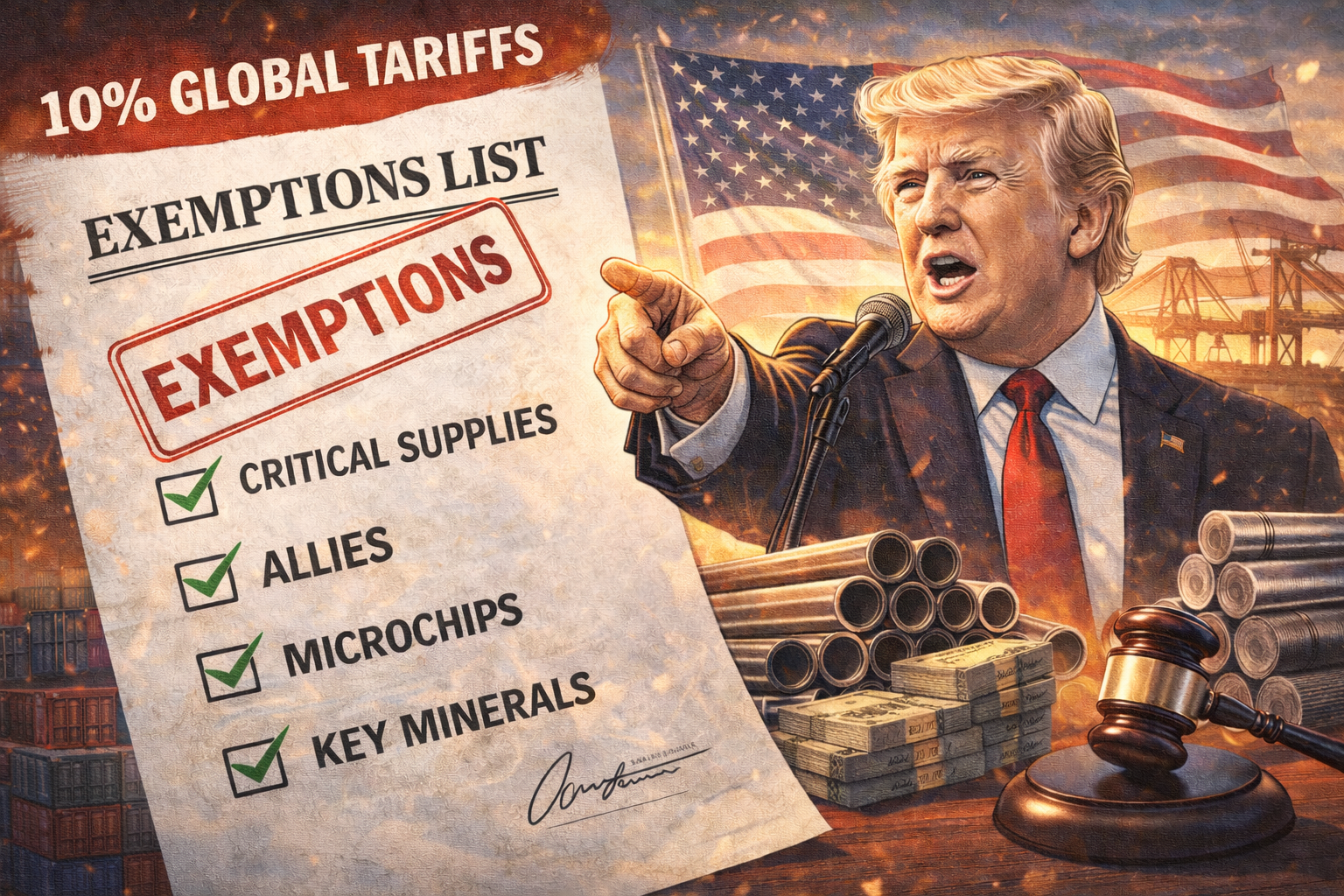
The U.S. Supreme Court ruled 6-3 that the International Emergency Economic Powers Act does not give the president unilateral authority to impose tariffs, finding that duties collected by U.S. Customs under that law since 2025 were unlawful, with estimates reaching $175 billion. Within hours of the decision, President Trump signed an executive order at the White House invoking Section 122 of the Trade Act of 1974 to add a 10% global tariff on top of existing duties.
The headline number is broad, but the actual scope is much narrower. On the same day, the White House released an exemption list covering more than a dozen categories of imports. According to the source material, over 90% of those exclusions were carried over from earlier reciprocal tariff carve-outs under IEEPA.
Exemptions span energy, medicine, semiconductors and consumer electronics
The list excludes oil, natural gas, and other energy products, along with natural resources and fertilizers that the United States cannot produce domestically or cannot supply in sufficient volume. Certain critical minerals are also exempt. In agriculture, the carve-outs include beef, tomatoes, oranges, coffee, tea, cocoa, spices, bananas, tropical fruits and fruit juices.
Pharmaceuticals and active pharmaceutical ingredients are excluded as well. The electronics category is extensive: smartphones, laptops, memory chips, flat panel displays, semiconductors and semiconductor manufacturing equipment are all outside the 10% tariff. In transport, the exemption list covers passenger vehicles, certain light trucks, selected medium- and heavy-duty vehicles and buses, plus specific parts used in those vehicles.
Other excluded goods include certain aerospace products, monetary and bullion metals such as gold and silver, informational materials like books and publications, humanitarian donations, accompanied baggage, copper and copper products, and wood products. Goods from Canada and Mexico that qualify under USMCA are exempt, as are textile and apparel items eligible for duty-free treatment under DR-CAFTA.
Goods already under Section 232 tariffs are carved out
The White House also said products already subject to Section 232 tariffs, including steel and aluminum, will not face an additional 10% tariff under Section 122. The same treatment applies to items that may be brought under Section 232 in the future. Cars are already within the Section 232 framework, which limits how far the new global tariff reaches across industrial imports.
The structure of the exemption list points to where the administration chose not to press. Energy, food and medicine, all directly tied to consumer prices, were left out. The source notes that core PCE inflation was running at 3%, above the Federal Reserve’s target. Another cluster of exemptions — semiconductors, critical minerals and pharmaceutical inputs — shows areas where U.S. supply remains dependent on imports in the short term.
So while Trump moved quickly to introduce a new tariff mechanism after the court ruling, the White House also fenced off many of the most sensitive categories. Phones, oil, pharmaceuticals, semiconductors and a large set of transport-related goods are not part of the 10% tariff hit list.