
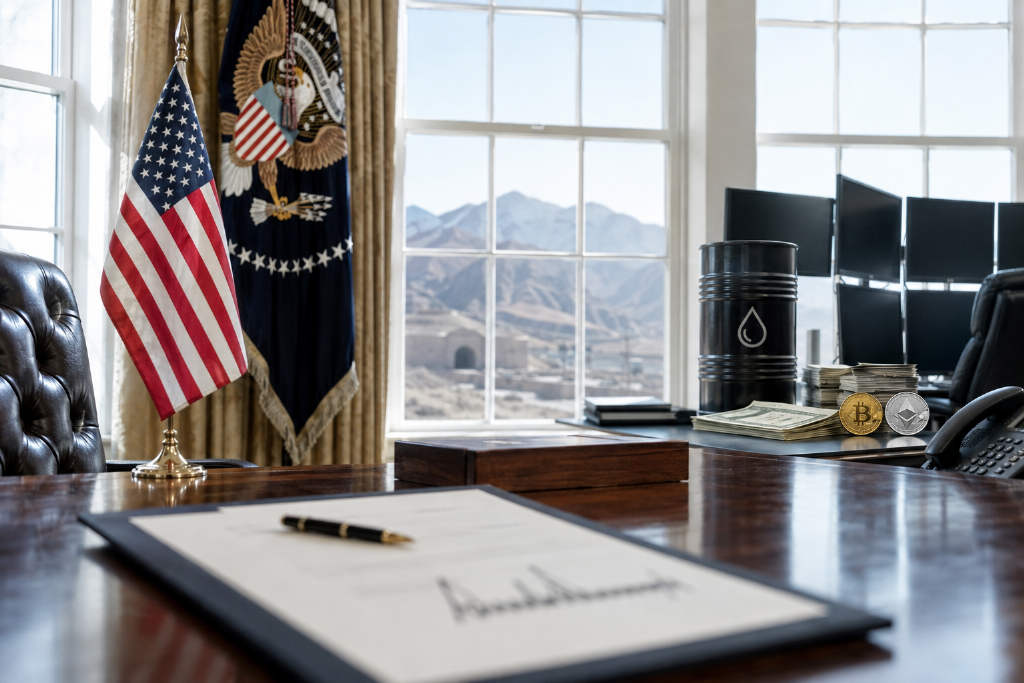
U.S. President Donald Trump said on Friday, Sept. 4, that the United States had "basically taken over Iran" and could "very soon" strike Iran’s underground Pickaxe Mountain nuclear facility, speaking to reporters in the Oval Office while signing executive orders.
He described the conflict, now in its sixth month, as a military confrontation rather than a war. Trump said, "To me, the Iran issue is just a military conflict, not a war," and added that for the United States it was "a very insignificant little thing, no big deal."
Oil, Treasuries and crypto all reacted
Markets showed a different tone. Brent crude settled at $95.23 a barrel on Sept. 4 and briefly rose to $97 during the session. West Texas Intermediate closed at $91.20. The U.S. 10-year Treasury yield climbed this week to its highest level since 2023.
As of the morning of Sept. 5 in Taipei, Bitcoin traded at $79,577, down 1.41% over the past 24 hours. Ether was at $2,452.
Trump echoed JD Vance on avoiding the word “war”
Trump’s comments matched an earlier line from Vice President Vance. Vance had said the situation should not be called a war. Trump responded on Friday that "that is true in many places" and said the U.S. was currently carrying out intermittent strikes.
He again drew a numerical comparison, placing the 18 U.S. military deaths in this conflict alongside the death tolls from the Vietnam War and the war in Afghanistan, which he described in the tens of thousands.
WSJ and Axios reports pointed to White House discussions
The Wall Street Journal reported on Sept. 3 that Trump had been privately discussing with senior aides whether to declare the Iran war over. According to that report, aides argued that if the conflict expanded beyond the scale of recent strikes, Republicans could lose the midterm elections.
Axios reported that the White House had already begun drafting a postwar Middle East strategy, with a focus on building a regional alliance to contain Iran and promoting normalization between Israel and neighboring countries.
The report also said polling showed weak public approval for Trump’s handling of the Iran conflict, and described the shift from calling it a "war" to calling it a "military conflict" as tied to electoral considerations.
What the report said about Pickaxe Mountain
Pickaxe Mountain is the English rendering of Kūh-e Kolang Gaz Lā, a site commonly referred to in Chinese-language media as Gaoshan. It is located in Iran’s central Isfahan province, about 220 kilometers south of Tehran and roughly 2 kilometers from the Natanz nuclear facility.
The facility is built beneath a granite mountain. Estimates of its depth are around 100 meters, with some putting it at 140 meters. The report said Iran began excavating the site in a neighboring area after an explosion in 2020 at the above-ground centrifuge assembly plant in Natanz.
The Institute for Science and International Security said the site has not entered operation. Satellite imagery shows two reinforced tunnel entrances and a perimeter security fence. The International Atomic Energy Agency has never been allowed to inspect it.
Israeli intelligence has claimed that Iran moved thousands of centrifuges into the facility. Trump, however, said he did not have documentary proof in hand.
Expert view and Iran’s warning
Nuclear policy expert James Acton said a deeply buried underground facility of this kind is essentially beyond destruction by conventional weapons. Under that assessment, a surface strike might cut power, damage ventilation shafts or seal tunnel entrances, but would not actually resolve the issue.
Iran has already issued a warning. The Khatam al-Anbiya Central Headquarters of Iran’s armed forces said that any U.S. attack on nuclear facilities would be treated as an escalation, and that the interests of the United States, its allies and its supporters would become targets.
Two channels cited for Bitcoin pressure
The report said the Iran conflict affects Bitcoin through two main channels. One is that higher oil prices lift inflation and rate-hike expectations. The other is that U.S. Treasury Secretary Bessent specifically said sanctions on Iran could be expanded to digital assets, aviation and shipping.