
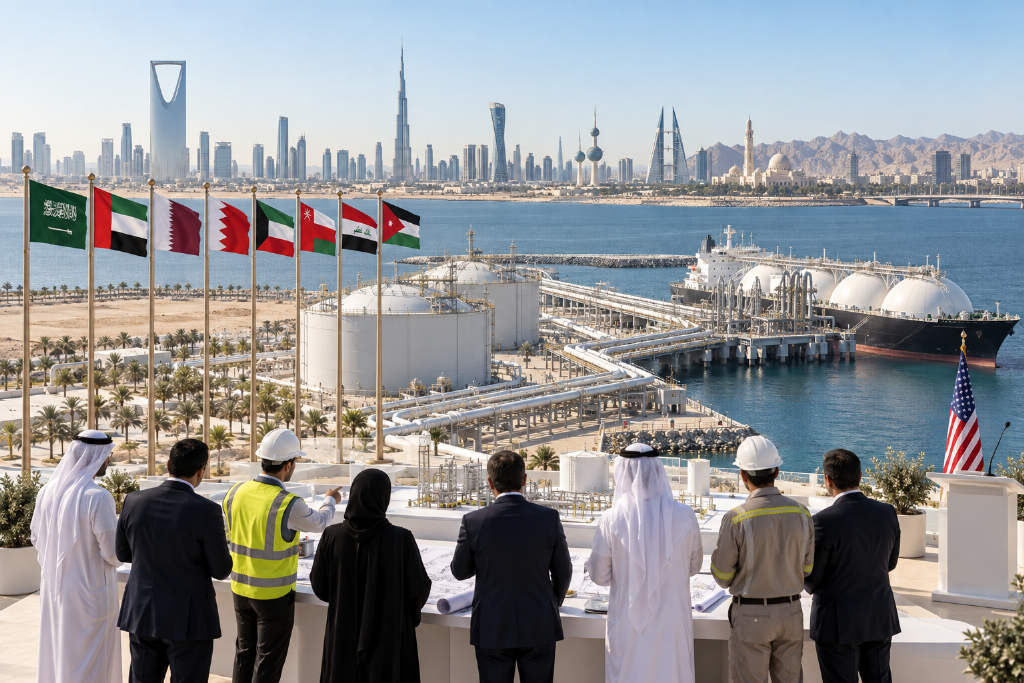
The Trump administration has formally proposed a $5 billion commitment to rebuild Middle East energy infrastructure damaged during the war involving Iran, while also trying to cut the region’s dependence on the Strait of Hormuz for oil and natural gas transport.
According to The Wall Street Journal on Sept. 22, the U.S. is seeking matching $5 billion contributions from eight Middle Eastern partners to form a $100 billion fund called Pact, short for Partnership of Allies for Confidence & Trust in Building.
Pact would pair U.S. funding with contributions from eight regional partners
Under the proposal, the countries identified by the U.S. are Saudi Arabia, the United Arab Emirates, Qatar, Bahrain, Kuwait, Oman, Iraq and Jordan. Each would contribute $5 billion alongside the U.S. commitment. Negotiations are still ongoing.
The fund would focus on two areas: repairing oil fields, natural gas wells, pipelines and storage facilities damaged during the war involving Iran, and reducing reliance on the Strait of Hormuz for oil and gas shipments.
Officials say reconstruction planning may be premature
Several Middle Eastern officials told The Wall Street Journal that Washington’s move is intended to reduce the strategic importance of the Strait of Hormuz and show unity between the U.S. and its allies in responding to Iran.
At the same time, those officials said setting up a reconstruction fund before reaching a peace agreement with Tehran appears early. They warned that Iraq and any new infrastructure could still be vulnerable to drone and missile strikes, raising questions about the efficiency of such investment.
On the same day, Trump said after meeting the mayor in New York that he would hold a meeting on Iran later that day.
Strait of Hormuz remains central to global oil flows
The Strait of Hormuz is a narrow waterway linking the Persian Gulf and the Arabian Sea. About 27% of global crude oil shipments pass through it. Most oil exports from Saudi Arabia, Iraq, the UAE and Iran also move through the strait. Any worsening in regional tensions, or a blockade of the route, would directly push global oil prices higher.
Barclays said in a Sept. 21 analysis that upside risks to oil price forecasts were continuing to increase because of developments in the Middle East. If current conditions persist, oil prices could rise by about 50% from current levels before the market reaches a natural balance. The report said that helps explain why the U.S. is pushing energy reconstruction and looking for alternative transport routes now.
The report also said Trump considered airstrikes on Houthi forces over the weekend, but decided on Sunday to put the idea on hold for now. Strike options submitted by U.S. Central Command covered multiple routes, showing that energy transit linked to the Strait of Hormuz remains under pressure.