
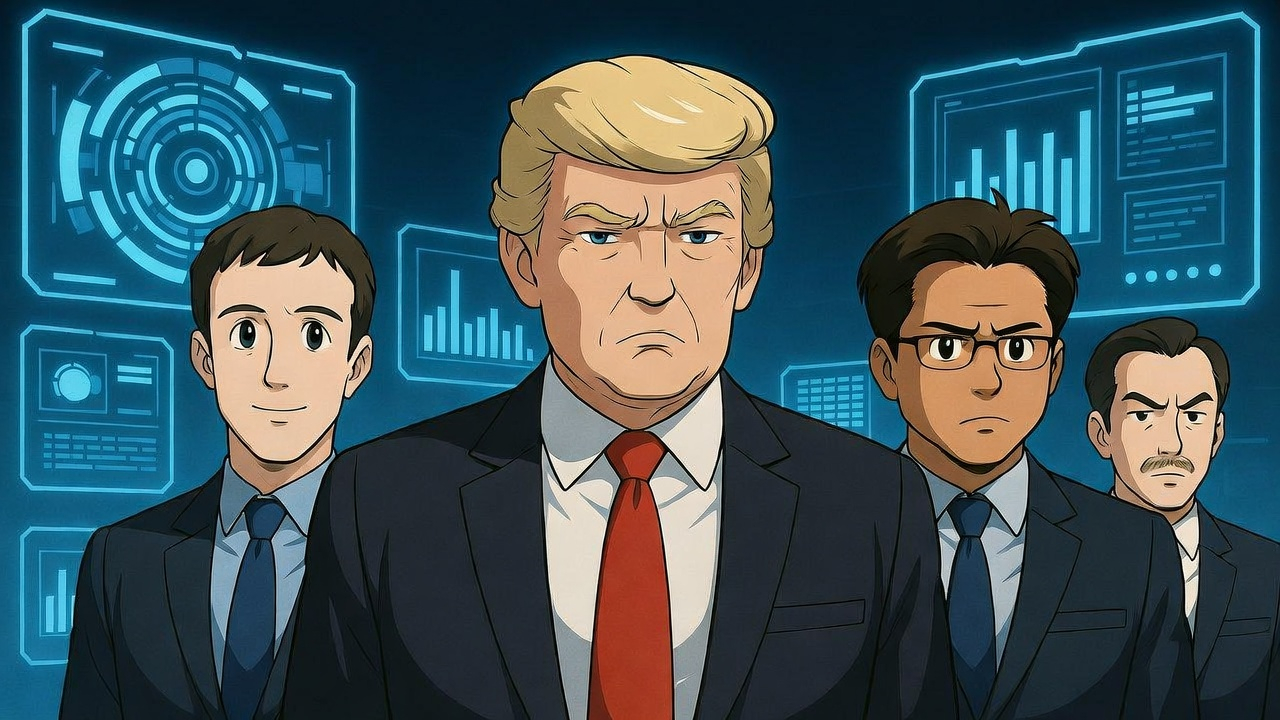
In the heated AI race of 2026, the Trump administration is bringing Silicon Valley's top talent and capital into the national fold. According to The Wall Street Journal, President Trump plans to reconstitute the President's Council of Advisors on Science and Technology (PCAST) by inviting Meta CEO Mark Zuckerberg, Nvidia CEO Jensen Huang, and Oracle founder Larry Ellison to directly shape U.S. AI and emerging tech policy. The move aims to secure U.S. leadership in AI semiconductors, cloud infrastructure, and global regulatory frameworks through public-private collaboration.
Three Pillars: From Hardware Sovereignty to Software Deployment
Each tech titan represents a key pillar of the U.S. AI supply chain. Jensen Huang (Nvidia) oversees hardware and export controls. As the AI chip kingpin, his role is seen as critical for stabilizing semiconductor supply and calibrating technology export restrictions on China. Mark Zuckerberg (Meta) drives infrastructure and social platforms. He has already pledged $600 billion in U.S. data center investment by 2028, and will focus on AI application proliferation and open-source policy within PCAST. Larry Ellison (Oracle) brings enterprise cloud and security expertise. A longtime Trump supporter, he will contribute deep experience in enterprise-grade AI infrastructure and data security. Additionally, Google co-founder Sergey Brin is reportedly on the initial 13-member industry list, with the council expandable to 24.
David Sacks Leads: Where AI Meets Crypto Policy
Notably, PCAST will be co-chaired by White House AI and Crypto Czar David Sacks. This signals that the Trump administration views AI compute needs and decentralized crypto finance not as separate tracks but as twin engines for a 'new American financial and tech frontier.' As one observer noted: 'With this list, Trump is telling the world that U.S. AI policy will no longer be crafted by bureaucrats behind closed doors, but by those who know the technology best.'
Balancing Regulation and Innovation
While the final list is not yet officially confirmed, multiple media outlets have widely circulated the report. Analysts see the move as a balance between deregulation for innovation and ensuring tech safety against risks. For investors, this means stronger policy backing and capital support for U.S. AI, particularly hardware sovereignty-related semiconductor stocks and infrastructure dividend-linked data center operators.