
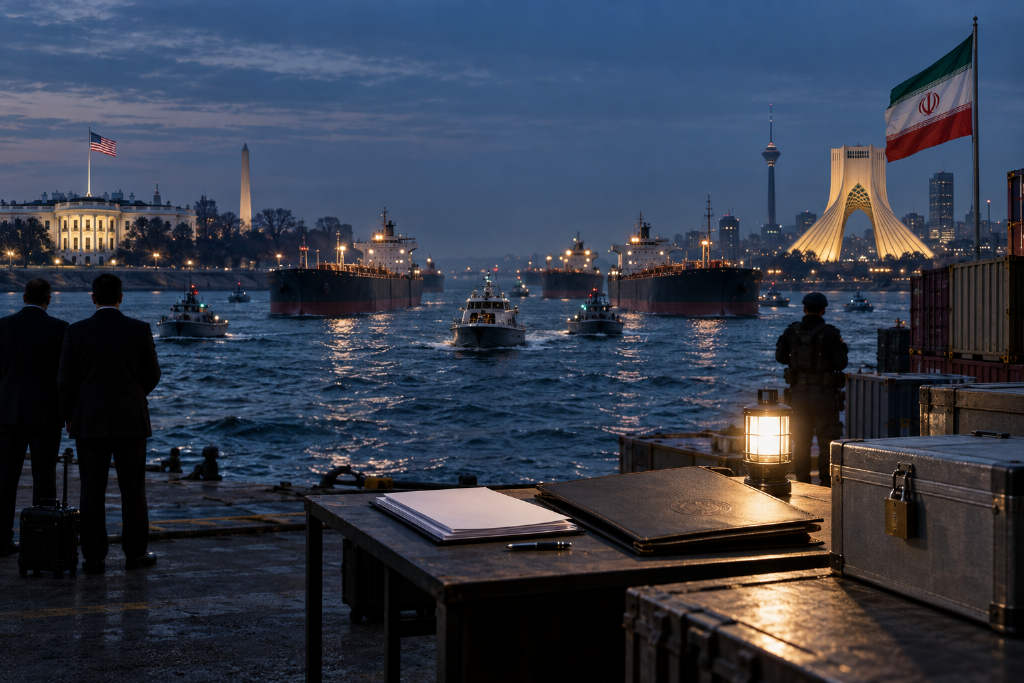
U.S. President Donald Trump said on Sept. 26 that he had rejected Iran’s proposed ceasefire plan tied to the Strait of Hormuz, describing Tehran as eager to negotiate because it had been "defeated too badly." Even so, he left room for talks, saying Iran wanted to make a deal and that he would like an agreement as well, but "that deal is unacceptable."
On Sept. 27, Iranian Foreign Minister Abbas Araghchi answered in a notably different tone on social media. He said Iran had seen the U.S. president’s first reaction, but mediators had not yet conveyed anything formally to Tehran. He added that Iran was waiting for mediators to return with Washington’s clear position and would decide after that.
Seven-day roadmap sent through Qatari mediators
Iran presented the proposal during United Nations General Assembly week in New York and passed it to the United States through Qatari mediators, according to the report. During the same trip, Araghchi also met Trump envoy Steve Witkoff.
The proposal matched conditions listed in an earlier U.S.-Iran memorandum this year. It included three steps: unfreezing and returning Iranian assets, easing oil-related sanctions, and ending U.S. maritime blockade operations against Iranian ports. Those measures were expected to be completed within four to five days.
The ceasefire would also be extended to Lebanon and Yemen. On day seven, shipping through the Strait of Hormuz would resume, and final-stage negotiations would begin at the same time.
Araghchi reiterated that Iran’s conditions had already been made clear and that any move to reopen transit through the Strait of Hormuz would require those conditions to be met first. He also said only negotiations could offer a way out of the current deadlock, and that this remained Tehran’s position.
Conflicting signals on the nuclear file
Compared with the ceasefire timeline, the messaging around Iran’s nuclear program appeared more confused. Iranian President Masoud Pezeshkian, in an interview with CBS program Face the Nation, sounded comparatively open. Asked whether he would allow United Nations inspectors into the country, he replied, "That is absolutely correct." He added that if inspectors wanted to enter and carry out checks, an agreement and understanding could be reached.
Pezeshkian also repeated that developing nuclear weapons is forbidden under Islamic law and said that if the message could be conveyed to the U.S. president, "the process would naturally begin." Central News Agency also cited him as saying the proposal had been coordinated with Supreme Leader Mojtaba Khamenei before it was put forward.
At the same time, however, a senior Iranian official told Reuters that Iran would not compromise on its nuclear program, would preserve its right to enrich uranium, and would not send highly enriched uranium outside the country. Separately, UAE media outlet The National reported on Sept. 25, citing informed sources, that Iran had privately floated a two-step approach: first dilute its stockpile of 60% enriched uranium, then ship it abroad under a mechanism recognized by the International Atomic Energy Agency, or IAEA. That account went beyond Pezeshkian’s public comments about dilution and inspections, but Iranian authorities have neither denied nor confirmed it.
Those three versions now sit side by side: a more flexible public line from the president, a harder internal line from an official, and a softer version reported by third-party media. The report said there is still no clear answer on which of them reflects Tehran’s real bottom line.
Deadlock centers on who moves first
The Wall Street Journal had earlier reported, citing several unnamed U.S. officials, that Trump privately doubted whether Iran would follow his demands and had told aides that the chances of resuming bombing after the November midterm elections were not low. Another U.S. official, however, had previously said talks through mediators were positive and constructive.
The coexistence of those two accounts points to a lack of a unified view inside the White House on the prospects for negotiations.
At the center of the impasse is sequencing. Trump has drawn a red line that Iran cannot obtain nuclear weapons, and without movement on the nuclear issue it would be difficult for him to present an outcome publicly. Iran, for its part, wants sanctions lifted and assets returned before discussing details of the nuclear file. Neither side wants to be the first to give way, and the November midterm elections add another political clock to the standoff.
In the CBS interview, Pezeshkian said, "They are increasing sanctions on us every day, and they are threatening us every day." He also accused the United States of failing to honor commitments it had written down. In the report, those remarks were presented as part of the reason Tehran does not want to move first: past agreements did not leave Iran feeling it had been treated fairly.