
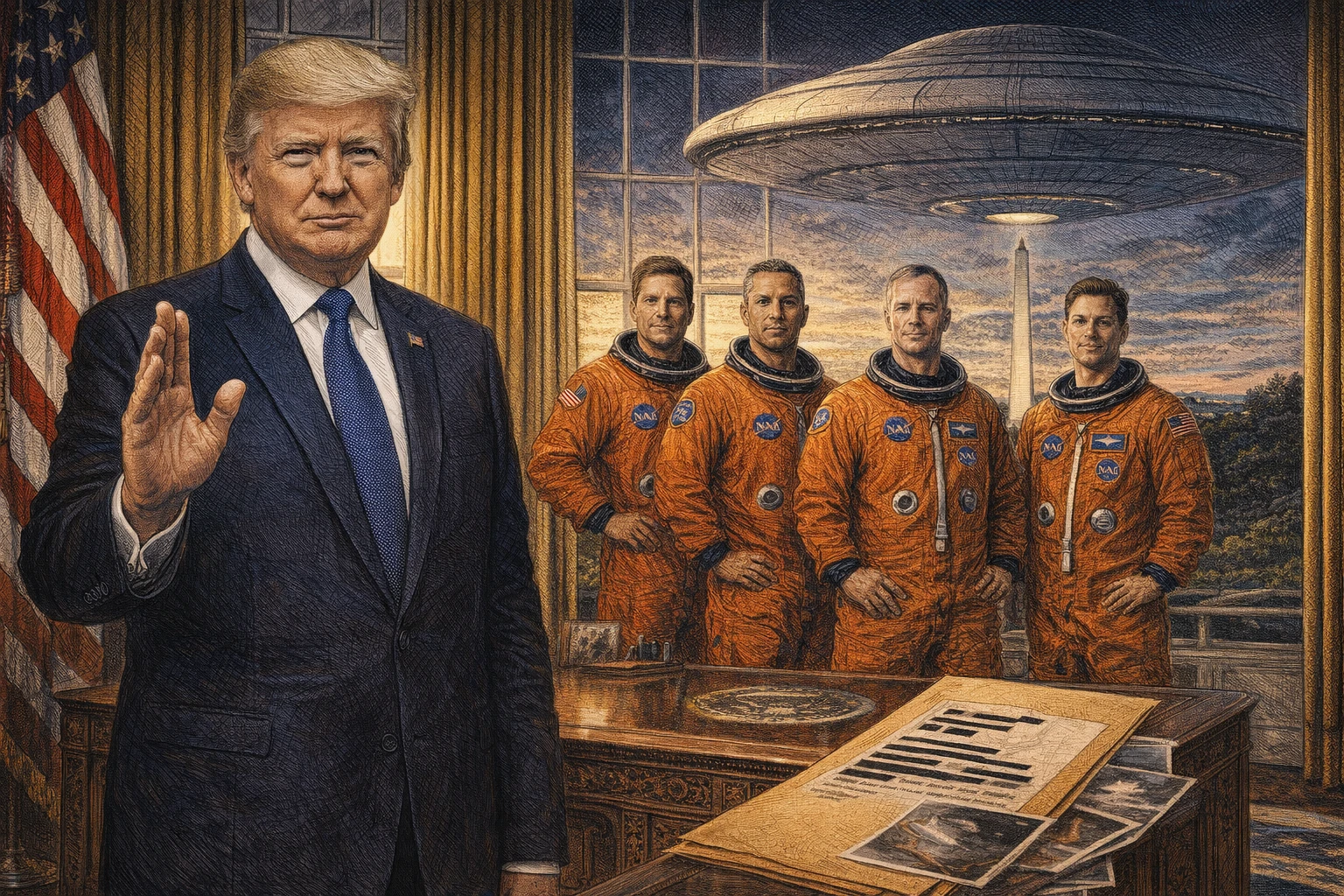
Donald Trump said on April 30 that the U.S. government would release as much UFO-related material as possible “in the near future,” adding that the disclosure would include a large amount of information that has never been made public. He made the remarks at the White House while meeting members of NASA’s Artemis II crew, marking his third public statement on UFO declassification this year.
The Oval Office meeting included Artemis II commander Reid Wiseman, pilot Victor Glover, mission specialist Christina Koch, and Canadian Space Agency astronaut Jeremy Hansen. When asked by reporters about the status of UFO disclosure, Trump said the government would make available everything that can be released, covering UFOs and related matters, and added that some of the material would be very interesting to the public.
Three public comments in a few months
Based on the source timeline, Trump had already called in February for the Pentagon and relevant intelligence agencies to begin a declassification process covering files related to UFOs, unidentified anomalous phenomena, or UAP, and possible extraterrestrial life. The White House also posted on X at the time, directing relevant agencies to identify and release those records.
On April 17, Trump gave another update, saying officials reviewing the material had uncovered “many interesting files” and that the first batch would be made public “very, very soon” through a centralized digital platform. His April 30 remarks went further, promising the release of as much previously undisclosed material as possible.
No new batch has been formally released yet
Despite the repeated comments, the source says the U.S. government had not yet formally published any new batch of declassified UFO or UAP records as of that point. Researchers and UAP advocacy groups remain focused on long-requested material, including the full assessment report from the Pentagon’s AATIP program, original footage and analytical records tied to military pilot sightings, and internal intelligence assessments involving the hypothesis of non-Earth origin.
The report also notes that if the centralized digital platform described by Trump does go live, the public would be able to access records through a single portal rather than searching across multiple agency websites. For now, attention remains on when the first batch of files will actually be published.