
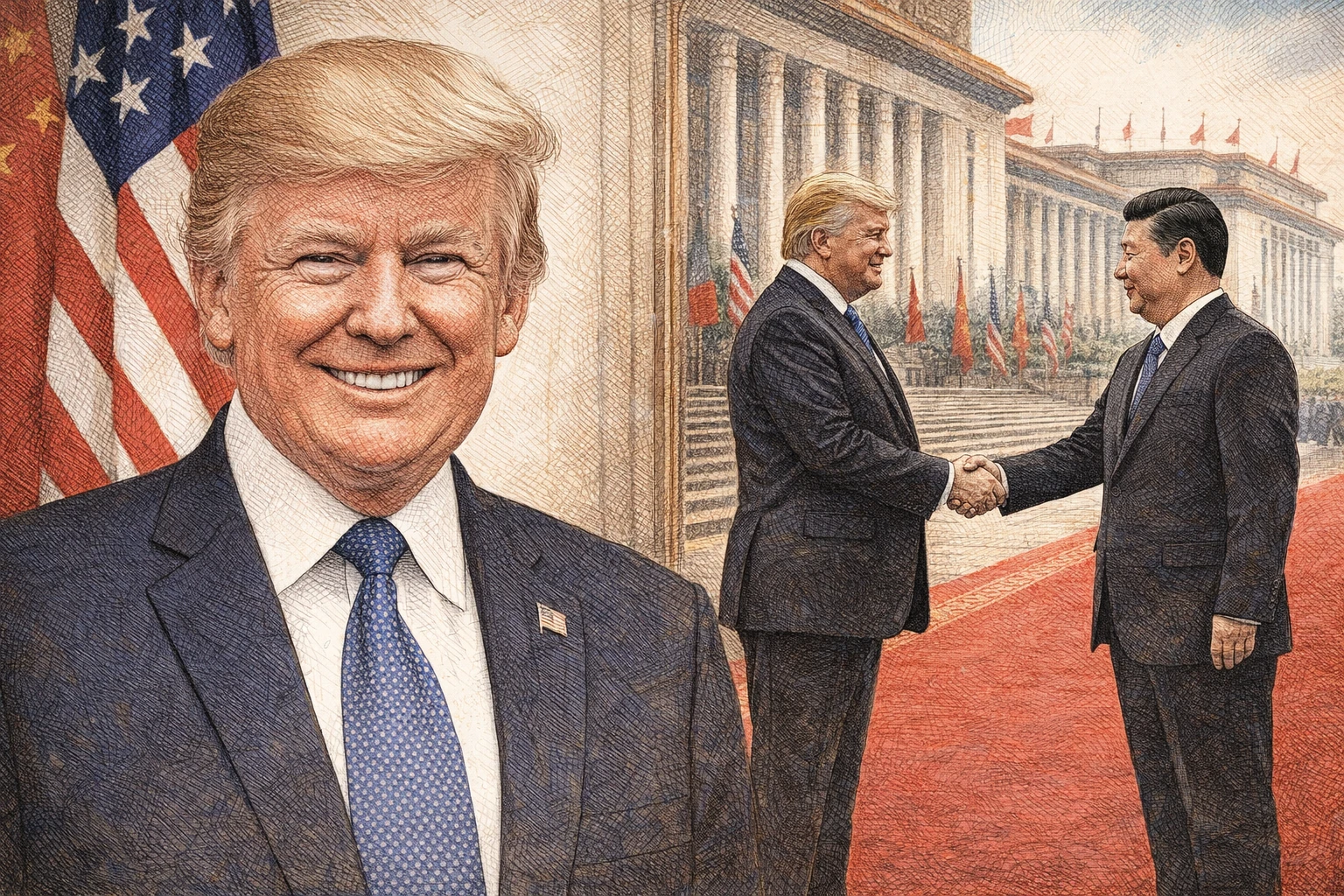
Donald Trump met Xi Jinping at the Great Hall of the People in Beijing on the morning of the 14th, with a 21-gun salute, the national anthems of both countries, and a red-carpet welcome. Xi personally received Trump after his arrival, and the two leaders shook hands for more than 10 seconds before walking side by side into the venue. Foreign media described the ceremony as a carefully staged display tailored to Trump’s preference for spectacle.
Senior officials from diplomacy, trade, and defense joined both delegations
The visit marked Trump’s first trip to China during his second presidential term and his first time on Chinese soil in nine years. The two delegations included top officials across foreign affairs, trade, and defense. China’s side included Cai Qi, Wang Yi, He Lifeng, Dong Jun, and Zheng Shanjie. The US side included Marco Rubio, Pete Hegseth, Jamieson Greer, and Scott Bessent. The lineup pointed to a broad agenda rather than a narrowly focused meeting.
Trump highlighted personal ties with Xi and praised the business delegation
In his public remarks, Trump opened with comments about the Chinese children who welcomed him, saying they were “more amazing than military performances.” He then shifted to his personal relationship with Xi, saying the two leaders could call each other directly when problems arose and handle matters quickly. Trump also repeated his description of Xi as a “great leader,” adding that he would say so even if some people disliked the comment.
He also stressed the makeup of the US delegation, saying he had brought “the top 30 business leaders in the world,” all of them company chiefs rather than second- or third-ranking executives. He closed by saying it was an honor to be Xi’s friend and that US-China relations “will be the best ever in history.”
Xi framed the meeting around the Thucydides Trap and strategic stability
Xi took a more formal tone. He opened by referring to the Thucydides Trap, the idea that conflict can emerge between a rising power and an established one. He then posed three questions: whether the two countries could avoid that trap, whether they could open a new model for major-power relations, and whether they could jointly bring more stability to the world.
Xi said each country’s success should be seen by the other as an opportunity, and that stable bilateral ties would benefit the world. He summarized his position with a direct line: cooperation brings gains to both sides, confrontation hurts both, and the two countries should be partners rather than rivals. He also said he hoped to make 2026 a historic year of continuity and renewal in US-China relations.
Private talks followed, with Taiwan arms sales, Iran, and tariffs on the agenda
After the public remarks, the two sides moved into closed-door talks. Three known issues were already on the table: US arms sales to Taiwan, Iran, and trade tariff arrangements. Trump was also scheduled to visit the Temple of Heaven later in the day and attend a state banquet hosted by Xi in the evening. Whether the meeting would produce specific concessions or a joint statement had not yet been announced.