
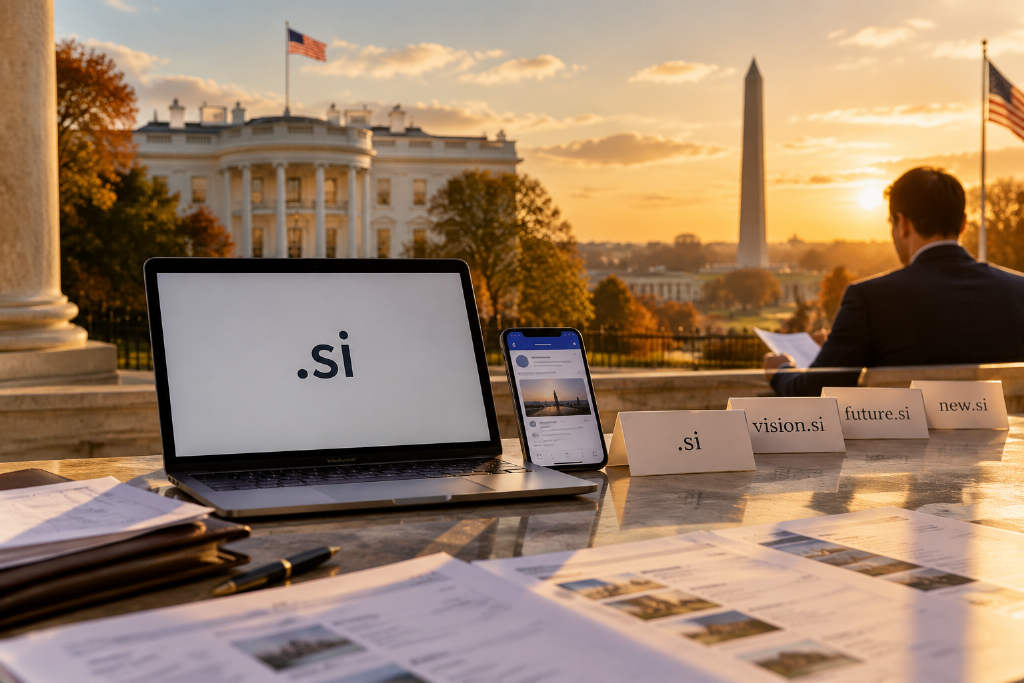
BlockBeats reported on Sept. 30 that crypto researcher Adam Cochran accused the Trump administration of helping create a market for .si domain speculation by promoting “SI” as a new term in artificial intelligence policy.
In a post on X on Wednesday, Cochran said some parties may have accumulated related domains before the policy signal became clear, then stood to profit once branding demand appeared. He also said there is still no independently verified evidence directly linking domain holders to the Trump family, government officials, or people around them.
How “SI” entered the policy discussion
SI refers to “Super Intelligence,” a term the Trump administration has recently promoted in discussions around artificial intelligence.
According to the timeline laid out by Cochran, Trump first raised the idea on Truth Social on Sept. 19, testing whether another term could replace AI. Around Sept. 21, he began explicitly using “SI (Super Intelligence).”
On Sept. 22, Trump said in a United Nations General Assembly speech that future U.S. government documents would adopt the term “Super Intelligence.” On Sept. 29, after meeting AI executives at the White House, he signed an executive order that pushed “Super Intelligence / SI” further into the formal federal policy framework.
Registration data cited in support of the claim
The issue, Cochran argued, is that .si is also Slovenia’s country-code top-level domain. If policy language shifts from AI to SI, a namespace that had been relatively obscure could become a sought-after digital asset for technology companies, policy groups, and brand marketers.
Cochran cited registration data that he said showed a sharp increase in .si activity this year. From 2023 to 2025, daily new registrations averaged about 55. In late June this year, single-day registrations rose above 400. In July, new registrations exceeded 7,000.
He also said he found about 12,000 .si domains tied to AI, MAGA, or U.S. politics that were newly registered or transferred before the policy signal became explicit. Some of them were later listed for millions of dollars. One example he gave was build.si, which was listed at $14 million.
Allegation, not a proven case
Under Cochran’s theory, companies that want to align themselves with Washington’s latest narrative may end up adopting SI branding and needing matching .si domains, giving early registrants a chance to exit at a profit.
But the claim still has major gaps. Whois data is shielded by privacy protections at major registrars, which means public records do not identify the ultimate beneficiaries behind the domains. A high asking price also does not mean a sale actually happened.
At this stage, the matter is closer to a public allegation about policy naming, domain front-running, and possible conflicts of interest than a confirmed case of improper benefit transfer.