
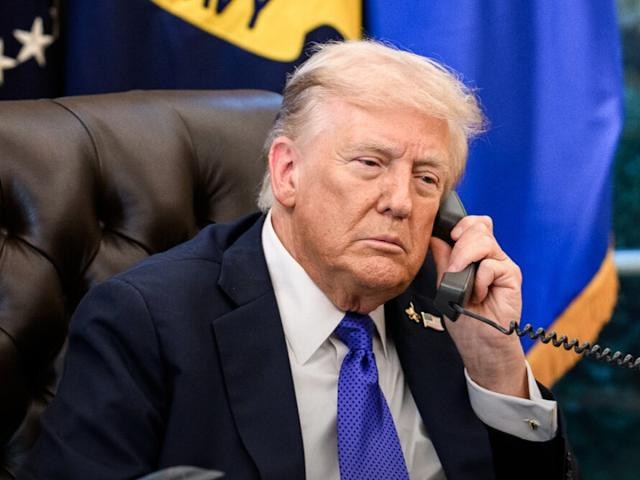
Trump Media & Technology Group has launched a subscription service called “Truth PSI” that costs $100,000 a month. According to ABMedia, citing a Fortune article, the product gives paying clients access to U.S. President Donald Trump’s Truth Social posts a few milliseconds before other market participants.
In highly automated financial markets, where trading firms compete on millisecond-level speed, that gap may be worth a great deal. The report says Trump’s remarks can affect political debate and also move global asset prices in a very short time.
Fortune authors describe an “Age of Big Players”
The Fortune piece was written by Steve H. Hanke, a professor of applied economics at Johns Hopkins University and a former member of President Ronald Reagan’s Council of Economic Advisers, and Roger Koppl, a finance professor at Syracuse University.
The two argue that the global economy is moving away from a system led by supply and demand, profits, and market competition, and toward what they call an “Age of Big Players,” where a small group of political figures, government leaders, and power centers exert outsized influence.
In that setting, they say, market participants are no longer focused only on corporate revenue, interest rates, or consumer demand. They are also trying to anticipate what Trump will say in his next post, which industry Xi Jinping may target next, and who has the closest access to power.
$100,000 a month for a time edge
The article frames Truth PSI as a way to turn Trump’s unpredictability into a proprietary asset that can be sold. That matters because his comments have repeatedly shown the ability to move markets.
As one example, the article says that after Trump announced a suspension of some tariff measures on April 9 last year, the S&P 500 rose 9.52% that day and the Nasdaq climbed 12.16%. For high-frequency trading firms, getting the news even a few milliseconds earlier could create a window to build positions before prices fully adjust.
The authors criticize the commercialization of uncertainty tied to Trump’s policies and moods, calling it an issue with clear ethical implications. At the same time, they argue that this is not just an unusual case tied to one politician. In their view, it reflects a broader shift in how the global economy is operating.
The piece says market prices are increasingly shaped less by economic fundamentals and more by the personal judgment, moods, and ad hoc decisions of a small number of people in power.
What qualifies as a “big player”
In the economic framework described in the article, a “big player” is a person or institution that can use discretion over a long period to influence markets while facing few of the normal profit-and-loss constraints.
An ordinary business that keeps losing money may eventually fail, exit the market, or be replaced by competitors. Big players, the authors say, do not face the same discipline.
They describe three main traits:
- large scale
- limited exposure to profit-and-loss constraints
- high discretionary power
Such actors can move markets with their words or actions. Even when their policies cause severe economic damage, they may not bear equivalent costs. Their decisions are often driven not by clear, stable, and predictable rules, but by personal judgment and, at times, mood or preference.
From fundamentals to access and influence
As the influence of big players expands, the article says, investors and companies are pushed to shift their attention away from fundamentals and toward political leaders.
Questions such as whether demand is growing or whether a product is competitive are being displaced by a different set of concerns: what a leader will do next, who can shape that decision, and who stands closest to the center of power.
Hanke and Koppl argue that when those questions crowd out standard economic analysis, markets begin to resemble court politics. In that kind of system, luck becomes more important and professional skill matters less. Corporate success depends less on serving consumers, controlling costs, or producing innovation, and more on correctly reading policy direction or maintaining good relations with power centers.