


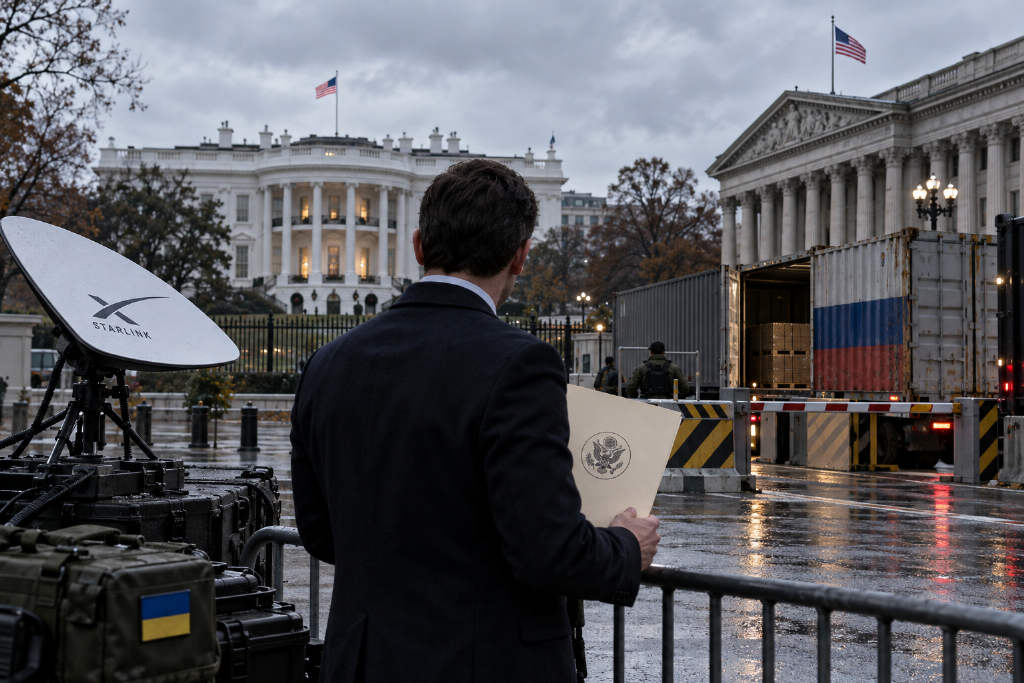
U.S. Treasury Secretary Scott Bessent said on Oct. 18 that Ukrainian President Volodymyr Zelenskyy should be "very careful" about making accusations against the United States, after Zelenskyy said he believed the U.S. government was responsible for restricting Starlink speeds in Ukraine.
According to CNBC, Zelenskyy made the comment earlier on the same NBC program, Meet the Press. Two days earlier, President Donald Trump had signed an executive order waiving all tariff provisions in a new Russia sanctions law passed by Congress last month.
Bessent calls Zelenskyy’s Starlink accusation reckless
Zelenskyy said on Meet the Press that he believed the U.S. government was behind the Starlink slowdown. He also said Ukraine had gone through a period in which it was "blocked" and unable to obtain U.S. intelligence. Starlink is a critical communications tool for Ukraine’s defense, and CNBC said the slowdown had affected Ukraine’s ability to respond to Russian offensives.
Bessent responded on the program: "President Trump and Secretary of State Rubio have both made it clear that no one in the Trump administration did that, and I think it is very reckless for President Zelenskyy to make that accusation." He added: "President Zelenskyy should be very careful about these kinds of false statements."
Elon Musk, chief executive of Starlink parent SpaceX, pointed to the U.S. government in a post on X last week. He wrote that Starshield, the military version of Starlink, is "owned and controlled by the U.S. government," and that any limits on speed or usage are decided by the U.S. military and ultimately by the president. Trump said last week: "I don’t know if somebody did it, because it wasn’t me, and I don’t think it was Elon."
Executive order waives 500% and 100% tariff measures
The law is formally titled the Lindsey Graham Sanctions on Russia and Iran Act, named after the late senator Graham. The House passed it on Sept. 16, and Trump signed it on Sept. 18. Its stated aim is to cut off Russia’s war financing. NBC said the measure targets the biggest buyers of Russian oil and gas, potentially including China and India.
A White House executive order released on Oct. 16 first set the tariff rates required by law: a 500% ad valorem tariff on Russian goods, and a 100% tariff on goods from the top five importing countries that continue buying Russian crude oil or natural gas after Oct. 18, as well as the top five countries helping Russia evade oil sanctions.
The order then invoked the national interest waiver under Section 115 of the law, exempting all tariffs under Sections 112 and 113, along with sanctions and restrictions under part of Section 102, Sections 103 through 111, and Section 117. It also said existing sanctions under prior Russia-related executive orders would remain in place, and that the waiver would continue until the president or the secretary of state determines that further action is needed. Trump said in the order that he had submitted a certification and report to Congress stating that the waiver is in the national interest of the United States.
With only two days left before the statutory implementation deadline, Trump told reporters on Oct. 17: "This is a very good decision. It’s good for the country, and I think it’s good for the world." According to NBC, Rubio said Trump wanted 60 days to assess how the tariffs and sanctions would affect the U.S. and global economies given tight global energy supply. One week earlier, the U.S. Treasury had temporarily waived sanctions on Russian diesel exports through April 2027.
Zelenskyy and lawmakers push back
Zelenskyy wrote on X on Oct. 17: "The decision to cancel all this and block all this is, in my view, wrong, and it definitely benefits only the Russians." He also said he expected the easing of sanctions to continue: "I believe the handling of the diesel deal and the Graham law is not the end."
Kirill Dmitriev, economic envoy to Russian President Vladimir Putin, said the suspension of some provisions was an "important and truly historic moment."
Opposition in Congress was not limited to Democrats. Republican Senator Thom Tillis wrote on X: "The Senate passed this law 86-11. What exactly do the president and his advisers not understand?" Republican Senator Ted Cruz called the decision "a mistake," while Democratic Senator Richard Blumenthal described it as a "craven, cowardly act."
NBC said U.S. diesel prices have risen nearly 70% since the Iran war began in February. The waiver came less than three weeks before the Nov. 3 midterm elections, with cost of living still the issue voters care about most.