
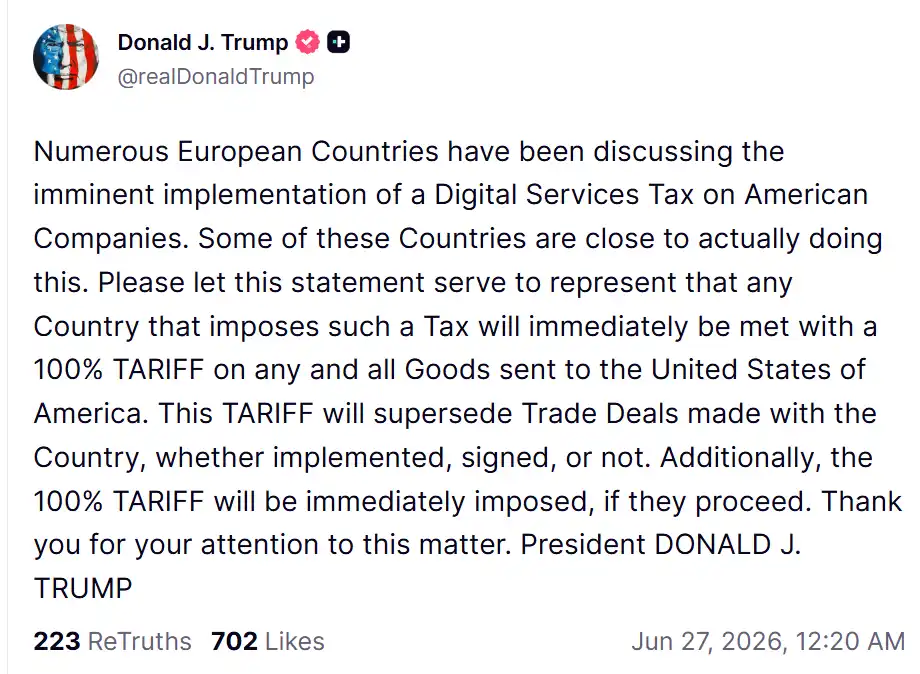
Event Overview: Trump's 100% Tariff Warning
According to BlockBeats, on June 27, former U.S. President Donald Trump posted on his social media platform Truth Social that multiple European countries are discussing a digital services tax (DST) targeting American tech companies, with some near implementation. Trump stated that if any country proceeds with such a tax, it will immediately face 100% tariffs on all goods exported to the United States. He emphasized that the tariff would take precedence over any trade agreement already signed or in effect with that country, and would be applied immediately if the tax is pursued further.
The digital services tax is a levy proposed by the European Union and some member states on the revenue of large internet companies such as Google, Amazon, and Apple, typically at a rate of 2-3%. The U.S. has long criticized the tax as discriminatory against American firms, threatening trade retaliation. Trump's latest hardline stance pushes U.S.-Europe trade tensions to a new peak.
Potential Impacts: Escalating Trade Conflict and Market Uncertainty
If European nations insist on implementing the DST, a new tariff war between the U.S. and Europe could break out. A 100% tariff would effectively double the price of major European exports to the U.S., including machinery, chemicals, and luxury goods, directly hitting bilateral trade volumes. For U.S. consumers already under inflationary pressure, higher import costs could exacerbate price increases, while European exporters would face a sharp drop in orders.
In financial markets, trade war expectations typically trigger risk aversion. Risk assets (including stocks and cryptocurrencies) may come under short-term pressure, while safe-haven assets such as the dollar, gold, and U.S. Treasuries could attract inflows. Cryptocurrencies, as high-beta assets, are prone to selling off during market panics. However, if markets expect the trade war to drag down global growth and prompt central bank easing, crypto could also attract safe-haven buying in the long run. Currently, markets await the actual responses from European countries and subsequent negotiations.
Indirect Links to Crypto Markets and Key Points to Watch
Although the digital services tax belongs to the traditional economy, trade conflicts between major economies can transmit to crypto markets through exchange rates, liquidity, and risk appetite. Trump's tariff threat may accelerate the 'de-dollarization' narrative, indirectly benefiting long-term demand for non-sovereign assets like Bitcoin. However, short-term volatility is likely to increase. Investors should closely monitor U.S.-Europe trade talks and whether Europe backs down.
Additionally, Trump's own stance on crypto policy deserves attention — he accepted crypto donations during his 2024 presidential campaign but has not clearly stated whether his administration would adopt similar policies. This tariff warning primarily reflects his protectionist trade philosophy, rather than directly targeting the crypto sector.