
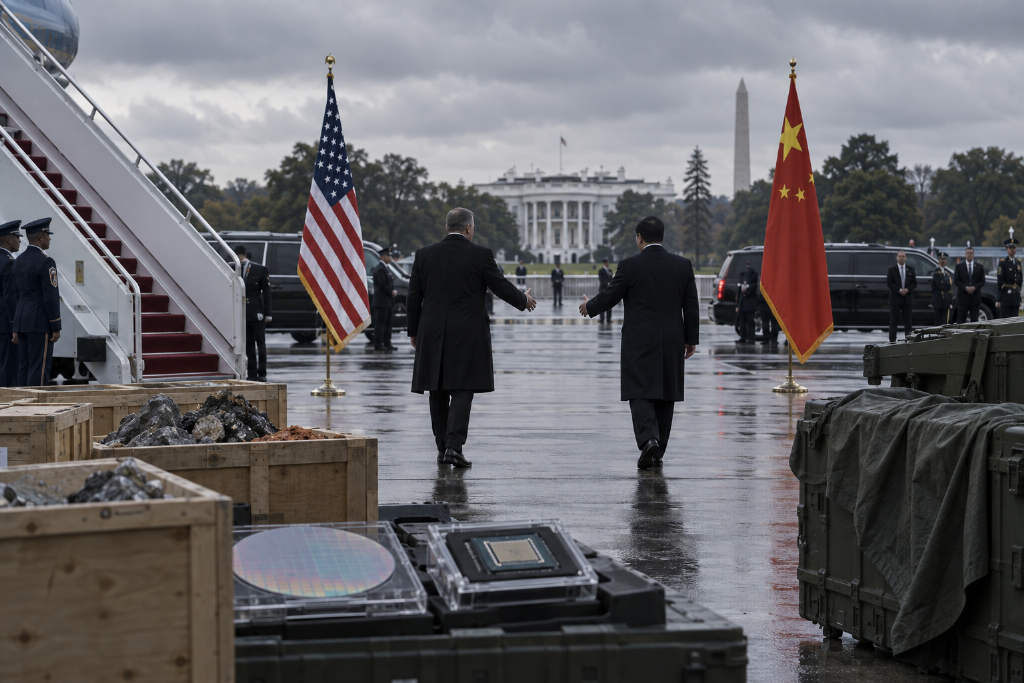
President Donald Trump is scheduled to travel to Joint Base Andrews on Sept. 23 to personally receive Chinese President Xi Jinping on arrival in Washington, according to BlockTempo. U.S. presidents do not typically go to the airport to greet foreign leaders, making the gesture unusual and adding weight to the White House summit that follows.
Before the leaders meet formally, Treasury Secretary Scott Bessent and U.S. Trade Representative Jamieson Greer are expected to meet Chinese Vice Premier He Lifeng to set the agenda.
Trade truce expires on Nov. 10
A trade truce agreed by Trump and Xi in Busan last year is due to expire on Nov. 10, leaving both governments to decide whether to extend it. Anna Ashton, founder of Ashton Intelligence and a China trade analyst, told CNBC: 「I think because a presidential-level summit is coming, there will be some deliverables on display, but I do not think we are on the edge of some kind of breakthrough.」
She added: 「I think maintaining the status quo is probably the best shared expectation on both sides.」
The report says the Busan deal reduced Trump’s tariff threat, paused port fees and created a temporary pause in trade tensions. With the deadline approaching, the two sides may set purchase targets for key categories including agricultural products, energy and Boeing aircraft. A separate package of roughly $30 billion covering about 10 categories of 「non-sensitive」 goods is also under negotiation, though the scope remains unresolved.
Rare earths remain a central bargaining chip
Another key part of the Busan agreement was China’s removal of export restrictions on rare earths and critical minerals. Those materials are described as core inputs for the auto, defense and technology sectors, including components needed for AI hardware. Washington wants more stable access to supply, while Beijing is using its position in global markets to keep the issue central to the talks.
AI safety and chip controls are tightly linked
Bessent has said AI safety will be included in the bilateral agenda. Beijing wants Washington to loosen restrictions on parts of China’s technology sector. In the U.S., though, some voices have recently called for slower AI development in the name of safety, while some American companies worry that slowing down would allow China to move ahead.
The report says Trump has repeatedly rejected those regulatory calls at home. That leaves the discussion uncertain and ties the AI debate more closely to negotiations over chip and material export controls.
Taiwan could still disrupt the summit
Taiwan is described as another issue that could upend the meeting. China has previously said it could withdraw from the summit if the U.S. approves a new round of arms sales to Taiwan.
Beyond trade, rare earths and AI, the two sides are also expected to discuss China’s economic ties with Iran and the issue of detained foreign citizens.
Washington wants access, Beijing wants relief
Based on a World Economic Forum summit agenda overview cited in the report, trade conflict, supply chains, technology competition and Taiwan will be among the main themes, both publicly and behind closed doors.
In broad terms, Washington is seeking wider access to the Chinese market, reliable supplies of critical minerals and commitments on selected security issues. Beijing, for its part, wants tariff relief and looser export restrictions. The report says both sides hold bargaining chips and that the contest also stretches into Africa and Latin America, even as both governments want to avoid geopolitical conflict over places such as Taiwan from damaging hard-won economic ties.
Expectations remain restrained
The report notes that a meeting held in Beijing in May this year was heavy on symbolism, while actual concessions at the negotiating table were limited. With this round moving to the White House, the question is whether the outcome will differ. Most analysts, it says, lean toward a cautious answer, with incremental progress seen as more likely than a major breakthrough.
The report also points to the U.S. still being deeply involved in conflict in the Middle East, with risks of further escalation. Under that pressure, preserving the existing trade truce may be the more practical bottom line for the Trump-Xi meeting.