
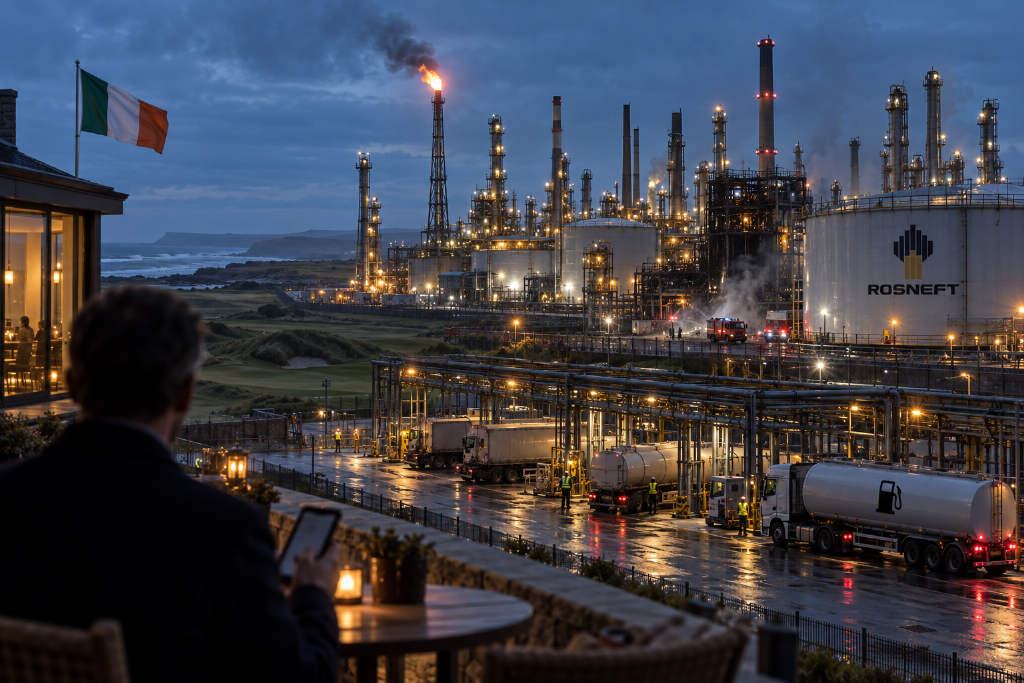
Donald Trump twice publicly urged Ukrainian President Volodymyr Zelensky over the weekend to stop striking Russian refineries, saying the attacks were pushing up global diesel prices and contributing to shortages.
Trump made the first remarks at his golf course in Doonbeg, Ireland, while watching the Irish Open. Asked by reporters whether he had contacted Zelensky after speaking with Vladimir Putin, Trump said: 「Zelensky has to do one thing. He has to stop hitting Russia’s diesel facilities. Let him hit other targets, but not diesel, because he is causing a diesel shortage.」
Hours later, aboard Air Force One, he repeated the point in sharper terms. Trump said: 「I have asked Zelensky not to hit Russian refineries. Diesel prices are rising because diesel is very hard to export from Russia. This is hurting the whole world, and we have to stop it.」
U.S. average diesel prices have now reached a record $6.20 per gallon, up 65% since the U.S. strike on Iran in February this year.
Ukrainian strikes have hit Russian refining capacity
According to the report, Ukraine has launched more than 194 drone attacks on Russian refineries since the start of 2026. Kyiv says the strikes have affected 42.7% of Russia’s refining capacity.
Just hours before Trump’s public comments, Ukrainian forces struck the TANECO refinery in Nizhnekamsk, in Russia’s Republic of Tatarstan. Local reports said two people were killed. The campaign has not been limited to refining assets. Wildberries, Russia’s largest e-commerce company, was also affected at one point.
Kyiv’s logic is straightforward: Russian oil revenue helps finance the war, so attacking refining capacity hits Moscow’s funding base.
The cost has also shown up inside Russia. Since April, at least 246 gas stations have been affected. By late August, some stations in St. Petersburg temporarily ran out of fuel, with queues and even fights reported in several areas.
Russia’s diesel exports have dropped from an average of 860,000 barrels a day in 2025 to 591,000 barrels a day in August 2026. Russia has also extended its diesel export ban to protect domestic supply.
IEA points to a broader supply shock
Still, the report argues that blaming Ukraine alone for the diesel price surge misses the larger driver.
In its monthly report published on Sept. 11, the International Energy Agency said net exports of diesel and gasoil from Gulf countries in August were only a little above one quarter of the level seen before the U.S.-Iran conflict began in February. The IEA wrote: 「Disruptions to Russia’s refining system, combined with the near standstill in Russian oil product exports after the escalation of Ukraine’s offensive, compounded these supply losses.」
The report also said that, in February, combined diesel and gasoil exports from the Gulf and Russia accounted for nearly 45% of global seaborne trade.
On that reading, the deeper hole in the global diesel supply chain came from the war between the United States and Iran in the Middle East, which hit crude production and exports. Ukrainian attacks on Russian refineries added to the pressure, but were not presented as the main cause.
Kyiv’s position has not changed. It maintains that Russia’s oil industry both funds and directly supports Moscow’s military campaign, and with the war now in its fifth year, Ukraine sees no reason to spare energy infrastructure.