
A Tsinghua University team has examined a narrower question behind the recent interest in digital fruit flies: under what conditions does the wiring structure of a real fly brain help embodied intelligence systems control a body more effectively?
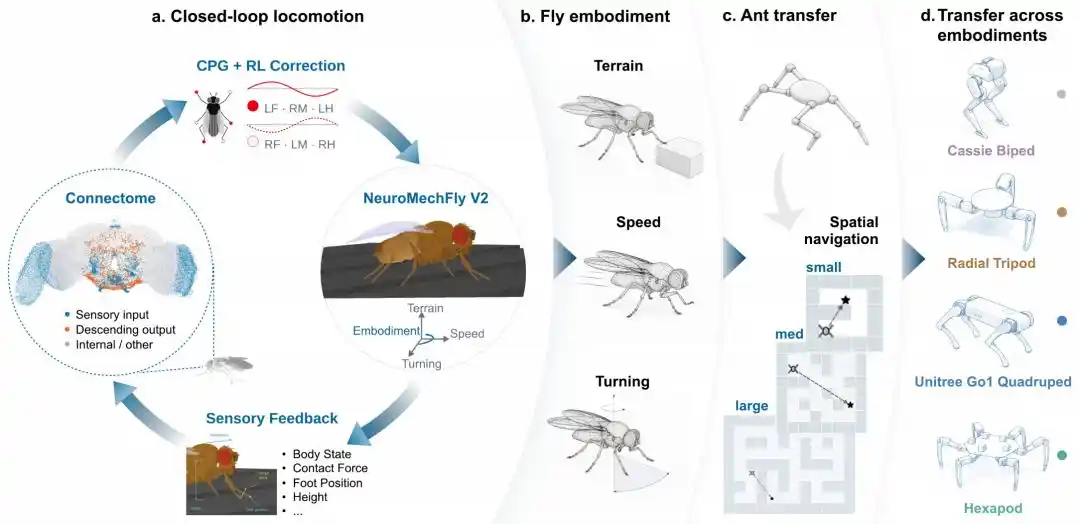
In the study, the researchers turned the adult fruit fly connectome into a fixed neural network core and tested it in simulation across several control tasks. The main result was not that the connectome dominates in every setting. Its advantage became clear when control demands changed.
From a biological wiring diagram to a runnable control network
A connectome records which neurons connect to each other, the direction of signal flow, and how many synapses each connection contains. Researchers can reconstruct those links through microscopy and then convert them into neural networks that run on a computer, receive sensory input and participate in body control.
The Tsinghua team focused on adaptability rather than task completion alone. It systematically evaluated control performance and traced the neural pathway mechanisms behind it, aiming to identify brain-inspired design principles for embodied systems facing change.
The group used the adult FlyWire connectome to build a recurrent network core with 138,584 neuron nodes and 3,732,460 directed connections. Weights were constructed from connectivity, synapse counts and predicted neurotransmitter types, then normalized and kept fixed during training. A learnable sensory interface fed body-state information into the network, while a motor interface converted network activity into control signals. The resulting actions changed the body and environment, which then generated the next sensory input in a closed loop.
Three dimensions of adaptation in the same body
The researchers first kept the digital fruit fly body unchanged. The connectome controller was combined with a central pattern generator to produce a basic gait, regulate 42 leg joints and foot attachment, and continuously adjust movement based on feedback from body-ground interaction. Tests were organized around motion in three spatial dimensions: terrain variation in the vertical dimension, left-right turning in the lateral dimension, and speed changes in the longitudinal dimension.
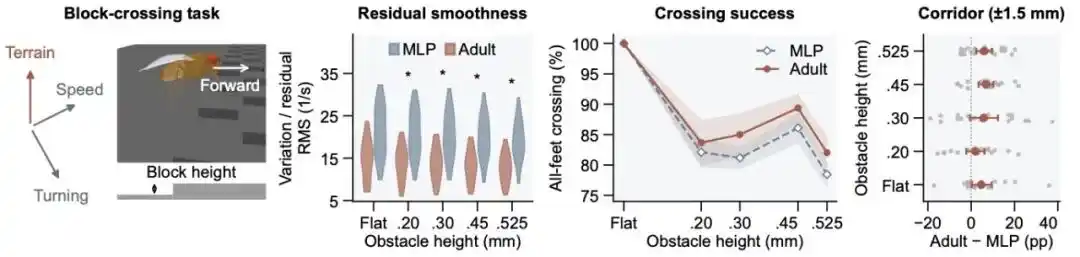
Vertical dimension: obstacle crossing
The team set obstacles at multiple heights and compared the share of trials in which all feet crossed successfully. On flat ground, the connectome controller and a parameter-matched multilayer perceptron, or MLP, performed similarly. Once obstacles were introduced, the connectome controller achieved a higher crossing success rate.
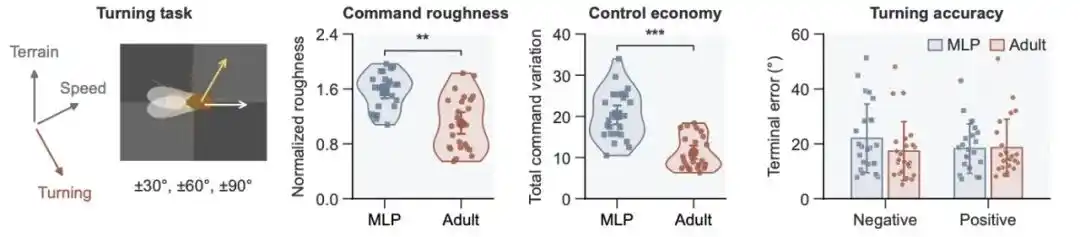
Lateral dimension: turning control
With body and terrain unchanged, the researchers tested target directions of 30°, 60° and 90° to both the left and right. The connectome controller produced smoother turning commands, cutting normalized command roughness by 29.9% and total variation by 44.6%.
Longitudinal dimension: speed tracking
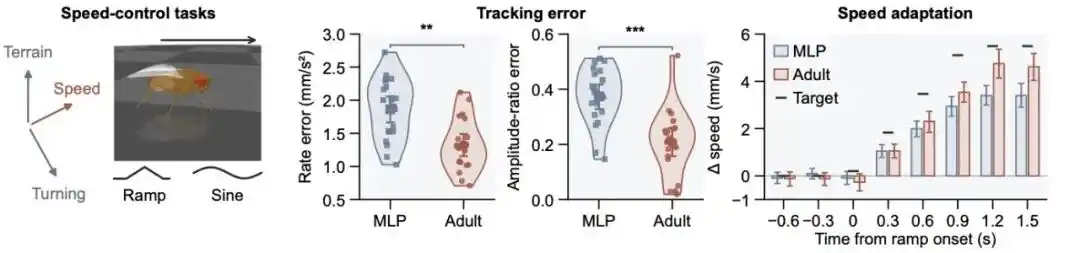
Keeping body, heading direction and terrain fixed, the team asked the fly to follow piecewise acceleration-deceleration commands and sinusoidal periodic speed changes. The connectome controller posted smaller tracking errors on both acceleration-slope and periodic-amplitude measures.
Taken together, the three experiments showed that within the same body, the connectome advantage emerged as control requirements changed, supporting more effective terrain handling, direction adjustment and speed regulation.
Performance held up after switching to different bodies
The researchers then connected the same fruit fly connectome to embodied agents with different morphologies. Even after body shape, action space and dynamics changed, the connectome core stayed fixed. Only the sensory and motor interfaces were relearned for each new body.
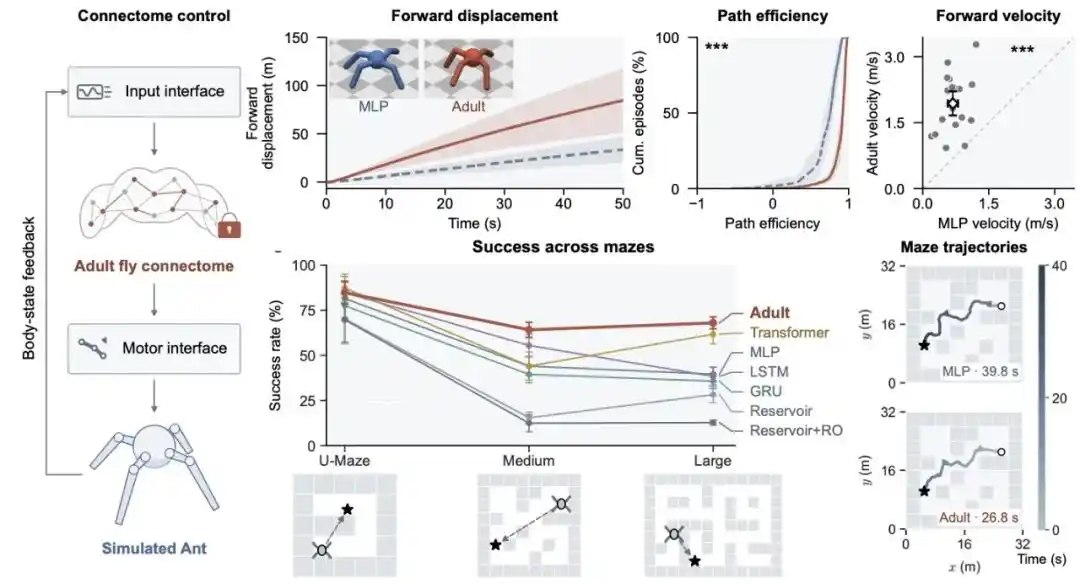
In flat-ground locomotion, the connectome controller reached an average forward speed of 1.94 meters per second, well above the MLP’s 0.68 meters per second, and followed a more direct path.
The gap widened when body changes were combined with more complex environments. In maze tests, the researchers compared the fruit fly connectome against MLP, Transformer, LSTM, GRU and two reservoir-based controllers. In both Medium and Large mazes, the adult connectome controller delivered the highest average success rate among the seven methods.
In the Medium maze, for example, success rate rose from 44.1% for MLP to 64.2%, an increase of 20.1 percentage points. On more complex routes requiring six to seven turns, success rate improved from 20.4% to 50.6%, expanding the advantage to about 30 percentage points. In the same maze evaluation, the physical failure rate fell from 15.1% to 9.2%.
Tests covered bipedal, tripedal, quadrupedal and hexapodal bodies
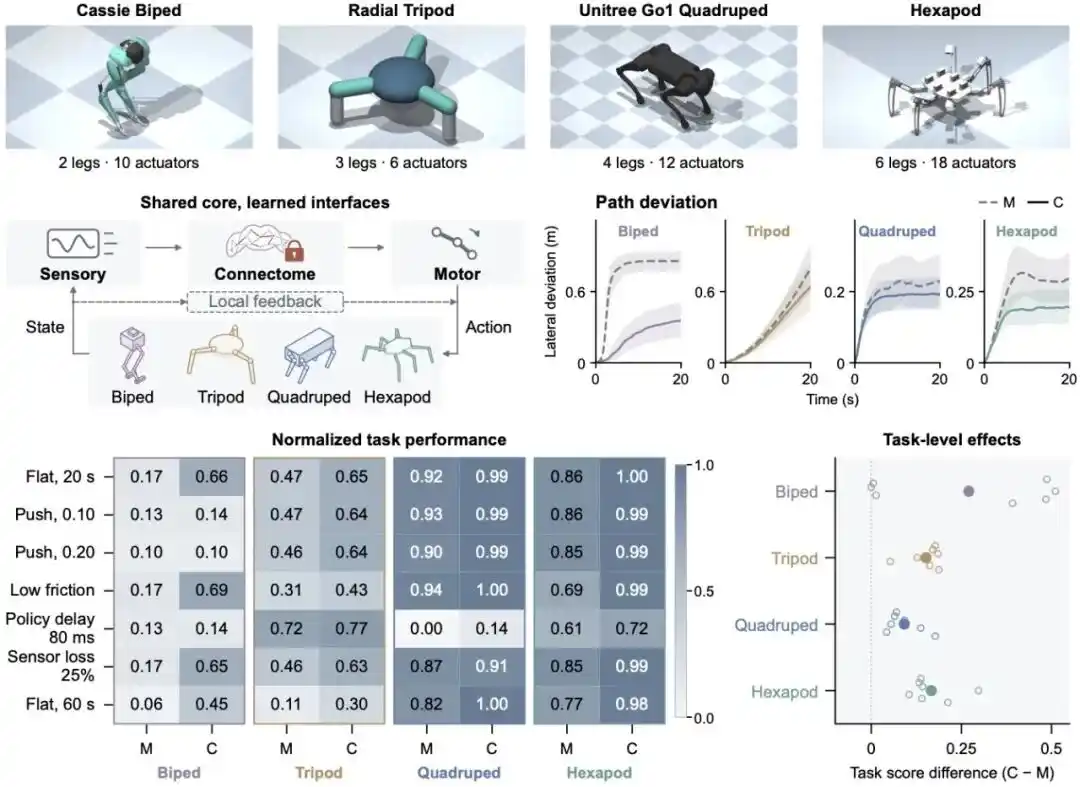
To measure how far the same connectome could stretch across body changes, the team tested four simulated bodies: bipedal, tripedal, quadrupedal and hexapodal robots.
The evaluation extended from normal conditions to lateral pushes, low friction, 80-millisecond action delay, partial observation loss and 60-second long-horizon operation. The goal was to examine how different bodies handled disturbances and sustained control.
All four bodies showed clear performance gains. The bipedal robot underwent the largest body change and showed the strongest adaptation advantage. The hexapodal robot was closest in form to a fruit fly and also delivered the best absolute performance.
Shared sensorimotor mechanisms emerged inside the network
The team also traced activity inside the network to ask why the connectome helped agents adapt to change.
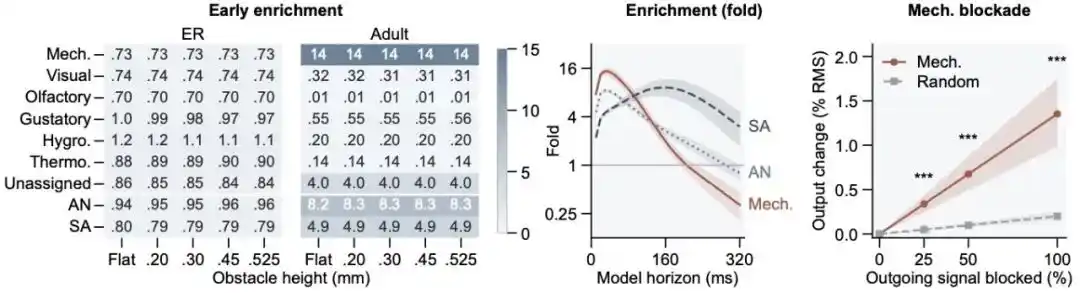
The researchers did not preassign which neurons should dominate each task. During learning and closed-loop interaction, however, mechanosensory and ascending neurons naturally became important groups influencing control output, and they participated in action regulation through descending pathways. In other words, functions tied to embodied control in the biological wiring structure were spontaneously recruited in the artificial tasks.
The same organization appeared across obstacle crossing, turning and speed variation. During obstacle crossing, mechanosensory pathways had a much stronger effect on control output than in random networks. During turning, mechanosensory and ascending-related groups acted on different timescales. During speed variation, ascending and mechanosensory pathways jointly responded to acceleration and deceleration commands.
Pathway intervention tests added support. Cutting the connections from ascending neurons to descending neurons increased average heading error by 3.52°, roughly three times the matched control intervention. Blocking mechanosensory signals, or limiting the ability of ascending groups to receive changing speed targets, also affected obstacle-crossing output and variable-speed responses.
At the same time, connectome controllers in all three task classes showed lower local policy sensitivity, meaning small perturbations caused smaller changes in control output. The study linked the adaptation advantage to the spontaneous recruitment of task-relevant pathways and to more stable control responses.
Research context and paper details
The article places the work in a broader line of connectomics and body simulation research. NeuroMechFly v2 provided a simulation platform for closed-loop sensorimotor studies in adult Drosophila. Flybody, developed by teams including Google DeepMind, enabled detailed fruit fly body models to walk and fly under learned controllers. BPU, meanwhile, used a larval connectome for image classification and move prediction in board games.
The Tsinghua team said it has been exploring how fruit fly learning and memory mechanisms can improve continual learning and adaptive ability in artificial intelligence. It cited a 2023 cover paper in Nature Machine Intelligence, a 2026 cover paper in Patterns, and a more recent brain-inspired hierarchical modularity framework as part of that line of work.
This latest study extends that path to measured neural connectivity structures and embodied control. According to the reported findings, the fruit fly connectome shows its advantage when terrain, motion demands and body structure change, and that advantage is accompanied by spontaneous recruitment of task-relevant sensorimotor pathways. The researchers said the results suggest that evolution-shaped neural connectivity can serve as a reusable prior for effective control across different bodies.
The paper is titled A Drosophila connectome prior enables adaptable embodied control. The research team is from Tsinghua University’s Department of Psychology, School of Biomedical Engineering, School of Life Sciences, and the IDG/McGovern Institute for Brain Research. The listed authors are Siyu Yu as first author, Kanglei Zhou, Hongwei Yan, Xinyi Wang, Sen Song, Bo Hong and Liyuan Wang as corresponding author.
- Project page: https://thu-neuroml.github.io/FlyControl
- Code: https://github.com/THU-NeuroML/FlyControl
- Paper: https://www.researchsquare.com/article/rs-11557476/v1
References cited in the source article
- [1] NeuroMechFly v2: Simulating Embodied Sensorimotor Control in Adult Drosophila. Nature Methods, 2024.
- [2] Whole-Body Physics Simulation of Fruit Fly Locomotion. Nature, 2025.
- [3] Incorporating Neuro-Inspired Adaptability for Continual Learning in Artificial Intelligence. Nature Machine Intelligence, cover article, 2023.
- [4] Spacing Effect Improves Generalization in Biological and Artificial Systems. Patterns, cover article, 2026.
- [5] Brain-Inspired Hierarchical Modularity for General Continual Learning. arXiv:2609.25146, 2026.
The source article said the piece originally came from the WeChat public account Quantum Bit, with authorship credited to “Fruit Fly Connectome.”



