
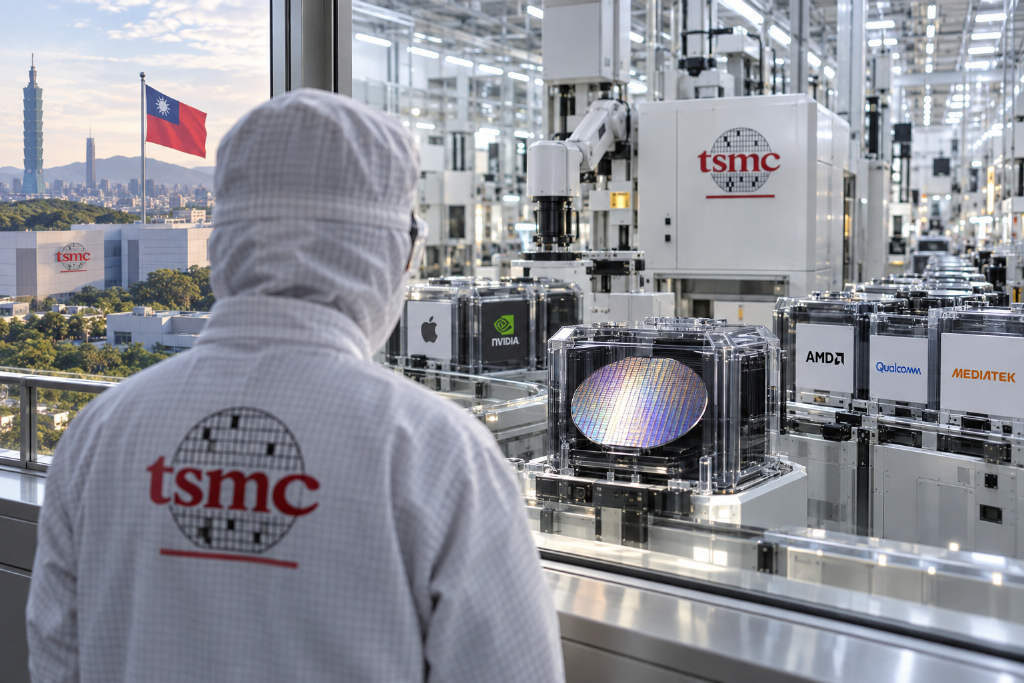
Taiwan Semiconductor Manufacturing Co. (TSMC) is reportedly accelerating its 2-nanometer capacity expansion after several major chip customers raised their bookings, according to a report by Taiwan’s Economic Daily News cited by ABMedia.
The report said Apple, Nvidia, Advanced Micro Devices, Qualcomm and MediaTek have recently increased reservations for TSMC’s 2nm family by 10% to 20% as they chase opportunities tied to artificial intelligence and high-performance computing, or HPC. As a result, TSMC’s 2nm monthly capacity is said to be heading toward 120,000 wafers by the end of this year, above an earlier estimate of 90,000 to 100,000 wafers. That would bring forward by one year a target that had originally been expected in 2027.
TSMC responded by saying it "does not comment on customer information and market rumors."
Five major customers are said to have lifted orders
Economic Daily News said the latest round of additional bookings is being driven by strong AI and HPC demand. The customer list includes Apple, Nvidia, AMD, Qualcomm and MediaTek, a group that largely overlaps with TSMC’s core advanced-node client base.
Industry sources cited in the report said strong follow-on demand from customers has pushed TSMC to expand 2nm family capacity faster than expected, with monthly output now seen reaching 120,000 wafers by year-end.
The story also drew attention in overseas semiconductor circles. Jukan, an account known for tracking Asian supply chains, reposted the report and drew more than 20,000 views in a single day.
At the same time, the report noted that both the order increase and the capacity figures came from industry and supply-chain sources rather than formal disclosures from TSMC.
Five 2nm fabs are set to ramp this year
TSMC’s previously disclosed plans offer some context for the expansion. Citing comments from TSMC Vice Co-Chief Operating Officer Y.P. Chyn, Economic Daily News said five 2nm fabs will begin volume ramp-up this year for the first time, including two in Hsinchu and three in Kaohsiung.
The report said first-year 2nm wafer output will be 45% higher than first-year 3nm output in 2023. It also said 2nm capacity is expected to post a compound annual growth rate of 70% from 2026 to 2028.
In other words, even without the latest reported order increases, 2nm was already on track to become one of TSMC’s fastest capacity ramps in recent years. If the new booking figures are accurate, customer demand is running ahead of an already aggressive plan.
Smartphone chips and AI accelerators are competing for the same node
ABMedia said Chain News had previously reported that competition around 2nm smartphone chips had already started, with Apple and Xiaomi helping drive orders across TSMC and suppliers including Hon Hai and Largan. It also said Microsoft’s in-house AI chip is reportedly set for mass production next year in partnership with TSMC.
The latest list of customers spans both smartphone chip buyers and AI accelerator developers. Apple, Qualcomm and MediaTek represent the smartphone side, while Nvidia and AMD are tied to AI accelerators. The report said that points to overlapping demand from two major end markets.
Customers are also spreading risk. Over the weekend, Qualcomm mobile executive Chris Patrick said in an interview that the company remains closely aligned with TSMC while also evaluating Samsung Foundry’s 2nm process in depth. For TSMC, getting capacity online earlier could help retain customers and reduce the incentive to shift orders elsewhere.
October earnings call is the next checkpoint
The report said TSMC’s next earnings call, which by convention is held in mid-October, will be the first major checkpoint for the story. Investors and industry watchers will be looking for any changes to 2nm capacity plans, revenue contribution and capital spending.
Until the company confirms the figures, the 120,000-wafer number remains a market report rather than an official target. Still, with five fabs ramping at the same time and customers spanning both smartphones and AI, 2nm is emerging as one of TSMC’s most important growth drivers over the next two years.