
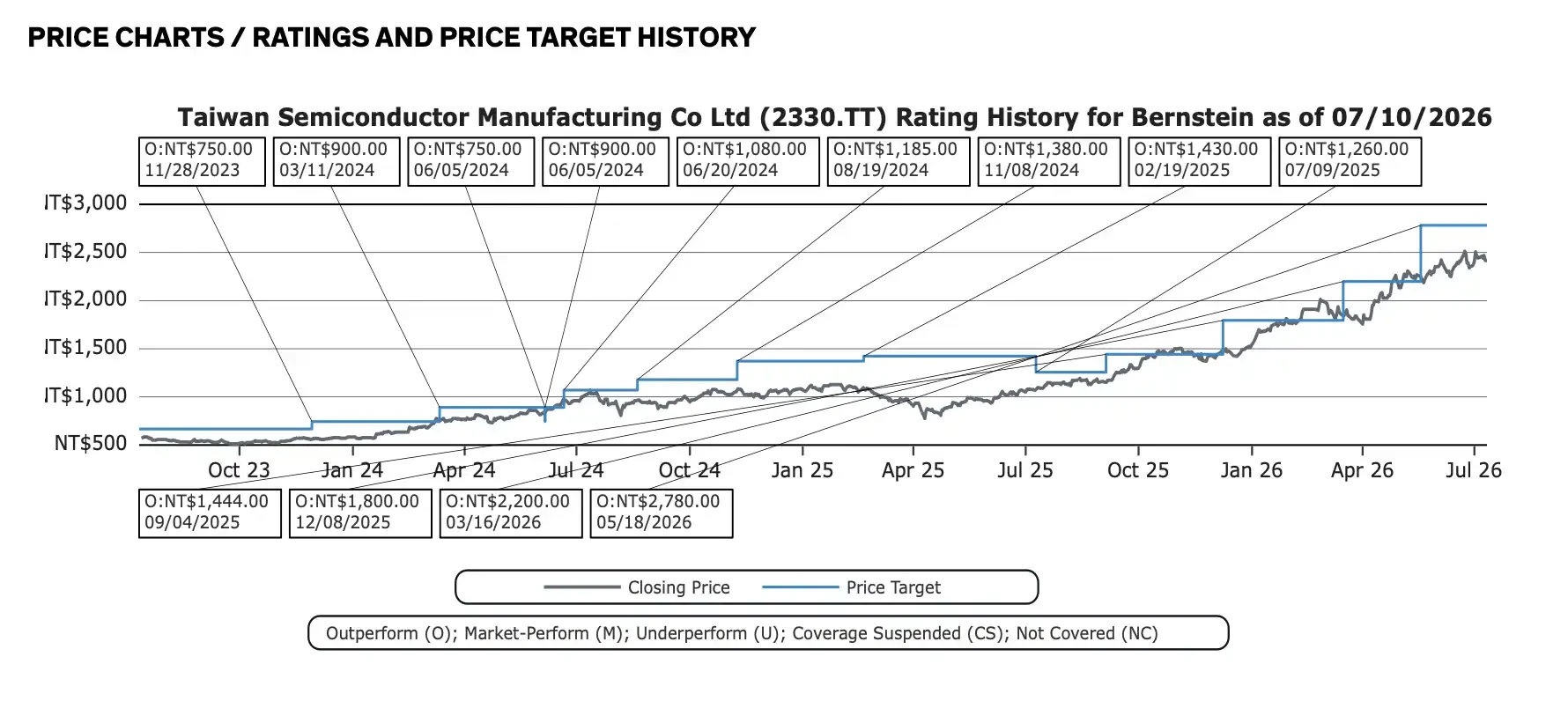
Taiwan Semiconductor Manufacturing Co. reported second-quarter revenue of about NT$1.27 trillion, while June revenue came in at NT$442.68 billion, up 67.9% from a year earlier. After the release, Bernstein maintained its Outperform rating on the company and kept its target price at NT$2,780. The market focus has now shifted from a single quarter’s sales to a narrower set of questions: how fast advanced packaging can expand, whether the N2 ramp stays on track, and whether margins can hold up under heavier spending.
Second-quarter revenue stayed within guidance and June growth remained strong
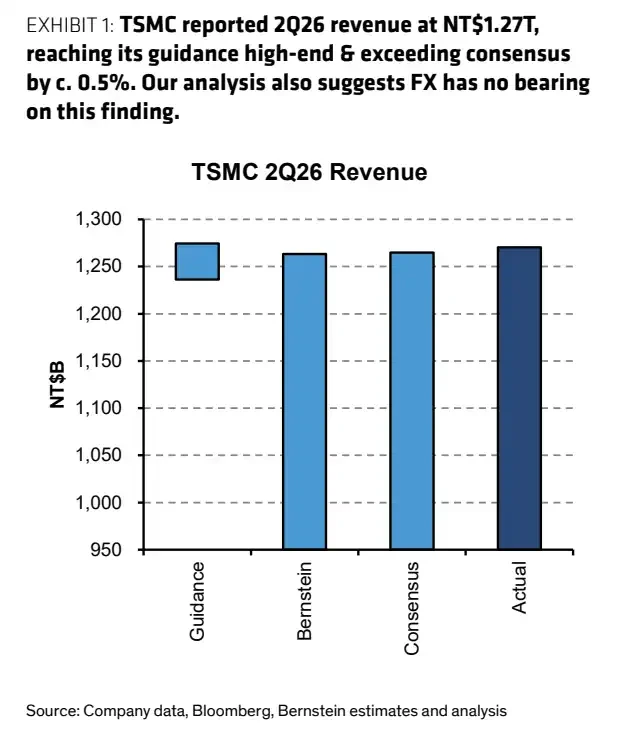
TSMC’s second-quarter revenue of about NT$1.27 trillion was up about 12% from the prior quarter and about 36% from a year earlier. The figure landed within the company’s earlier guidance for second-quarter revenue of $39 billion to $40.2 billion, based on an exchange-rate assumption of 31.7, and sat near the upper half of that range. On that basis, quarterly revenue was about $39.6 billion.
Monthly sales data posted on TSMC’s website showed June revenue of NT$442.68 billion, up 6.2% from May’s NT$416.975 billion and up 67.9% year over year. First-half revenue totaled NT$2.404 trillion, an increase of 35.6% from the same period a year earlier. In the report’s framing, those figures show that orders for advanced nodes and AI-related demand are turning into reported revenue rather than remaining only a market narrative.
The source report described second-quarter 2026 revenue of roughly NT$1.27 trillion as above some market expectations while still landing inside company guidance. That has reinforced the prevailing market view that demand for AI chips, advanced process technologies, and advanced packaging continues to run ahead of supply.
July 16 earnings call will put demand, capex, and margins under the spotlight
TSMC is scheduled to hold its second-quarter earnings conference on July 16. With quarterly revenue already disclosed, attention has turned to how management may update its view on full-year demand, the pace of advanced packaging expansion, capital expenditure plans for 2026 through 2027, and whether high levels of investment are beginning to weigh on gross margin.
Margin expectations remain another key issue. The source report estimated second-quarter gross margin at about 65%, while TSMC’s own earlier guidance called for 65.5% to 67.5%. Before the official earnings release, the more cautious read is that the market still expects gross margin to remain elevated, but the final figure will come from the July 16 results.
For a foundry business, margin durability depends on the mix of leading-edge nodes, factory utilization, depreciation pressure, and customer pricing power. TSMC’s current support comes from sustained demand in AI and high-performance computing, which is helping absorb a larger spending base.
Bernstein’s model leans on heavier spending to secure more AI capacity
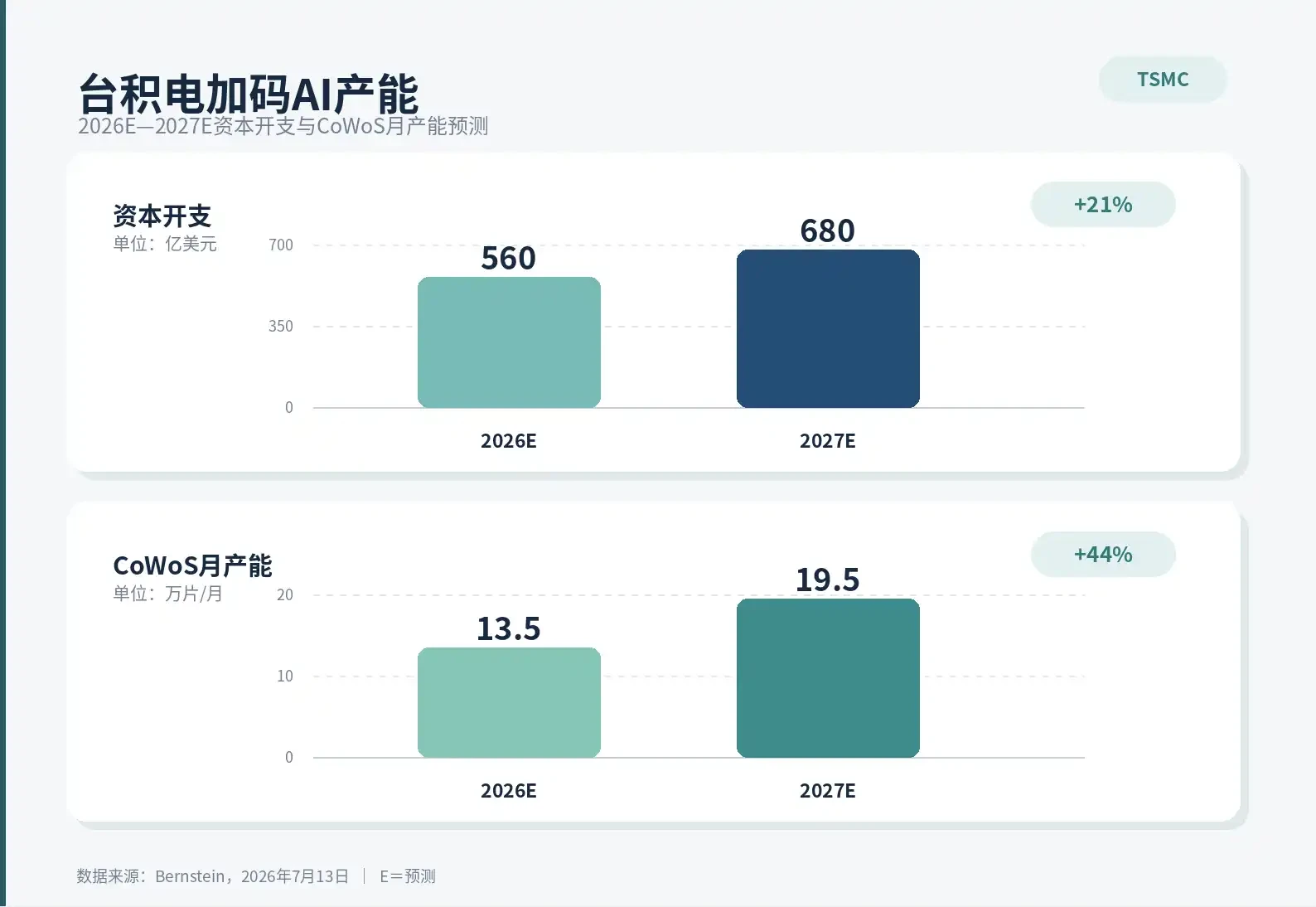
Bernstein’s valuation case for TSMC does not rest only on how much second-quarter revenue beat expectations. It centers on whether the company can convert AI demand into deliverable capacity. In Bernstein’s model, TSMC’s capital expenditure reaches $56 billion in 2026 and rises to $68 billion in 2027.
That scale reflects two pressures at once. Demand for advanced nodes is still increasing, and advanced packaging remains a bottleneck for AI chip deliveries. Under the assumptions cited in the source report, CoWoS capacity is expected to reach 135,000 wafers per month by the end of 2026 and 195,000 wafers per month by the end of 2027.
For NVIDIA, AMD, and large cloud companies developing in-house AI chips, advanced packaging capacity has a direct effect on whether products can be delivered on schedule. Even after wafer fabrication is complete, shipments can still be constrained if packaging capacity does not keep pace. That is why investors are paying close attention to TSMC’s capex outlook.
High capital expenditure sends two signals at the same time. It points to strong demand, but it also brings higher depreciation and greater pressure on cash flow. If customers continue to lock in capacity and pricing for advanced processes holds, the spending can still be treated as growth investment. If AI demand slows, the same spending could begin to squeeze margins.
N2 ramp is another critical variable
The N2 process will also be a major point of discussion on the earnings call. TSMC’s lead in advanced process technology remains one of the clearest distinctions between the company and other foundries. What the market wants to confirm now is whether the N2 ramp is progressing on schedule, whether customer adoption is moving smoothly, and whether cost pressure tied to the new node can be offset by pricing and scale.
From a valuation standpoint, that question matters as much as advanced packaging expansion. Revenue validates current demand. Capacity additions and the pace of new-node execution shape how much of that demand can turn into growth over the coming quarters and into 2026 and 2027.
NT$2,780 target still implies upside, but this is no longer a cheap re-rating story
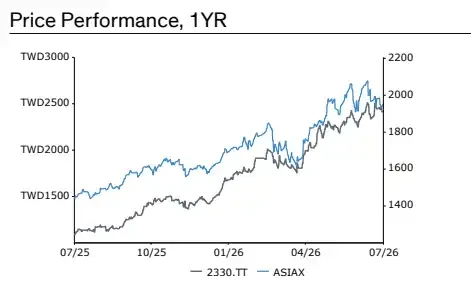
As of July 13, 2026, TSMC’s shares in Taiwan closed at NT$2,440. Bernstein’s NT$2,780 target, based on about 20x one-year forward earnings, still implies room to rise from that level.
But the report makes clear this is no longer a simple low-valuation rebound story. On the source report’s numbers, the stock was already trading at about 21x forward earnings. Investors have already assigned a meaningful premium for AI demand, leadership in advanced nodes, and high gross margins.
TSMC shares have climbed steadily over the past year, and the stock was around NT$2,440 at the time referenced in the report, with trailing 12-month relative performance at 86.5%. From here, the next move depends more heavily on operating results. If revenue, margins, and capacity expansion continue to come in ahead of expectations, earnings growth can continue to support a rich valuation. If capex keeps rising while margins start to soften, investor tolerance for that valuation could fall.
Over the last 12 months, TSMC’s relative performance reached 86.5%. The source article said the market already treats the company as one of the clearest beneficiaries of AI infrastructure expansion. That status can support the stock, but it also means any cooling in expectations may show up more quickly in the valuation.
Second-source efforts are increasing, though not enough to displace TSMC in the near term
The competitive risk highlighted in the report is not that TSMC’s lead has already been broken. It is that customers, faced with tight capacity, are starting to look more actively for alternative suppliers. The article cited media reports that Samsung raised prices by about 15% for some new customers at 4/5nm and 8nm nodes, and has discussed 2nm AI chip projects with Anthropic and Meta.
Intel has also drawn market attention over whether it could take part in supply linked to Google TPU. But the current discussion points more to advanced packaging or EMIB-related work, rather than wafer foundry orders in a straightforward sense.
Those developments are not expected to create a material hit to TSMC revenue in the short term. TSMC still holds clear advantages in leading-edge yields, scale, and customer relationships. The more important signal is that when leading-edge process and advanced packaging supply stays tight for a long time, major customers become more willing to develop a second source.
Even if alternatives remain constrained in the near term and still face long technology validation cycles, they could weaken TSMC’s pricing flexibility over the medium to long term. Geopolitical uncertainty and customer concerns about supplier concentration may also keep diversification efforts alive.
At TSMC’s current valuation, those risks do not need to hit revenue immediately to matter. If they affect the multiple investors are willing to pay, they can still move the stock. The July 16 earnings call is expected to address a very specific set of questions: how quickly advanced packaging will continue to expand, whether the N2 ramp will weigh on gross margin, and whether elevated capex can keep being absorbed by AI-related orders. TSMC remains one of the strongest companies in the AI manufacturing chain, but Bernstein’s NT$2,780 target will still require more evidence from capacity growth and margin performance.