
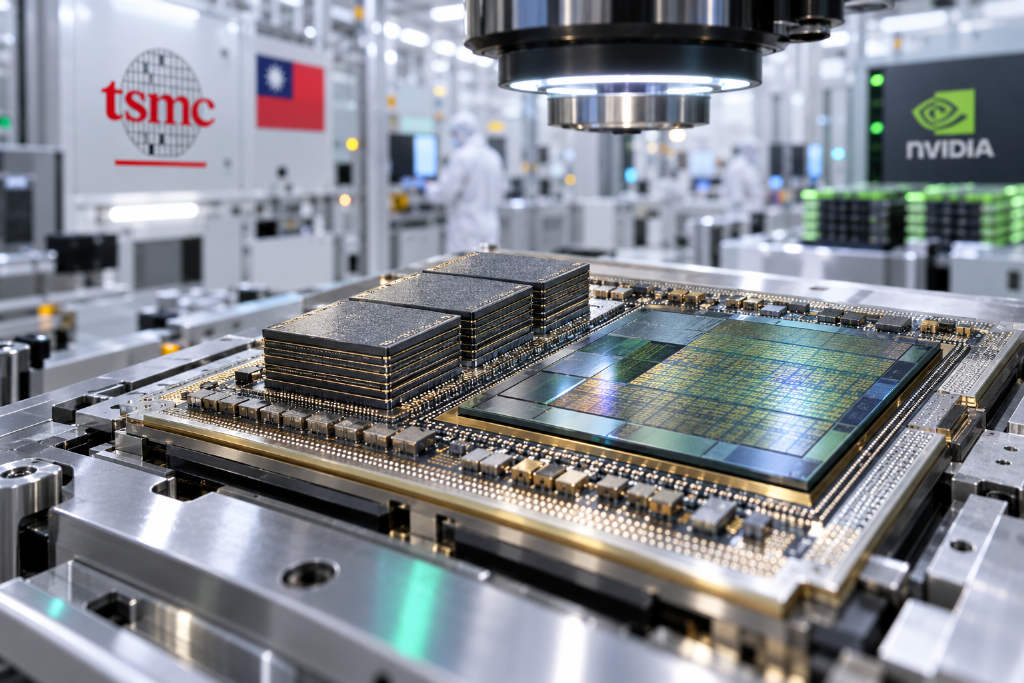
TSMC is considering raising prices for its advanced CoWoS packaging by as much as 20%, according to media reports, as strong demand for Nvidia’s Blackwell and Rubin chips adds to capacity pressure and longer delivery times for chipmaking equipment. TSMC has not commented on the report.
Blackwell and Rubin add to packaging strain
CoWoS combines logic chips and high-bandwidth memory, or HBM, in a single package, giving AI accelerators the data bandwidth needed for heavy computing workloads.
The report said Nvidia’s Blackwell architecture already stacks two large GPU dies with eight HBM3E memory stacks. Rubin and Rubin Ultra, which are expected to follow, are projected to increase integration further, putting more pressure on packaging capacity and the related supply chain.
Testing has also become part of the bottleneck. Blackwell testing takes three to four times as long as the previous-generation Hopper, the report said, while Rubin testing could take up to seven times longer. That keeps equipment tied up for longer periods. Server CPUs and custom ASICs are also competing for advanced packaging capacity, tightening an already constrained supply base.
Equipment lead times stretch to eight months
Equipment delivery times have reportedly extended from three to six months in the past to as long as eight months. TSMC has already placed equipment orders this year at current prices and is no longer seeking discounts or extra features through negotiations, according to the report.
TSMC Deputy Co-Chief Operating Officer Hou Yung-ching said the company’s expected equipment demand has reached 1.9 times its initial estimate as AI demand accelerates. Hou said TSMC has not seen demand grow this quickly or change this frequently compared with conditions 30 years ago, and the company is working to expand its packaging supply chain.
GlobalFoundries deal covers silicon interposers in the US
The report also said GlobalFoundries signed a five-year, $2 billion agreement with TSMC to produce silicon interposers for CoWoS in the United States, with mass production expected to begin in the first half of 2028.
Still, the report noted that interposers are only one part of the packaging process, and the agreement alone will not remove the shortage.
Advanced-node wafer prices may also rise in 2027
Cost increases are not limited to packaging. TSMC is also considering a broader price increase in 2027, the report said, with wafer prices for advanced process technologies expected to rise 5% to 10%.
Customers using 2nm and 3nm nodes could face the largest increases. Those seeking capacity beyond their original allocation may need to pay an added premium, pushing some cost increases as high as 25%.
TrendForce, citing industry forecasts, said TSMC’s monthly capacity is expected to exceed 106,000 wafers in 2026 and reach 227,000 wafers in 2027. If both packaging and wafer prices move higher, AI hardware costs would also increase.



