
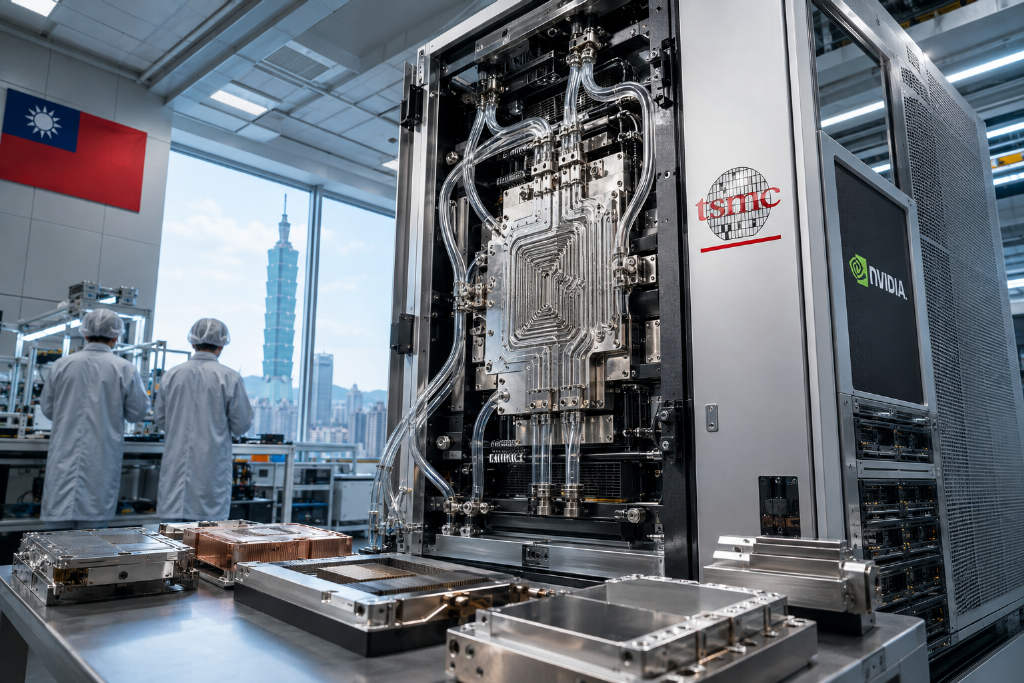
Taiwan Semiconductor Manufacturing Co. (TSMC) has added microchannel cooling to its R&D roadmap, according to ABMedia, which said the move tracks the upgrade cycle of NVIDIA’s next-generation Feynman platform and is stirring a fresh race across Taiwan’s cooling supply chain.
Rising AI chip power is exposing the limits of cold plates
The report said the computing capability of AI accelerators is growing rapidly, and power draw is rising with it. As transistor counts increase and chip performance improves, thermal design power, or TDP, for a single chip is expected to break above 4,000W.
At that level, conventional cold plate technology is no longer seen as sufficient. The article pointed to high thermal resistance and limited heat dissipation density as the main bottlenecks, leaving the industry searching for a new cooling approach.
What microchannel cooling does
Microchannel cooling uses fluid flowing through micron-scale channels to deliver more efficient heat exchange. The basic advantage comes from geometry: when channel size shrinks to the micron level, the surface-area-to-volume ratio rises sharply and the fluid boundary layer becomes thinner, which increases the heat convection coefficient and helps remove dense waste heat in a very small space.
Compared with a standard cold plate, a Microchannel Lid, or MC Lid, can provide a more direct liquid-cooling interface between the chip die and the cooling medium, reducing thermal resistance. The report described the technology as one of the most promising next-generation cooling options for AI data centers. Even so, manufacturing precision has to reach the micron scale, so most projects are still in R&D and sample verification.
TSMC’s push puts focus on NVIDIA’s Feynman platform
ABMedia, citing Economic Daily News, said NVIDIA had previously wanted to introduce microchannel cooling into its products but had not managed to deploy it because of the technology’s complexity. TSMC’s decision to place microchannel cooling on its R&D roadmap is being viewed as support for a major customer’s product transition and as a signal that microchannel designs are moving closer to the mainstream for next-generation thermal systems.
The report also said market analysts expect NVIDIA’s Feynman platform to adopt MC Lid and move into mass production, making the part one of the most closely watched components in the platform.
Auras and Ichia are early contenders
Among Taiwan suppliers, Auras is described as a recognized leader in thermal solutions and an early mover in microchannel development. The company has both Microchannel Lid and Vapor Chamber Lid, or VC Lid, routes. Auras said its MC Lid products are designed for high-power environments where AI accelerators and high-performance computing chips exceed 1,000W TDP, with the aim of lowering thermal resistance between the die and the cooling medium. Before Ichia’s progress became more visible, industry expectations had centered on Auras as the likely sole winner of Feynman-related orders.
That picture is now less clear. ABMedia said Ichia, drawing on years of precision metal processing and advanced surface electroplating capabilities, has shifted from traditional optoelectronics into chip-level AI cooling and has already entered the cooling supply chains of cloud giants including Google and Amazon. For NVIDIA’s Feynman platform, Ichia has already sent samples and is running validation across multiple architectures, putting it in direct competition with Auras.
The report added that supply chain sources said NVIDIA intends to cultivate Ichia as a second supplier, a development that was described as supportive of a higher valuation outlook for the company.
More Taiwan suppliers are moving in, and pricing is higher
AVC and Cooler Master-related peer Sunonwealth were also named in the report as companies investing in microchannel-related R&D. Sunonwealth Chairman Lin Yu-shen said faster AI computing will keep lifting demand for cooling, and as chip power and the technical threshold rise, microchannel technology should become the natural direction because it carries better margins. He said, 「Sunonwealth has already entered the sample testing stage and will not be absent from this opportunity.」
On pricing, industry analysis cited in the report said microchannel modules and related components can sell for 3 to 5 times the price of standard cold plates. For Taiwan cooling suppliers, the competition is not only about winning a technical position in the next AI platform cycle. It is also about improving profitability in a business long marked by low margins and intense competition. The companies that complete validation first and enter NVIDIA’s mass-production supply chain stand to capture the largest early gains.