
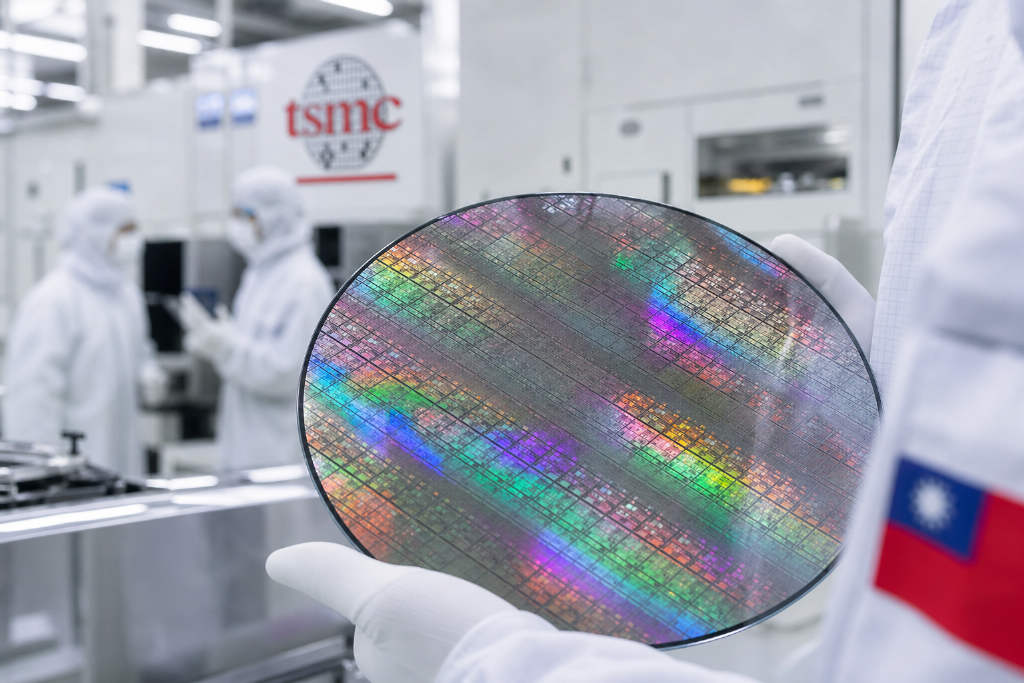
Taiwan Semiconductor Manufacturing Co. turned in another record set of numbers on Oct. 15, hitting fresh highs for quarterly revenue, net income and earnings per share in the third quarter of 2026. Net income jumped 68.7% from a year earlier, stretching the company’s run of record quarterly profit to six straight quarters.
Chairman and CEO C.C. Wei did not leave much room for doubt as the company lines up for another expansion push: "We have no intention of handing the benefits to others. We want to win every business opportunity possible!" His point was blunt. TSMC sees the AI boom as a chance to grab as much business as it can, not leave space for rivals.
Revenue, profit and EPS all hit records
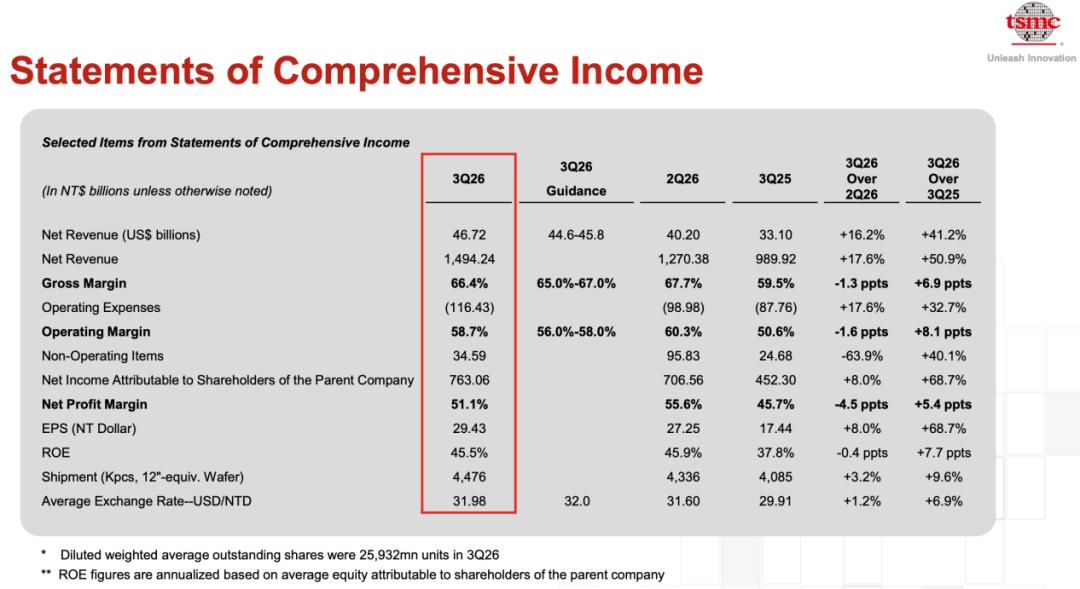
TSMC said third-quarter consolidated revenue reached NT$1.49424 trillion, up 50.9% from a year earlier and 17.6% from the previous quarter. Net income after tax came in at NT$763.06 billion, rising 68.7% year over year and 8% from the prior quarter. Earnings per share climbed to NT$29.43 from NT$27.25 in the second quarter.
In U.S. dollar terms, third-quarter revenue was $46.72 billion, up 41.2% from a year earlier and 16.2% from the prior quarter. That was above TSMC’s earlier guidance range of $44.6 billion to $45.8 billion.
Profitability stayed high. Gross margin was 66.4%, operating margin was 58.7%, net profit margin was 51.1%, and return on equity reached 45.5%.
Advanced nodes remained the core driver
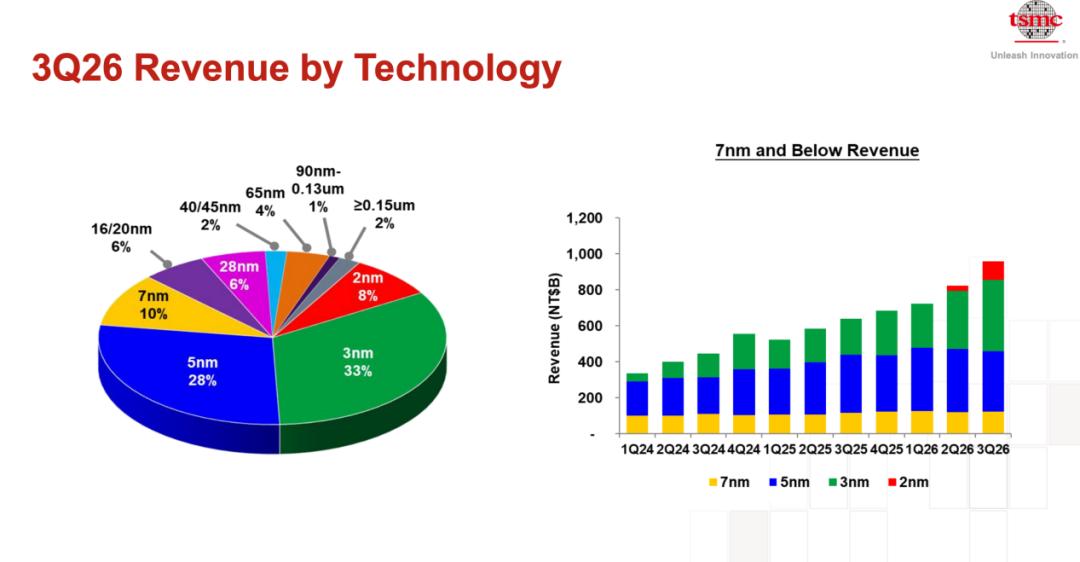
By process technology, 2nm made up 8% of wafer revenue in the third quarter. The shares for 3nm, 5nm and 7nm were 33%, 28% and 10%, respectively. Technologies at 7nm and below accounted for 79% of total wafer revenue.
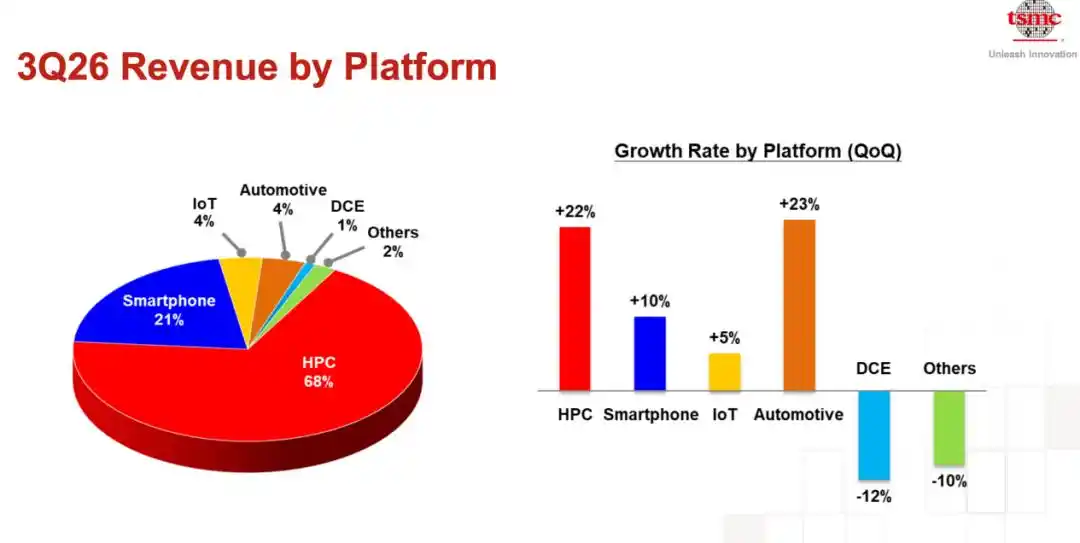
By platform, high-performance computing stayed TSMC’s largest business line. HPC revenue rose 22% from the previous quarter and made up 68% of total revenue. Smartphone revenue increased 10% sequentially and accounted for 21%. Automotive climbed 23% and represented 4%. Internet of Things revenue rose 5% and also made up 4%. Consumer electronics dropped 12% from the prior quarter and represented 1%.
Fourth-quarter guidance points higher
For the fourth quarter, TSMC projected revenue of $52.3 billion to $54.3 billion, with a midpoint of $53.3 billion. Using that midpoint, revenue would increase about 14% from the previous quarter and about 58% from a year earlier. The company expects fourth-quarter gross margin of 65% to 67% and operating margin of 56.5% to 58.5%.
For the full year, Wei said TSMC expects revenue in U.S. dollar terms to grow about 44% in 2026, backed by strong demand for advanced process technologies.
Wei says AI demand now reaches CPUs and networking chips
Wei said AI is still one of the company’s biggest long-term demand drivers. He described the industry as moving beyond chatbots and toward AI assistants, or agentic AI deployment. As generative AI spreads further and open-source AI models gain wider use, application efficiency is improving and barriers to adoption are coming down. That, in turn, is lifting demand for chips built on advanced nodes.
And the AI wave is no longer limited to GPUs and AI accelerators, he said. The rise of CPUs for agentic AI, along with continued demand growth for networking chips, is also pushing wafer demand higher.
Wei said every future AI route still depends on the most advanced semiconductor manufacturing technologies. He also said that, based on TSMC’s technology lead, manufacturing capacity, global footprint and customer trust, all AI customers are currently working with TSMC.
Even then, the company stayed careful on 2027 planning. Wei said consumer electronics and other price-sensitive end markets are under pressure from rising component prices and broader macroeconomic uncertainty. But he also said demand for advanced nodes remains very strong and should support business in the first quarter of 2027, including through the rapid ramp of 2nm.
2nm family capacity to more than double in 2027
TSMC is speeding up mass-production preparation for 2nm and later technologies. Wei said N2 entered high-volume manufacturing in the fourth quarter of 2025 with good yield performance, and multi-phase ramp efforts are still underway at the company’s Hsinchu and Kaohsiung sites. Strong demand from smartphones, high-performance computing and AI applications is driving this. TSMC expects full-year capacity for the N2 family in 2027 to increase by more than 100%.
As for the next generation, TSMC has already begun preparing capacity for A14. Risk production is scheduled to start in 2027, and mass production is expected to begin in 2028. Wei also said demand for A16, the 1.6nm process, is very high and customer interest is strong.
Another 3nm fab in Tainan, with Arizona and Japan projects moving ahead
TSMC is also putting more emphasis on 3nm. The company had already planned three new fabs globally to meet strong multiyear demand for the node. Then customer demand picked up again. So TSMC decided to add another 3nm fab in Tainan Science Park in Taiwan, China. That facility is expected to enter mass production in the first half of 2028. An existing new 3nm fab in Tainan is expected to begin mass production in the first half of 2027.
Overseas projects are moving ahead at the same time. The second fab in Arizona has finished construction and is now in the equipment move-in and installation stage. It is expected to begin mass production in the third quarter of 2027, slightly ahead of the original schedule. The second fab in Japan is progressing as planned, will use 3nm technology, and is expected to start production in 2028.
Wei said nearly 25 fabs are currently being advanced worldwide. Over the next few years, TSMC plans to build 13 advanced-process and advanced-packaging facilities in Taiwan, China, and another five to six wafer fabs overseas.
CoWoS remains undersupplied
Advanced packaging is another big piece of the expansion plan. Wei said demand for CoWoS packaging remains very strong and keeps rising. Even with large annual capacity increases, supply still cannot fully meet demand, and the company is trying to raise output as quickly as possible.
For forward-looking technologies such as fan-out panel-level packaging, silicon photonics and co-packaged optics, TSMC is developing larger panel-level packaging solutions to lower future costs. Wei said the company remains ahead of the industry in both technology and manufacturing maturity.
In the U.S., Wei said the Arizona buildout and expansion are being driven mainly by broad demand from American customers. Beyond wafer manufacturing lines, TSMC is actively evaluating and planning advanced packaging capacity in the United States and remains in discussions with customers about detailed specifications and needs.
Equipment conversion and flexible capacity planning
TSMC is also trying to lift near-term output through equipment conversion and capacity optimization. Wei said the company is continuing to convert some 5nm tools in Taiwan, China, to support 3nm capacity. It is also improving productivity across manufacturing sites to produce more wafers, while offering more flexible support across N7, N5 and N3 nodes.
On demand planning, TSMC has sent teams to inspect the construction progress of U.S. data centers and local power supply conditions. Wei said cloud service providers are well prepared, and the feedback has been positive. TSMC is using both top-down and bottom-up methods to map customer product roadmaps over multiple years and arrange capacity earlier.
Capex stays high, while overseas expansion adds pressure to margins
With advanced-node and related capacity expansion still going, TSMC said capital intensity will remain high. The company reaffirmed 2026 capital expenditure of $60 billion to $64 billion and said spending from 2026 through 2028 will be clearly higher than in the previous three years.
CFO Huang Jen-chao said some equipment supply is still tight, but the company is continuing to work with suppliers early to plan capacity for future customer demand.
That expansion is not cheap. Huang said the midpoint of fourth-quarter gross margin is expected to be about 0.4 percentage point lower than in the third quarter, mainly because of the fast 2nm ramp and the higher cost structure of overseas fabs. Productivity gains, cost improvements and optimization across nodes may offset part of that pressure.
TSMC expects the dilutive impact from overseas fab production on full-year 2026 gross margin to be closer to 2 percentage points. As U.S. expansion continues in the coming years, that drag could widen to 3 to 4 percentage points.
The company said it plans to use the benefits of a larger Arizona scale, improve operations to reshape the cost structure, and work with customers and suppliers to manage the cost impact while preserving cost competitiveness across manufacturing regions.
High-NA EUV adoption will depend on maturity and returns
On equipment investment, Wei said TSMC is focused on technology maturity and return on investment when it comes to High-NA EUV tools. The company will not chase new equipment blindly and will only consider high-volume deployment once the tools are mature and cost-effective.
Asked about competition, Wei said TSMC treats fabless semiconductor companies and integrated device manufacturers equally, and it includes competitors’ internal capacity in its overall assessment.
From third-quarter earnings to three-year capital spending plans, the message from the company’s briefing was pretty direct: demand for advanced process technologies is still growing steadily, and TSMC is matching that with a global capacity expansion program. The company is pushing ahead on 2nm, 3nm and later nodes, adding CoWoS and other advanced packaging capacity, and increasing output through tool conversion and cross-node optimization. Wei said TSMC will do everything it can to maximize support for customers as quickly as possible under feasible conditions.



