
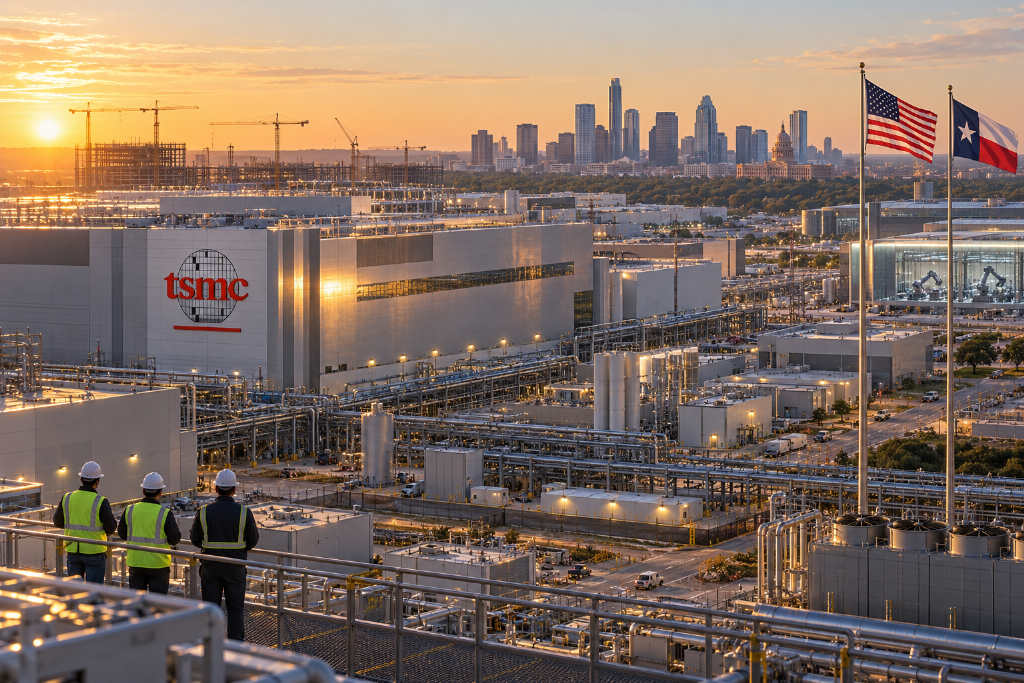
Taiwan Semiconductor Manufacturing Co. (TSMC) reported NT$1.49 trillion in revenue, NT$763.064 billion in net profit and earnings per share of NT$29.43 for the third quarter of 2026, then used its earnings call to lay out a much broader message: the company is pushing ahead with one of its fastest expansion cycles yet, sees no sign of an AI slowdown, and is evaluating new manufacturing options in the US beyond Arizona.
Wei confirms Texas review and talks around Terafab
During the analyst Q&A, JPMorgan analyst Gokul Hariharan asked about market speculation that TSMC could build a new fab cluster in Texas, while companies linked to Elon Musk had previously referred to contact with TSMC. He asked whether the two sides were discussing cooperation and how TSMC was thinking about further US expansion.
Chairman and CEO C.C. Wei said the US is home to many of TSMC’s key customers, those customers continue to ask for more local capacity, and the US government has offered support. On that basis, he said, TSMC has begun evaluating expansion options outside Arizona.
Wei said the company has already sent a team to Texas for assessment work and is also talking with the customer planning the Terafab project. 「We are discussing with them to see whether we can also use related capacity.」 He added that the talks remain at the discussion stage and that TSMC would share more if concrete conclusions are reached.
When analysts pressed on whether that meant TSMC could take part in the Terafab project instead of only building its own fab, Wei said different forms of cooperation remain possible. He also set out a clear condition: 「The fab must be operated by TSMC.」
TSMC says it still sees AI demand running ahead of supply
Analysts also raised questions about whether AI capital expenditure is becoming overheated and whether data center construction, power availability, HBM memory and other key components could turn into bottlenecks.
TD Cowen analyst Laura Chen asked how TSMC is assessing customer demand and whether the company is worried about excess building across the supply chain. Wei said TSMC has already built cloud service provider capital spending, data center construction progress, financing conditions, power supply and other component capacity into its internal demand models.
Even after accounting for those constraints, he said, TSMC still believes demand is above current supply, which is why it is moving aggressively to add capacity and narrow the gap.
TSMC had previously projected that AI accelerator revenue would grow at a CAGR in the high-50% range from 2024 to 2029. Asked whether that forecast now needs updating, Wei answered: 「Demand is very, very strong. We have not seen any sign of slowdown. Whether the CAGR is near the upper end of 50% is not that important. In fact, it could be even higher.」
Agentic AI is lifting CPU demand as well
A Bank of America analyst asked whether the rise of Agentic AI is leading customers to shift resources toward CPUs, network switches and more efficient computing architectures.
Wei said TSMC does see continuing growth in demand for Agentic AI CPUs, but that does not mean demand for traditional AI accelerators is weakening. In his description, overall AI-related demand remains very strong.
He added that the AI accelerator CAGR TSMC discussed earlier used a narrower definition and did not include Agentic AI CPUs, because the company cannot directly separate which CPUs will end up in conventional servers and which will go into AI servers.
In management remarks, Wei also said TSMC has become more proactive in checking demand than it was in the past. Beyond discussions with chip customers and downstream buyers on long-term needs, the company is now sending its own teams to the US to verify actual data center construction progress and local power supply conditions. He said the feedback so far has been positive and cloud service providers appear well prepared on the data center buildout side.
Profitability has no ceiling, Wei says, but gains will not come overnight
As TSMC keeps raising capital spending, analysts are paying closer attention to equipment costs for next-generation nodes, overseas fab expenses and the long-term margin path. Asked about the adoption of High-NA EUV and future profitability, Wei said the company still plans to begin using High-NA EUV around 2030, when it expects the technology to be mature enough and economically viable enough.
On profit potential, he said: 「There’s no ceiling for TSMC’s profitability. But a dramatic increase will not happen overnight either.」
Wei said TSMC wants to grow alongside customers, help them succeed in their markets and earn a reasonable return from the value of its technology. CFO Wendell Huang said overseas fabs still carry higher production costs, but with larger scale and cost-improvement measures, the gross margin dilution from overseas expansion is now estimated to be close to 2 percentage points.
As more US fabs begin production, that dilution is expected to widen to around 3 to 4 percentage points over the next few years.
N2 capacity to more than double by 2027, A14 risk production due in 2027
TSMC said its global capacity buildout is moving at an unprecedented pace. Wei said the company plans to build 13 advanced process and advanced packaging facilities in Taiwan over the next several years, along with another five to six fabs overseas.
The 2 nm process entered mass production in the fourth quarter of 2025, and capacity at the Hsinchu and Kaohsiung sites continues to expand. Driven by smartphone, high-performance computing and AI demand, TSMC expects annual capacity for the N2 family to increase to more than double by 2027.
The A14 process is scheduled to enter risk production in 2027 and mass production in 2028. In the Q&A, a Morgan Stanley analyst asked whether A14 could become a bigger node family than N2 if large IDM customers outsource more CPU production. Wei did not comment on any specific customer outsourcing plan, but said customer engagement around A14 is already higher than it was at the same stage for N2, and he expects A14 to become a larger process family than N2.
For 3 nm, TSMC said strong market demand has led it to add more capacity to an existing node, an unusual move for the company. New capacity in Tainan is scheduled for mass production in the first half of 2027 and the first half of 2028. Arizona Fab 2 is expected to begin mass production in the third quarter of 2027, slightly ahead of the prior schedule. A second fab in Japan is planned to use the 3 nm process and is expected to begin production in 2028.
CoWoS remains the preferred packaging option, with GlobalFoundries helping on interposers
Advanced packaging also drew attention on the call as AI chips keep getting larger. A Morgan Stanley analyst said customers are developing chips as large as 14 times reticle size and asked whether TSMC can support those bigger AI processors and how it plans to respond to packaging competition from other foundries.
Wei said TSMC is already able to mass produce advanced packaging products at 5 times reticle size with solid yields, and is working on 9 times and 14 times reticle-size solutions. He said that although several advanced packaging technologies are now in the market, CoWoS remains the preferred choice for TSMC customers.
The last analyst on the call also asked about TSMC’s recent cooperation with GlobalFoundries on silicon interposers. Wei confirmed that the tie-up is part of TSMC’s back-end supply chain strategy.
He said the company does face a degree of supply tightness in back-end packaging capacity and is working with partners such as GlobalFoundries to make sure customers can secure enough capacity and bring products to market on time.
2026 capex stays at $60 billion to $64 billion
Addressing concerns about overinvestment across the semiconductor industry, TSMC management repeatedly said on the call that AI demand has not weakened. The company kept its 2026 capital spending budget unchanged at $60 billion to $64 billion and said capex for 2026 through 2028 will be materially higher than in the previous three years.
Huang said equipment, materials and labor costs are all rising, but the main factor behind capital spending decisions remains long-term customer demand rather than equipment price increases alone.
Wei said TSMC is accelerating expansion as much as possible because demand for advanced processes and advanced packaging still far exceeds available supply. He summed up the company’s stance in blunt terms: 「We have no intention to leave food on the table for others. And we want to capture every piece of business possible.」



