


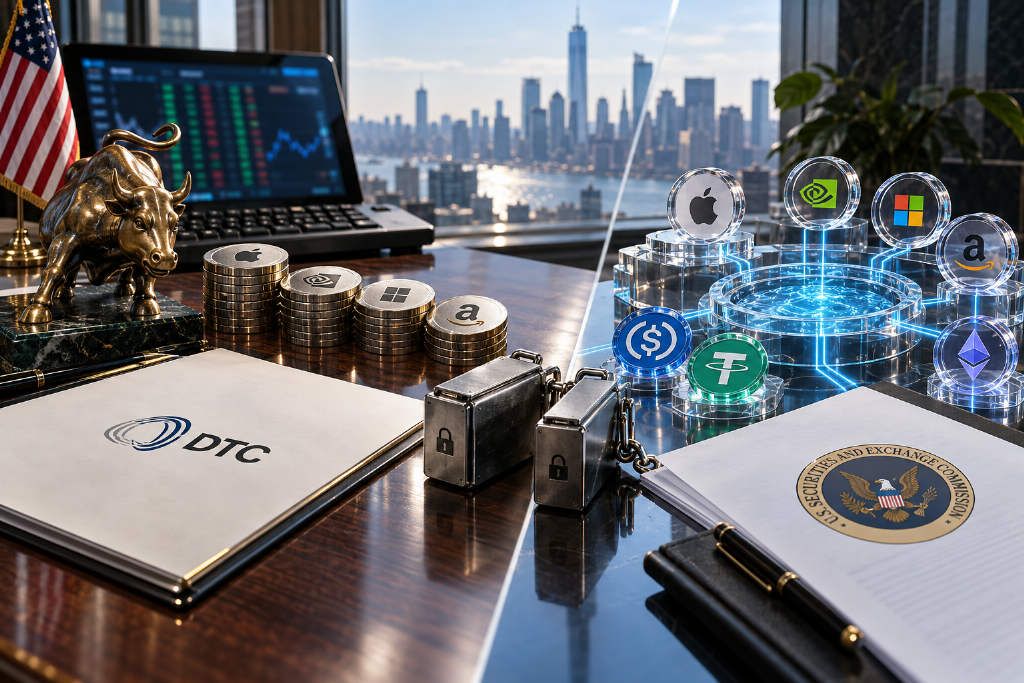
Two new market structures for tokenized U.S. stocks have now been assembled, but neither had reached publicly verifiable live trading as of Oct. 14, 2026.

One route would place tokenized shares into the existing Nasdaq order book and the Depository Trust Company, or DTC, settlement system. Trading would still happen in the traditional market, while the change would appear after execution, at the delivery stage. The other route would create a separate onchain venue under a U.S. Securities and Exchange Commission innovation exemption, allowing tokenized stocks to trade directly against stablecoins and other eligible onchain assets in liquidity pools, with both trading and settlement completed onchain.
The focus here is not on offshore stock-token products that already exist, nor on U.S. onchain stock trading conducted under the current broker-dealer or ATS framework. It is on two newer structures that took shape over roughly the past year, each with a different rule set, a different source of liquidity, and a different set of bottlenecks.
Four milestones split the market into two routes
The two structures emerged through four developments.
In December 2025, the SEC allowed DTC to pilot tokenization services. In March 2026, Nasdaq won approval to trade tokenized stocks. In September 2026, the SEC issued an innovation exemption that permits new onchain trading venues. On Oct. 4, OKXICE, a joint venture between OKX and ICE, published the first opening notice under that framework.
The first two developments belong to route one. Tokenized stocks would enter the existing exchange and settlement system, giving investors an onchain holding format while leaving the stock itself unchanged. Trading would still occur on Nasdaq, and DTC would still handle post-trade settlement. The latter two developments belong to route two. A new onchain venue would be created where tokenized stocks trade directly against stablecoins and other onchain assets, with settlement also taking place onchain.
The core distinction is simple: whether trading and settlement remain inside the existing market structure.
As of Oct. 14, 2026, RWA.xyz put onchain tokenized stocks and ETFs at about $3.28 billion, versus about $14.9 billion for tokenized U.S. Treasurys. The former is roughly one-fifth of the latter. That comparison has limits. Most of the stock and ETF figure comes from offshore products such as xStocks, Ondo and Robinhood, which are not the same as the equal-rights tokenized shares required under the two U.S. routes discussed here. For that reason, current market size says little on its own about where these structures may go next.
A better way to read progress is to look at who is laying the groundwork. Both routes depend on a small group of institutions across rulemaking, custody and settlement, trading venues, tokenized-stock supply and onchain funding.
Eight key roles and who matters most
If the screen is limited to institutions that made verifiable moves over the past year and sit at a required step in one of the two routes, the relevant players fall into three layers.
The first layer determines the structure itself. The SEC writes the rules for both routes. DTC is the sole launch node for route one. At this stage, neither has a substitute.
The second layer is the venue layer. Nasdaq and OKXICE are the first venues to land in each route, but they are replaceable. Five exchanges under NYSE Group have already adopted rules broadly similar to Nasdaq’s, and route two allows other operators to establish venues under the exemption.

The third layer consists of asset and service providers, including Circle, BlackRock and Ondo. None is a prerequisite for the routes to function. OKXICE, for example, accepts three stablecoins, USDC, USDG and USDT, and does not use a tokenized money market fund. Securitize sits in a more complicated position. It provides tokenized issuance and transfer-agent services for listed companies, while also offering onchain stock trading through its own registered broker-dealer. That makes it more than a simple asset supplier, but not a control point for the two new structures.
Outside that list, listed companies still hold a stock-by-stock veto. Cerebras has already used it once. For now, that affects whether individual names can be listed, not the overall supply picture.
Route one: tokenization changes delivery, not price formation
DTC brings securities interests onchain, but the official record stays at DTC
Route one starts with DTC’s tokenization service.
Under the SEC’s no-action letter, DTC participants can convert securities held at DTC into onchain tokens and can also ask DTC to convert them back into the existing book-entry form at any time. The scope covers Russell 1000 constituents at launch, stocks added to the index later, ETFs tracking major indexes and U.S. Treasurys, for three years after the service goes live. If a stock later leaves the Russell 1000, that alone does not make it ineligible.
The conversion does not alter the legal framework governing ownership. Shares remain registered in the name of DTC nominee Cede & Co. DTC recognizes only participants as the holders of record, and the official record remains on DTC’s books. Shareholder rights do not change.
Nasdaq uses the same order book, with the difference appearing after the trade
In March 2026, the SEC approved Nasdaq’s rule change, allowing stocks covered by DTC’s tokenization service to trade in tokenized form on Nasdaq.
At the exchange level, tokenized shares and conventional shares sit in the same order book, match in the same sequence, and use the same ticker and CUSIP. That means there is no second price for the same stock. Tokenization is effectively a settlement flag attached to the order. If a DTC-eligible participant selects it, execution priority does not change, and the exchange does not verify eligibility. Orders from ineligible parties settle in the traditional form. At T+1, DTC then delivers the stock either into a conventional account or into a registered wallet, depending on the election. Market data does not distinguish between the two forms.
So route one does not create a separate tokenized-stock market. Tokenized orders enter the existing quote, matching and price-discovery process for that stock. The change happens only in how the security is delivered after the trade. It does not need to build fresh liquidity in a new pool, and it does not depend on stablecoins or tokenized money market funds.
Ondo has said that tokenized interests generated by DTC can serve as the “digital twin” of the underlying securities for CRCLon and SPYon, while the underlying securities remain inside DTC custody and the user-facing product is still provided by Ondo. That integration path already exists, though there is no public data on its scale.
Broad coverage, but limits on movement and risk valuation
In asset coverage, route one already reaches most of the U.S. equity market. The Russell 1000 accounts for about 95% of U.S. investable equity market capitalization.
The real constraint is not what can be tokenized, but where those interests can go. Wallets can only be registered by DTC participants. Participants may open wallets for clients and may even hand over private keys, but tokens can move only between wallets registered with DTC. DTC recognizes only participants as the holders of record and retains the technical ability to force conversion, transfer, minting or burning in specified reversal scenarios, including corporate actions and the correction of erroneous transfers.

That makes route one look more like an onchain extension of existing market infrastructure than an open onchain trading market.
Reusing existing liquidity does not mean tokenization is costless. The no-action letter states that during the pilot, DTC gives tokenized interests no collateral value and no settlement value when calculating participants’ net debit caps and collateral-monitoring metrics. In other words, positions converted into tokens cannot contribute value in those risk controls the way ordinary book-entry positions can. There is no participant-level public data showing how large that cost may be for any specific type of institution.
Rules are approved, but exchanges are still waiting for DTC to be ready
As of Oct. 13, 2026, route one had completed the rule-approval stage but had not entered formal exchange trading.
DTCC said it completed its first production-environment transactions on July 15 using real custodied stocks and Treasurys, with more than 30 institutions involved. Formal service was still planned for October, but no launch notice had appeared. Nasdaq’s rules are approved, and five NYSE Group exchanges have adopted broadly similar rules. Even so, tokenized trading on those exchanges still depends on DTC putting the required infrastructure and post-trade settlement service in place. The front end can be handled by multiple exchanges. The back end remains concentrated in the same DTC settlement layer.
Those two milestones are not the same thing. The July test shows that DTC can complete conversion, transfer and settlement processes for several types of tokenized securities in a production environment. Public materials do not clearly say whether those tests covered the full tokenized settlement flow after an exchange execution. Likewise, an October service launch would only confirm that underlying securities can be tokenized and moved between registered wallets. It is still unclear whether the October launch would include every settlement function Nasdaq needs to begin trading.
The clearest signal that route one has actually started would be a Nasdaq Equity Trader Alert. Under the rules, Nasdaq must notify members at least 30 days before tokenized-stock trading begins. Once trading starts, ordinary market data will not show which executions elected tokenized settlement. DTC must report tokenization size, transfer volume and wallet counts to SEC staff on a quarterly basis, but current documents do not require public disclosure. Actual usage in route one will therefore depend on whether DTC, an exchange or a regulator releases separate data.
Route two: rebuilding the trading and pricing layer onchain
An onchain venue under the innovation exemption
Route two rests on the SEC’s innovation exemption issued on Sept. 17, 2026.
The exemption allows new “tokenized securities trading venues” to trade already-issued U.S. stocks onchain without registering in the same way as a traditional securities exchange. Trading can happen through automatically priced liquidity pools, but only in the secondary market. New share issuance is not allowed there, and participants must first pass venue screening. The exemption currently runs for five years.
This route differs from route one in a basic way: both trading and settlement happen directly onchain. Tokenized stocks must be paired in a pool with another onchain asset, and an algorithm handles pricing and exchange. Only three categories of paired assets are allowed: another tokenized stock, non-security crypto assets such as stablecoins, and tokenized money market funds.
That means route two needs not only stocks, but also onchain money that can actually trade against them.
Stock supply and the issuer objection right
Tokenized stocks generally come from two sources: self-issuance by the listed company or third-party tokenization. In either case, the token must represent a real equity interest. It cannot be a synthetic product that merely tracks the stock price.

If a stock is tokenized by a third party, prior issuer consent is not required, but notice must be given in advance. The listed company then has 30 days to object. If it does, that stock cannot trade on the venue. Securitize is building along the other supply path, working with transfer agents such as Computershare and Continental to help listed companies issue onchain shares themselves.
Stablecoin pairs, liquidity pools and trading caps
Once stock supply is addressed, route two still needs the funding side.
All 63 stocks in OKXICE’s first batch are paired with USDC, USDG or USDT. Of the three eligible asset categories, it is using only stablecoins for now. Tokenized money market funds have not entered the setup. The asset types needed to start are in place, but the actual amount of money that will sit in the pools is still unknown. The notice did not describe any initial liquidity arrangement. OKXICE affiliates will not act as liquidity providers, and outside liquidity providers generally have no obligation to remain in the pools.
Even if both the stocks and the onchain funding are ready, route two cannot scale immediately because the rules impose trading caps. The SEC classifies large, liquid stocks as Tier 1 and most other names as Tier 2. A single venue may trade up to 75 Tier 1 stocks and 250 Tier 2 stocks. For each stock, tokenized trading volume may not exceed 0.25% or 2.5%, respectively, of the prior month’s average daily volume in the traditional market. If multiple venues are operated by the same group, the caps are aggregated across them.
That makes route two look, at least early on, more like a controlled experiment than a market that can expand quickly.
Converted into dollar terms, the initial scale is easier to see. Using OKXICE’s first 63 stocks and September 2026 average daily volume, the combined theoretical daily cap for October comes to about $710 million. Capacity is concentrated in a small number of large-cap names. The top 10 stocks by cap account for 55% of the total, while the median cap per stock is only about $5.4 million. Even NVIDIA, the most actively traded name in the set, would be limited to about 280,000 shares, or $64 million, a day. These are theoretical ceilings, not expected turnover.
Even with those limits, route two has its own appeal. It supports round-the-clock trading and instant onchain settlement, and it offers crypto exchanges a compliant path to trade tokenized U.S. stocks in the United States.
Still, 24/7 trading looks more like a feature than a proven source of demand. Over the past three weeks of offshore tokenized-stock turnover, weekends accounted for only about 15% of volume. Average weekend turnover was roughly one-third to 40% of weekday levels, and for all 49 stocks in the sample, weekend daily averages were below weekday averages.
Onchain prices form independently, but inventory and halts still follow the traditional market
OKXICE’s notice also gives a more concrete picture of how route two would work. The venue is deployed on X Layer and uses permissioned Uniswap v4 liquidity pools.
No formal launch date was given. Under the 30-day advance notice requirement, operations could not begin before early November.
According to the notice, pool prices are determined solely by the quantity ratio of the two assets in the pool. There is no oracle, no external market feed, and no circuit breaker or reference price band other than trading halts. The notice also says token prices may diverge from the underlying stock, especially outside regular market hours.

What ties the onchain token back to the stock is the traditional-market side. The tokenizer holds the shares one-for-one through a broker. When tokens are minted, the stock is first purchased and custody is confirmed. On redemption, the stock is sold or delivered. If the underlying stock is halted, all related pools are paused until trading resumes. Route two therefore builds a new onchain trading and pricing layer, while inventory and halt mechanics still anchor to the traditional market.
From rule capacity to real demand, the constraints are starting to diverge
Rule approval is only the starting point. To reach actual market use, both routes still have to move through five steps: approval or qualification, system integration, formal launch, the appearance of real trading or funding, and then meaningful scale.
So far, all eight key roles remain within the first three stages. Public information does not yet show that any of them has entered verifiable real use.
A product can exist without being used by the market
On that five-step ladder, most players are still somewhere between approval and system integration. DTCC and BlackRock are relatively advanced, but their progress means different things.
DTCC has completed limited production-environment transactions, but formal service has not launched. BlackRock’s tokenized money market fund already exists, but no venue has chosen it as a paired asset, and there is no public evidence that any stablecoin issuer has adopted it.
The distinction matters. A product existing is one thing. A product being used by the market is another. The first has happened. The second cannot yet be confirmed.
Same common premise, different sources of constraint
The two routes share one basic premise: the token must represent a real equity interest, and the holder must have the same rights as an ordinary shareholder.
Robinhood’s stock tokens for EU users provide stock-price exposure rather than actual shareholder rights, so they cannot be mapped directly onto either U.S. route.
Once that common premise is in place, the constraints diverge. Route one has broad coverage, but asset movement is bound by the DTC registration system. Tokenized interests receive no collateral or settlement value in the pilot’s net debit cap and collateral-monitoring calculations, and launch timing still depends on DTC’s settlement service being ready. Route two is constrained by scale and stock supply. Caps are set stock by stock, and third-party tokenization can be blocked one issuer at a time.
Total capacity is not yet tight, but single-stock caps may bind first
Whether the cap becomes a real constraint depends on the stock.
Using offshore tokenized-stock turnover as a demand reference, 49 names in the list had complete data over the 19 days from Sept. 24 to Oct. 12, 2026. Their combined average daily turnover was about $430 million, equal to roughly 60% of the combined daily cap for the 63-stock OKXICE list. Total capacity is not tight. Single-stock capacity may be.

Six stocks already had offshore average daily turnover above a single venue’s theoretical daily cap: Circle at about 14 times the cap, Strategy at about 2.7 times, SpaceX and Coinbase at about 2 times, and NVIDIA and Google at about 1.35 times. Those six names account for about 60% of offshore demand. If that offshore turnover were clipped each day at a single venue’s cap, about one-third could not be absorbed by one venue alone.
By contrast, offshore turnover in most other names, including Tesla and Micron, remained below the cap. In those cases, demand is the limiting factor, not the rule.
The mismatch comes from different distributions of capacity and demand. Capacity is allocated by traditional-market trading volume, with the top 10 names accounting for 55% of total capacity. Offshore demand is more concentrated, with the top 10 accounting for 81%. Offshore demand still broadly tracks traditional turnover, but a few names stand out. Measured as offshore tokenized turnover divided by traditional-market turnover over the same period, the median across the 49 stocks is below 0.1%. Circle, Strategy and Coinbase rank first, second and third at about 6.4%, 1.1% and 0.7%, respectively.
Both routes sit inside time-limited regulatory windows
These are not final rules.
DTC’s no-action letter is valid only for three years after service launch. The SEC’s innovation exemption for route two runs for five years. Both routes are still in a trial phase, and market participants are operating inside a regulatory window with a defined end date. What happens after that, whether the rules continue, expand or are revised, remains unanswered.
What could change the picture over the next six months
Over the next half year, both routes will face their first real test: can they move from preparation into actual trading? The earliest signals will mostly come from infrastructure providers and regulators because those milestones usually carry formal notices and public announcements.
They are easier to observe. They are not more important than real trading itself.
Route one: DTC launch and exchange start signals
The next key issue for route one is still DTC’s formal launch and the pace at which exchanges move.
DTCC plans to launch the tokenization service in October. The main points to watch are the first participating institutions, the range of tokenizable securities and the supported blockchains. As for whether exchange trading actually begins, the direct signal is whether Nasdaq issues an Equity Trader Alert. If NYSE venues move ahead with similar trading, they would also need advance notices. After trading starts, the next question is whether any separate usage data is disclosed.
Route two: OKXICE operations, stock supply and a second venue
The most immediate observation point for route two is how OKXICE performs once it opens.
After launch, three things matter most: whether the first batch of stocks can trade smoothly, whether turnover quickly runs into the caps, and which of USDC, USDG and USDT becomes the main paired asset. Offshore demand in names such as Circle, Strategy and SpaceX is already near or above a single venue’s limit, so actual turnover after launch would directly test whether those caps bind in practice.

Stock supply also remains important. Cerebras is the only listed company publicly known to have objected so far. If more issuers object, the range of stocks available for third-party tokenization would narrow, and route two would rely more heavily on direct issuer participation. If listed companies begin issuing tokenized shares themselves and those shares start trading on these venues, that would point to a more stable supply path.
Another point to watch is whether a second venue appears. So far, no other venue has published a public notice. Robinhood has said turnover in its stock-token product could hit some of the caps and that it is studying the details of the exemption, but it has not announced a concrete plan. If a second or third venue emerges later, route two would begin to look less like a single project and more like a broader market experiment. The paired assets chosen by those venues would also show whether tokenized money market funds are truly entering this route.
On the funding side, the next date is Jan. 18, 2027, when the GENIUS Act takes effect. The Office of the Comptroller of the Currency plans to issue final rules around November. Those rules will determine what conditions money market funds and their tokenized forms must meet to qualify as stablecoin reserves, which in turn affects whether products from firms such as BlackRock can enter reserve structures. That does not affect whether OKXICE can open. It affects the asset composition behind the stablecoins used on such venues.
What would count as entering the usage stage
If one route shows real trading first, that would only mean it entered the usage stage earlier. It would not show which route will dominate later.
The two routes compete for some overlapping demand, but route one cannot offer the openness of route two. Route two, meanwhile, is constrained by venue-level caps that are aggregated within the same corporate group, making it hard in the near term to absorb the main body of traditional equity-market liquidity. If some time passes and the market still has only service launches and venue notices, with no real trading or funding data, that would show the market has not moved beyond preparation. It would not prove that demand is absent.
Two structures are built, but neither has reached real trading yet
The biggest change in U.S. stock tokenization over the past year is not the appearance of more tokenized products. It is that two new market structures have now been built.
Route one trades broad asset coverage and existing price discovery for asset movement constrained by the DTC registration system. Route two offers a more open onchain trading format, but it must build liquidity from scratch and operate under per-stock trading caps. Their design goals differ, and so does their progress. Route two already has an OKXICE venue notice. Route one is still waiting for exchange activation. Neither side, though, has reached the stage of verifiable real trading.
Three points remain unresolved. First, there is still no public trading or funding data proving that either route has generated real usage. Second, the actual depth of route two’s liquidity pools is unknown. Stablecoins already satisfy the asset-type requirement for launch, and tokenized money market funds are not a prerequisite, but OKXICE has not committed any initial liquidity. The amount of capital in the pools will only become visible after operations begin. Third, it is still unclear whether the trading demand already seen in offshore stock tokens can convert into demand under these two U.S. routes, because the rights structure of the products is not the same.
What will change the picture is not the number of new announcements. It is whether either route can produce verifiable operational progress. For route one, that means whether exchanges actually start. For route two, it means whether OKXICE can operate and then expand to more stocks, more issuers and more venues. Only then will it be possible to judge whether U.S. stock tokenization has moved from institutional preparation into market use.
At least for now, the two structures look more like parallel architectures than a simple substitute for one another.