
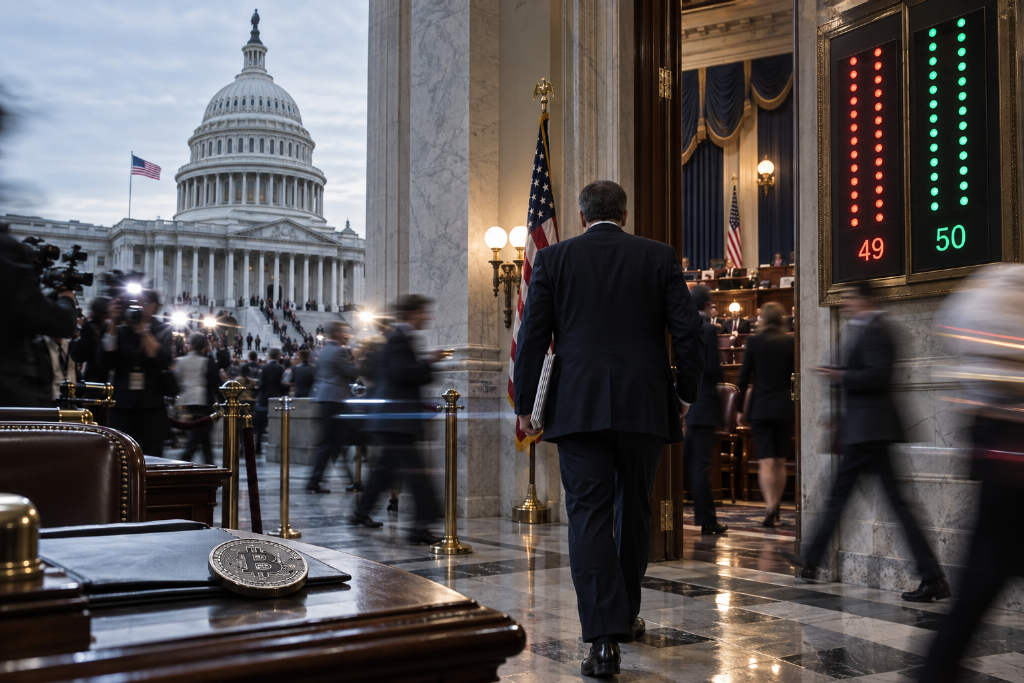
The U.S. Senate failed to advance the Digital Asset Market Structure Clarity Act, or CLARITY Act (H.R. 3633), after a cloture vote fell short on Sept. 15 at around 14:15 local time. Senators voted 49 in favor and 50 against, leaving the bill 11 votes short of the 60 required to move ahead.

The vote was the first direct setback for the measure on the Senate floor. The bill had passed the House in July 2025 by a 294-134 vote and cleared the Senate Banking Committee in May 2026 by 15-9.
Warren says the bill serves Trump’s crypto interests
Before the vote, Senator Elizabeth Warren of Massachusetts, who has led opposition to the bill in the Senate, delivered a forceful speech against it. Her argument centered less on technical market-structure design and more on conflicts of interest and political power.
Warren said the Trump family took in $1.4 billion from crypto businesses in 2025 alone, a figure she said exceeded that of any publicly listed U.S. crypto company. She also cited what she described as a string of administrative failures: a meme coin promoted before Trump took office that she said led retail investors to lose nearly $4 billion, the dismantling of the Justice Department’s crypto enforcement team, decisions not to prosecute several campaign-donor companies, and presidential pardons for multiple convicted executives.
“This is not a regulatory disagreement,” Warren said. “It is a case of a major financial beneficiary using the machinery of the state to write rules for his own private industry.”
She also attacked ethics revisions made by Republicans shortly before the vote, calling them a “get-out-of-jail-free card.” Warren said Attorney General Todd Blanche, who would be involved in enforcement, had publicly described himself as “Trump’s lawyer, not America’s lawyer.” She argued that the revised framework would allow White House regulators to waive potential violations through legal opinions and would leave Trump-linked holdings, including World Liberty Financial, with room to continue expanding.
“When the president himself can easily shut down an investigation into himself, any so-called detailed ethics provision is just a carefully designed legal back door,” she said.
Lummis says the bill already gave Democrats major concessions
On the other side was Senator Cynthia Lummis of Wyoming, the bill’s lead advocate in the Senate. In her final floor remarks, she reviewed a year of drafting and negotiation around the legislation.
Lummis said the text had grown from 300 pages to 635 pages because the drafting team had incorporated and converted 126 Democratic amendment requests into the bill. “This is a model of good-faith legislation,” she said, arguing that opponents were blocking a framework that should have drawn support across party lines.
To make the case that the measure was not purely partisan, Lummis pointed to the fact that 78 House Democrats voted for it. She also said the White House had accepted what she described as “the most restrictive self-limitations in history” on ethics matters, extending compliance restrictions to the president, vice president, federal judges, and their family members, while also giving direct enforcement authority to state attorneys general.
Still, the 635-page compromise did not survive the Senate’s polarized politics. The report said some conservative Republicans broke ranks on ideological grounds, while Democrats framed the fight as an anti-corruption test.
All 49 yes votes came from Republicans
The roll call showed a clean partisan split on the support side. All 49 votes in favor came from Republicans, with no Democrat or independent senator crossing over.
The 50 votes against included 46 Democrats, two independents — Angus King of Maine and Bernie Sanders of Vermont — and four Republicans: Susan Collins of Maine, Josh Hawley of Missouri, Jerry Moran of Kansas, and Thom Tillis of North Carolina.
Tillis changed his vote from yes to no during the vote. The report described that switch as a standard Senate procedural tactic designed to preserve the ability of supporters to file a Motion to Reconsider later. After the vote, Tillis formally submitted that motion as a member of the prevailing side, keeping open a technical path for another attempt.
The report also said Senator Chris Coons of Delaware was absent that day.
Time is running short this year
The vote did not completely shut the bill down on procedural grounds, but it sharply narrowed the time available for another push this year.
According to the report, the first remaining window is before the end of September. The Senate is set to enter its election recess in early October. To force another breakthrough before then, supporters would need to flip at least 11 senators within two weeks.
A second opening would come during the lame-duck session from November to December. Once the makeup of the next Congress is known, the Senate will enter the period before the new class takes office. The report said the bill could still have a last-minute chance if the two parties reach a compromise over White House ethics provisions during that period.
If both windows close without progress, the current committee approvals and accumulated legislative work would reset when the next Congress opens in January 2027, meaning the process would have to begin again from scratch.
