

Public mutual funds raised exposure to A-share hard-tech stocks to record levels in the second quarter of 2026, with electronics, telecom, the STAR Market and ChiNext emerging as the main destinations, according to UBS’s latest China equity strategy report.
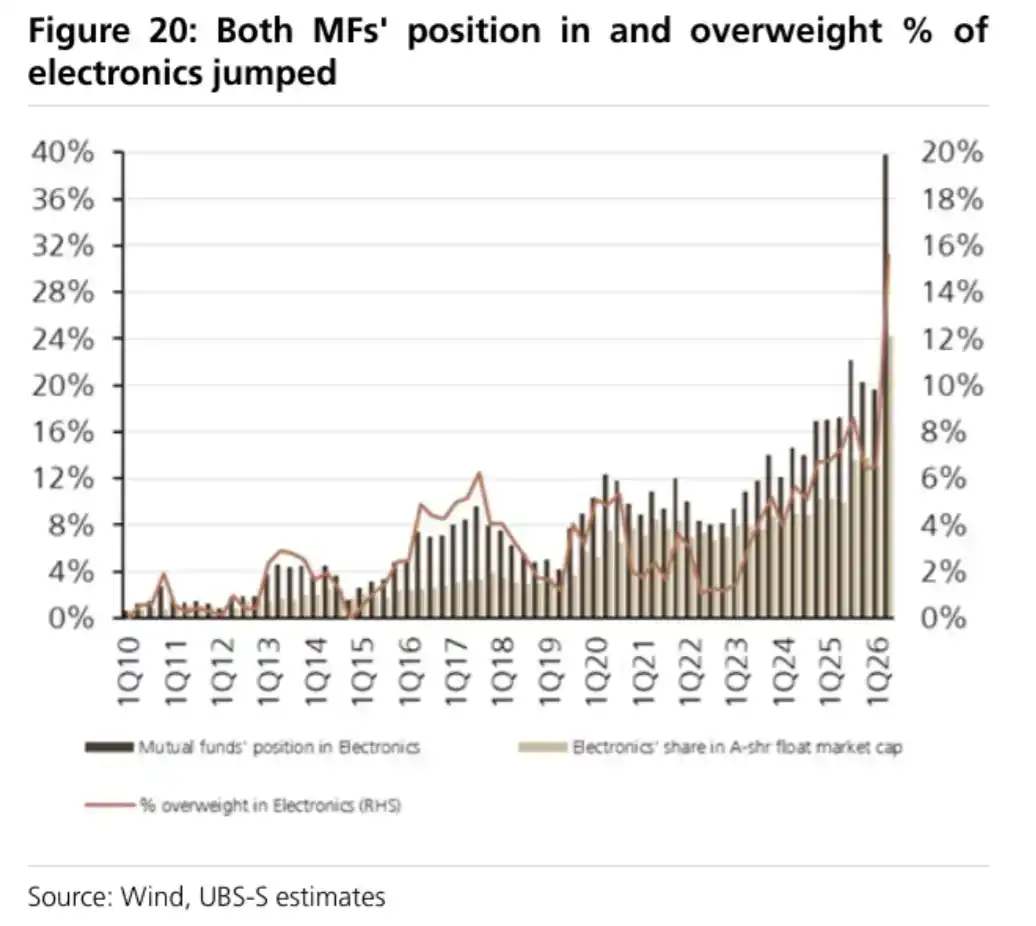
UBS said big tech — a basket that includes electronics, telecom, computers and defense — accounted for 57.3% of mutual fund holdings in the quarter. The sector’s overweight position reached 18.5%. Both figures were record highs. By UBS estimates, electronics exposure rose by 20.2 percentage points from the first quarter, making it the strongest area of buying in Q2. Telecom holdings increased by 4.4 percentage points, and machinery rose by 0.8 percentage points.
Electronics led the quarter’s reallocation
UBS said the shift in public-fund positioning was not a broad-based rise across all industries. Capital was concentrated in electronics and telecom.
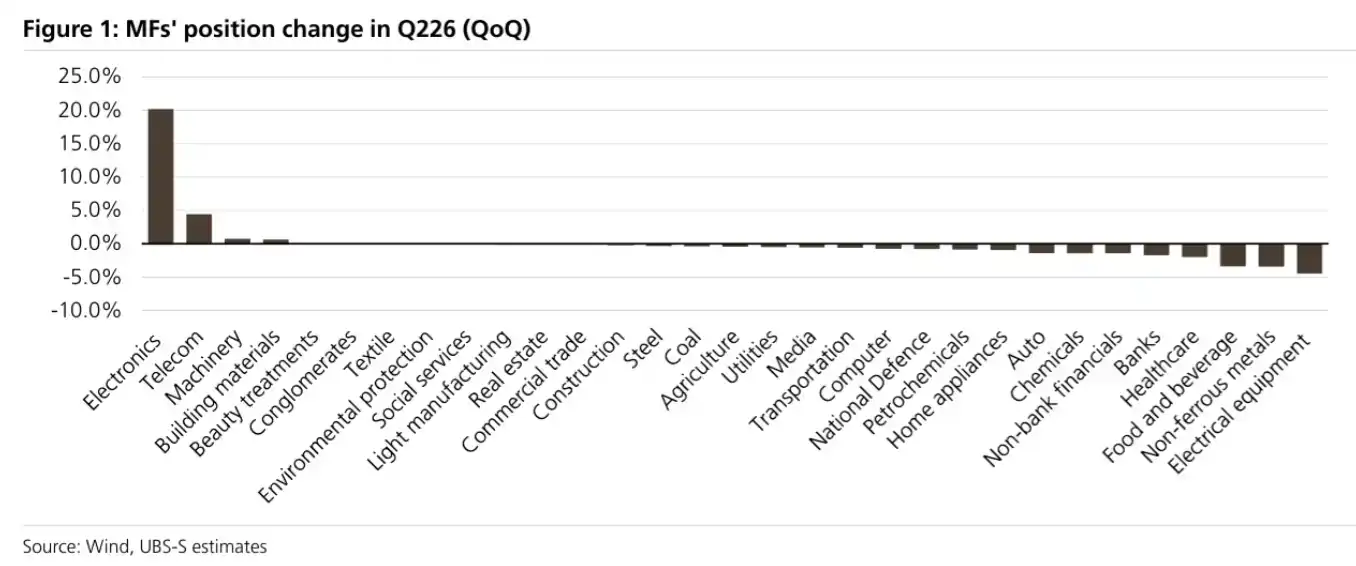
Holdings in electrical equipment, food and beverage, nonferrous metals, chemicals, defense and banks fell or continued to decline during the quarter. In the bank’s reading, traditional consumption and parts of the cyclical complex no longer formed the core of public-fund buying.
The scale of the move stood out. UBS said the 57.3% holding ratio and 18.5% overweight in big tech not only marked fresh highs, but also moved well above the peak allocations once seen in the consumer sector during its hottest period. The pattern points to a targeted preference inside A-shares: not broad technology exposure and not an indiscriminate bid for all growth stocks, but a heavier tilt toward assets linked to AI computing power, semiconductors, equipment and advanced manufacturing chains.
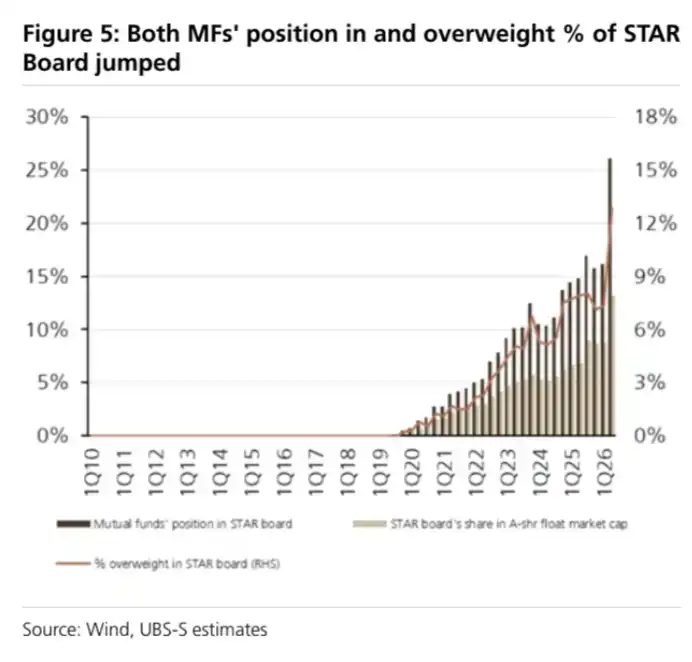
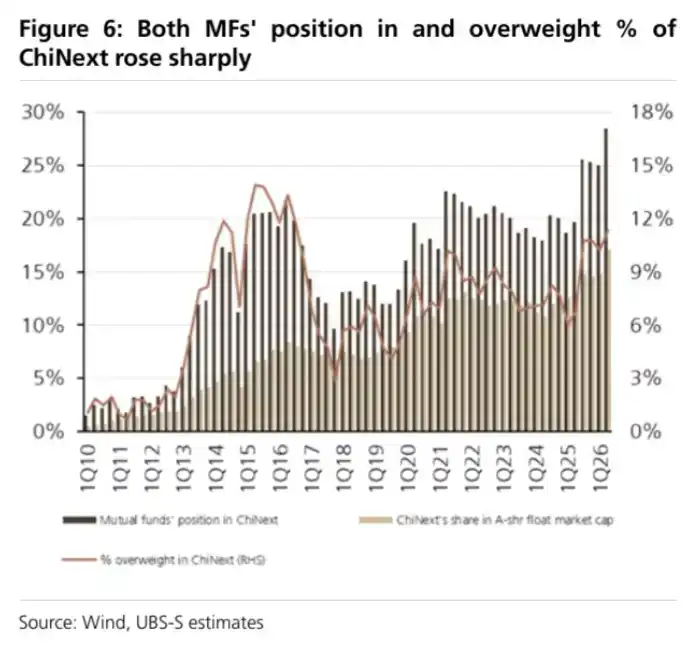
The shift was also visible in board-level allocations. Public funds increased holdings in the STAR Market by 9.9 percentage points in Q2 and lifted ChiNext exposure by 3.5 percentage points. Both hit record levels. UBS said that suggests capital is not only chasing a handful of sector leaders but also raising overall exposure to more volatile technology assets.
Technology-focused active funds also expanded
UBS said quarterly industry positioning alone does not fully explain the trend. The expansion of actively managed technology-focused funds shows that the shift has also been reflected in product structure.
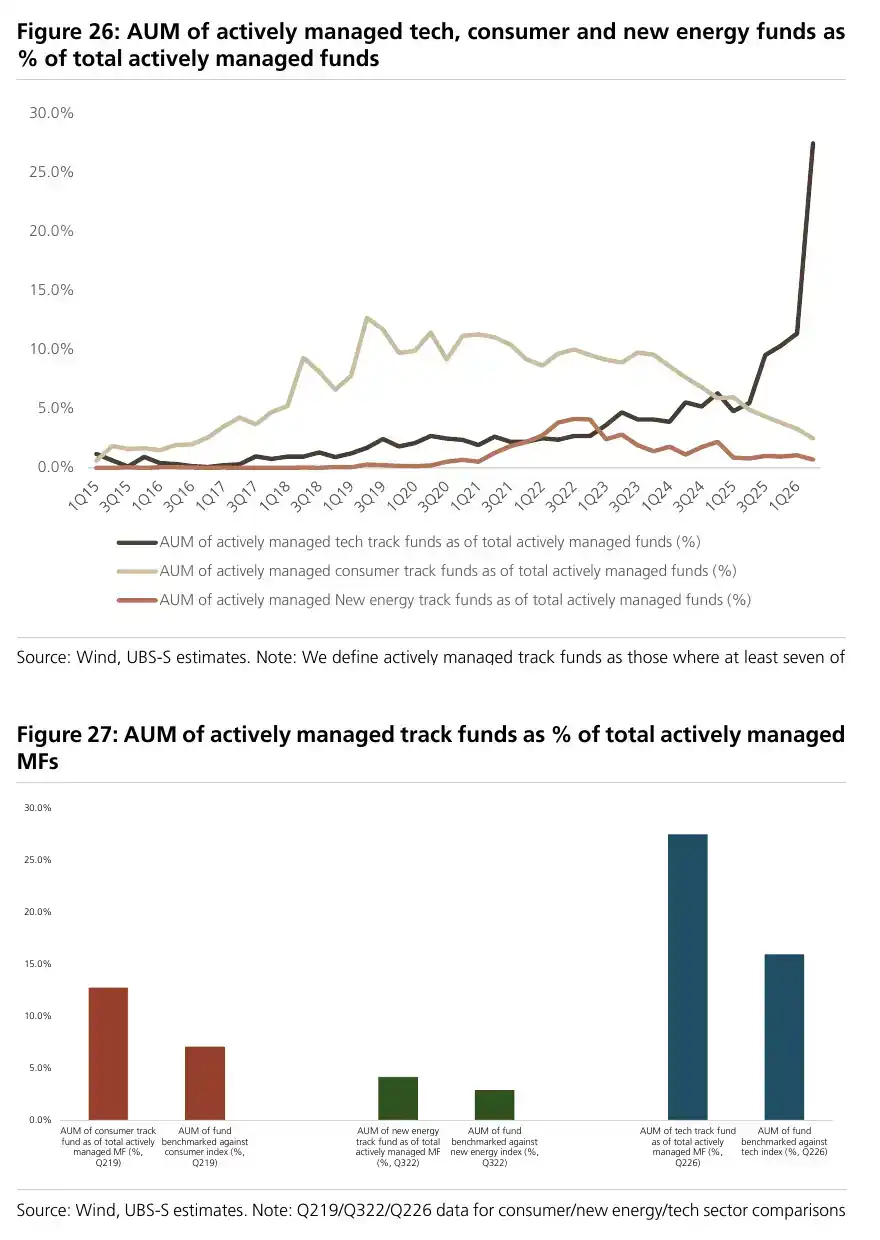
The bank defines such funds as active products whose top 10 holdings include at least seven technology-track stocks and whose combined weight exceeds 50%. On that basis, these funds now account for 27.5% of total actively managed public-fund AUM, another record high.
UBS said that share is clearly above the proportion for active funds tracking technology indexes and also above the relative popularity reached by consumer and new-energy themes at their peaks. More active managers are no longer treating technology as a small sleeve inside diversified portfolios. They are making it the central allocation.
The bank said the market impact cuts both ways. More money flowing into technology can strengthen liquidity in electronics, communications, AI infrastructure, semiconductor equipment and industrial technology supply chains. But with holdings and overweight positions already at historic highs, crowded trades are also more likely to become a source of short-term volatility.
Northbound inflows turned positive in Q2
Foreign capital flows added another layer to the hard-tech story.
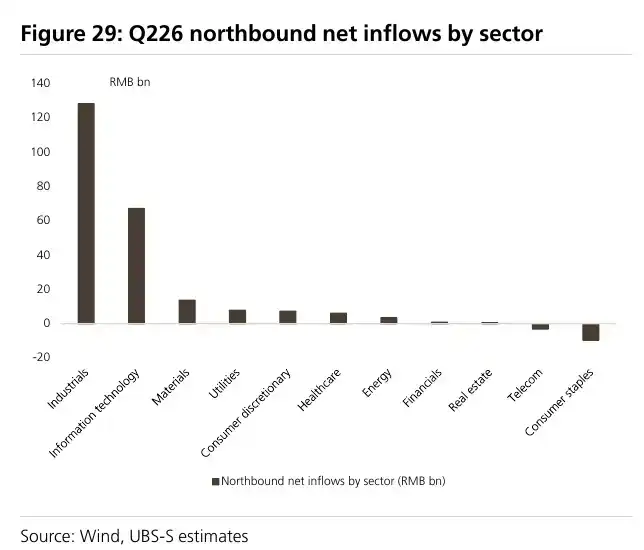
Public estimates cited in the report showed China Merchants Securities putting second-quarter northbound net inflows at about RMB 223 billion, while Guosen Securities estimated roughly RMB 219.3 billion. Both point to a shift from net outflows in the first quarter to clear inflows in Q2. The South China Morning Post, citing Choice data, reported that northbound holdings through Stock Connect reached RMB 3.13 trillion by the end of June 2026, a quarterly high since the program began.
Sector breakdowns differ by classification system. Public reporting more often uses frameworks such as Shenwan or CITIC, under which electrical equipment, electronics and machinery drew strong inflows. Under UBS’s own classification, industrials saw net buying of RMB 128.5 billion and IT drew RMB 67.2 billion, making them the main destinations.
Whichever classification is used, the direction was similar: foreign money returning in Q2 favored industrial technology, IT and advanced manufacturing. That broadly matched the domestic mutual-fund move into electronics, telecom and machinery, showing a much higher overlap between domestic and overseas positioning in hard tech.
Earnings revisions and policy support remain part of the case
UBS said investor concern in the A-share market has centered on how quickly technology stocks have risen, whether leverage became overheated and whether earnings delivery was strong enough. If both domestic and foreign capital continue to add hard-tech exposure while earnings expectations move higher, the debate may shift from whether fundamentals exist to whether the rally has gone too far too quickly.
The bank expects year-on-year earnings growth for the broad A-share market to recover from 3.9% in 2025 to 11% in 2026. UBS said that gives institutions a stronger basis for lifting exposure to technology and growth assets. In its view, money is moving into hard tech not only because of AI enthusiasm, but also because earnings expectations, industrial profit trends and policy direction are moving in the same direction.
The report also said AI, advanced manufacturing, domestic substitution and industrial upgrading remain key supports for Chinese technology assets over the longer term. Even so, a clear policy direction does not mean share prices will rise in a straight line in the short term.
Deleveraging may be nearing an end, but high positioning raises sensitivity
One of the main market concerns during the Q2 pullback in technology stocks was the retreat of leveraged funds. UBS said margin financing balances in the A-share market have already fallen quickly from their highs, and leverage in the technology segment is now broadly in line with the overall market. It also pointed to heavier turnover and large net inflows into CSI 300, ChiNext and STAR 50 ETFs as signs that the deleveraging phase may be approaching its end.
Still, UBS did not frame that as settled. Whether deleveraging has truly ended will depend on whether margin balances can remain stable and whether ETF inflows continue. If leveraged capital contracts again later on, or if global technology shares see another round of sharp volatility, A-share hard-tech stocks could still face pressure on both valuation and sentiment.
UBS stopped short of saying that the second-quarter reallocation had confirmed a full hard-tech bull market. Its view was narrower: capital has clearly shifted toward hard tech, but the very fact that holdings are already so elevated leaves the sector more exposed to external shocks, profit-taking and changes in financing conditions. Whether the trade can continue will depend on earnings upgrades, deleveraging progress and the durability of foreign inflows.