

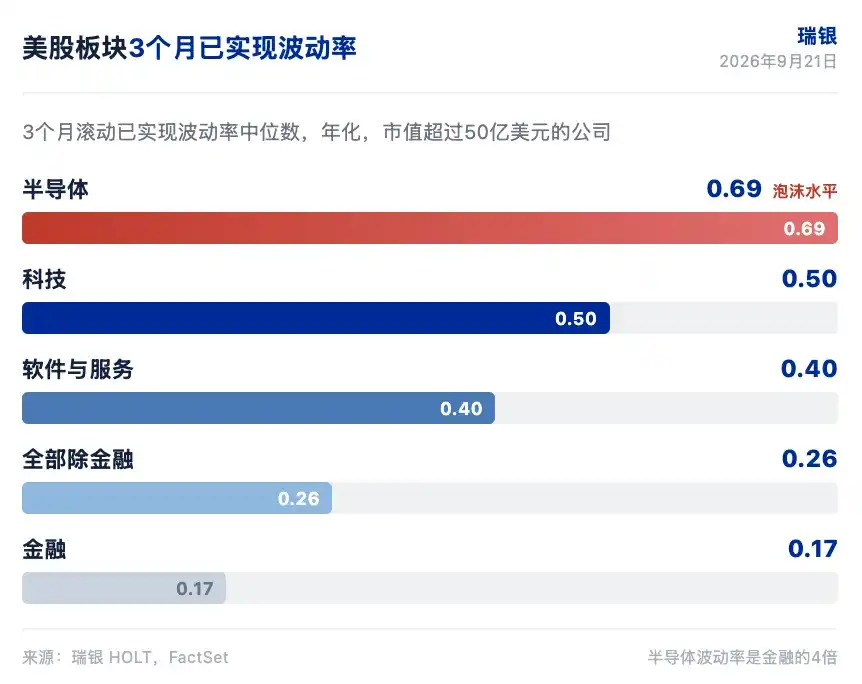
UBS said in its HOLT Global Review published on Sept. 21, 2026 that investors are still crowded into U.S. technology stocks, but volatility in the sector has risen to levels comparable to the internet bubble period. The bank reported a median 3-month rolling realized volatility of 0.69 for semiconductors, 0.5 for technology, and 0.4 for software and services. In a higher-rate setting, UBS said elevated capital spending by hyperscalers and the concentration of the U.S. equity market in technology have become key risks.
The bank’s central view is that the tailwind from loose monetary conditions has disappeared, leaving companies that rely on external financing under tighter scrutiny. UBS said U.S. technology and growth stocks carry the highest concentration and, in turn, the greatest risk. Value stocks, defensive sectors, and low-volatility equities each have limitations, it said, but their relative appeal is improving.
Tech volatility rises back toward bubble-era territory
Semiconductors stand out from the rest of the market. UBS said the median 3-month rolling realized volatility for financials was only 0.17, while the median for all sectors excluding financials was 0.26. Against that backdrop, technology at 0.5 and semiconductors at 0.69 point to growing doubts over the long-term earnings potential of AI-linked companies.
UBS also highlighted the scale of hyperscaler capital spending. It said that in 2015, hyperscaler capex accounted for less than 5% of total U.S. capital spending. By 2026, that share is expected to exceed 30%. In absolute terms, the figure has risen from less than $100 billion to more than $1.2 trillion. According to UBS, that surge creates downside risk through dilution of cash flow return on investment, or CFROI, and higher yields amplify that pressure.
CFROI is improving across regions, but U.S. valuations remain rate-sensitive
UBS said CFROI is improving in every region it tracks. North America has the highest forecast CFROI at about 12%. Emerging markets, Asia-Pacific excluding Japan, the UK, Europe excluding the UK, and Japan are all showing improvement as well. At the sector level, forecast CFROI for information technology, healthcare, financials, consumer staples, and communication services is above the 10-year median.
Once CFROI improvement is considered alongside price moves, valuation multiples have compressed. Emerging market indexes showed the strongest performance, but they also posted the largest 12-month forward improvement in CFROI. In the U.S. and Japan, price gains outpaced CFROI improvement, so valuation compression was relatively smaller. UBS said the U.S. market’s high valuation and heavy technology concentration leave it more sensitive to rising rates.
UBS sees better value opportunities in Europe and the UK
UBS said value stocks in the U.S. and Japan are no longer cheap relative to history, and forecast CFROI in those markets is often near cyclical peaks. Europe and the UK look more attractive on a relative basis.
Among European value stocks, UBS said companies with larger CFROI improvement include AstraZeneca, BNP Paribas, AXA, Prysmian, BASF, and Munich Re. The bank’s screen for European value names includes market capitalization above $5 billion, positive CFROI change, valuation ranking in the top 60%, valuation relative to history in the top 50%, and positive fixed-charge coverage.
For U.S. equity investors, UBS said this group can serve as a reference for reducing concentration in technology, though currency and liquidity differences across regions still need to be considered.

Defensive sectors have become cheaper
UBS said high-quality defensive sectors, especially consumer staples and healthcare, now trade at cheaper levels relative to history. These sectors still show high CFROI, but the valuation premium has disappeared.
The bank’s screen for quality names in consumer staples and healthcare includes UnitedHealth, Nestlé, Amgen, Novo Nordisk, AB InBev, Unilever, Colgate, Kimberly-Clark, General Mills, and Kroger. The criteria include market capitalization above $10 billion, quality ranking in the top 60%, momentum ranking in the top 40%, and HOLT price-to-book relative to history in the top 50%.
UBS added that investors still need to avoid companies facing structural pressure on the CFROI outlook. For U.S. stock investors, quality names in healthcare and consumer staples offer a direct way to reduce technology exposure.
Highly leveraged U.S. stocks face greater pressure as rates rise
UBS said companies with fixed-charge coverage below 1x face the highest risk in a rising-rate environment. Its U.S. screen includes Alphabet, Microsoft, Amazon, SpaceX, Tesla, Oracle, Blackstone, Cloudflare, Snowflake, and Air Products. UBS said these companies rely on external financing and maintain elevated capital spending, while fixed-charge coverage below 1x means operating cash flow is not enough to cover interest, lease payments, and other fixed expenses.
The bank also listed U.S. stocks facing CFROI headwinds and demanding valuations, including Microsoft, Berkshire Hathaway, Qualcomm, Northrop Grumman, Cencora, and Expedia. Microsoft appears on both lists. UBS said that overlap shows the company faces pressure from both valuation and cash flow structure as rates move higher.
UBS said that if inflation data continue to come in above expectations and force central banks to tighten policy further, the ability of concentrated U.S. technology leadership to keep supporting current valuations will be a key test of this cycle’s resilience.
This article is a整理与解读 of a third-party brokerage report by UBS dated Sept. 21, 2026 and public market information. The ratings, target prices, earnings forecasts, and related judgments cited in the source material are the views of UBS analysts and represent only the position of their institution. They do not constitute investment advice.
Markets carry risk, and investment decisions should be made independently. This article should not be used as the basis for buying or selling any security.