
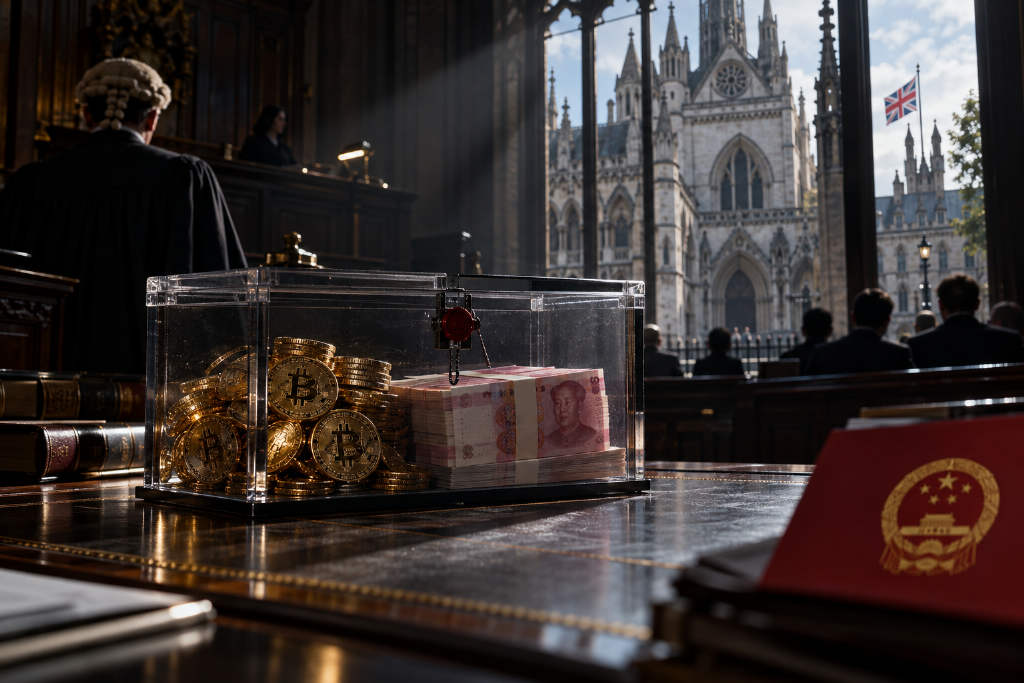
The High Court of England and Wales has ruled that Chinese law will govern whether Chinese victims can assert proprietary rights over more than 61,000 BTC tied to the money-laundering case against Qian Zhimin, according to an article by lawyer Liu Zhengyao republished by WuBlockchain.
The ruling was issued in the civil recovery proceedings over the seized Bitcoin in Director of Public Prosecutions v Qian and others. Liu wrote that the immediate practical effect may be that roughly 16,000 Chinese victims who joined the UK recovery process are more likely to recover their renminbi principal, and possibly interest, rather than benefit from Bitcoin’s price appreciation over the years.
What the UK court decided
The civil recovery case was brought by the Director of Public Prosecutions under Part 5 of the UK Proceeds of Crime Act 2002, or POCA. Under Section 281, a person who says the property subject to recovery “belongs to him” may apply to the court for a declaration. By the May 22 registration deadline this year, about 16,000 Chinese victims had filed claims through that process.
Liu said the latest judgment addressed only a preliminary issue: whether the victims’ claimed property rights should be determined under English law, Chinese law, or a combination of both. The court chose Chinese law. English law, however, still governs the civil recovery procedure and the statutory mechanisms around it.
The article stressed that some online descriptions of the ruling as a finding that “Bitcoin value should be calculated under Chinese law” are inaccurate. The court decided which law applies to the question of whether victims have proprietary rights in the seized Bitcoin. It did not directly decide how Bitcoin should be valued.
Liu separated two issues. One is whether Bitcoin has property value. The other is who owns this batch of Bitcoin as a matter of law. In China, the 2013 notice jointly issued by the People’s Bank of China and four other agencies classified Bitcoin as a “specific virtual commodity,” and Liu said that characterization has not changed. But that alone does not prove that Chinese victims automatically hold proprietary rights in Bitcoin purchased by Qian with illegally raised funds.
In his account, moving from a claim for repayment of invested funds to a claim that “this Bitcoin, or part of it, belongs to me” still requires a specific legal argument under Chinese law.
The article also said the presiding judge, Turner, held that the tracing provisions in POCA are used to identify what property law enforcement may recover. They do not create or enlarge third-party property rights. How Chinese law defines the relevant rights, and whether the applicants’ evidence can support their claims, will still need to be decided in later proceedings.
The judgment further stated that no evidence on the content of Chinese law had yet been submitted at this stage. So while the applicable law question has now been settled, there is still no final answer on whether victims can obtain the Bitcoin involved in Qian’s laundering case, or how much they could obtain.
How the 61,000-plus BTC entered the case
Tianjin Lantian Geri Electronic Technology Co., Ltd. was established in March 2014. Liu wrote that the company marketed products around elderly care, environmental development, and Bitcoin mining, and launched more than 10 wealth-management products including “Lantian No. 1.” It advertised zero risk and high returns, claiming annualized returns of as much as 300%. One of its slogans was: “Give Geri three years, and Geri will give you wealth for three lifetimes.”
According to the criminal judgment in the Lantian Geri case, the company illegally absorbed more than RMB 40.2 billion from the public between April 2014 and August 2017. All of the funds were controlled and used by Qian Zhimin, the actual controller. More than RMB 34.1 billion was eventually used to repay more than 120,000 fundraising participants.
At least RMB 1.14 billion of the money was used by Qian to buy Bitcoin.
When the Hedong branch of the Tianjin Public Security Bureau opened a criminal investigation into suspected illegal deposit-taking by Lantian Geri on April 21, 2017, Qian had already left China with a laptop containing an encrypted wallet. According to statements by UK prosecutors in court, she traveled through Myanmar, Thailand, Laos, and Malaysia, then flew to London on a Saint Kitts and Nevis passport under the alias “Zhang Yadi.” The laptop was later retrieved from Thailand by her London-based assistant, Jian Wen.
Once in the UK, the problem became how to convert Bitcoin into pounds sterling. In 2018, Qian and her assistant tried to use Bitcoin to buy a mansion in Hampstead, London, valued at GBP 23.5 million. The attempt drew police attention because the source of funds was unclear.
In late October and early November 2018, London police searched properties and safety deposit boxes linked to Qian and seized devices containing Bitcoin wallets. Authorities later confirmed that the devices held about 61,000 BTC.
Qian then disappeared again and was not arrested until April 2024 in York, England. On Sept. 29, 2025, she pleaded guilty at Southwark Crown Court to two money-laundering offenses: possessing criminal property and transferring criminal property. On Nov. 11 that year, she was sentenced to 11 years and 8 months in prison. Her assistant Jian Wen had already been sentenced in 2024 to 6 years and 8 months.
Liu highlighted another detail from court documents disclosed in the UK. Qian bought about 195,000 BTC in total, while police secured only about 61,000 BTC. She also claimed that she had lost the password to another wallet holding 20,000 BTC.
The criminal side of the UK case is largely settled. For Chinese investors, the central question remains whether they can get their money back.
What applying Chinese law could mean for investors
Liu’s conclusion was direct: the ruling is bad news for domestic investors who hoped to share in Bitcoin’s gains, but it may not be bad news for the larger group focused on recovering principal.
Claims to Bitcoin appreciation may be hard to sustain
The article said Chinese law follows a strict rule that no one may profit from illegal or criminal conduct. Once investors handed money to Lantian Geri, ownership of the cash transferred upon delivery. In Liu’s view, investors then held a claim for repayment against the company and Qian, something closer to a creditor’s right than a direct property right in the Bitcoin Qian later bought.
He tied that point to the way Chinese authorities handle illegal fundraising cases in practice. Under the Regulations on the Prevention and Disposal of Illegal Fundraising, the guiding approach is to recover illicit assets, reduce losses, and return funds on a proportional basis. The benchmark is the principal loss suffered by fundraising participants, while promised high returns are not protected. On that logic, even if a property-right claim under Chinese law were recognized, the claim would more likely be framed as “I invested this much and should be repaid this much,” not “the Bitcoin bought with my money is now worth this much.”
As for the appreciation in Bitcoin, Liu cited an earlier proposal from UK prosecutors reported by the Financial Times. Under that proposal, compensation for Chinese investors’ principal and interest would be sent to China and distributed through the existing domestic repayment mechanism, while the UK might retain a large share of the remaining Bitcoin, mainly the appreciation. Liu wrote that lawyers representing Chinese victims strongly opposed that proposal.
With the UK court now having settled the governing-law issue, Liu argued that the route under Section 281 of POCA for Chinese investors to take both the original property and the appreciation is, in practical terms, close to blocked.
If the focus is principal, the asset pool may be enough
The article then turned to the numbers. Based on the Tianjin court’s judgment in the Lantian Geri case, more than RMB 40.2 billion was illegally raised. After subtracting more than RMB 34.1 billion already returned, about RMB 6.1 billion remained unpaid on paper. Liu cautioned that this is an aggregate figure and that losses vary widely from person to person. Some early investors may even have received more than their principal.
He then compared that figure with the Bitcoin holdings. Qian’s purchase cost for the relevant Bitcoin was about RMB 1.14 billion, while the current value was put at about RMB 33.5 billion in the article. If the goal is only to repay principal to all domestic investors, Liu wrote that the seized Bitcoin would be more than sufficient.
He also referred to public reporting that the UK judge, during sentencing, said the assets already identified were enough to repay Chinese investors. If those assets can be returned to China, Liu argued, then even under China’s principal-based repayment approach the eventual recovery ratio would be far above the two earlier domestic repayment rounds of 5% and 8%.
The ruling also matters for victims who never registered in the UK
Liu pointed to another issue that can be overlooked. Of the 128,000 known victims in China, only about 16,000 registered in the UK, less than 13% of the total. If English law had allowed those UK-registered claimants to share in the appreciation while others without the ability to pursue cross-border claims, such as elderly victims or people with limited access to information, received something very different, the same case could have produced sharply unequal outcomes.
If Chinese law applies, Liu said, there may be fuller consideration of principal repayment for all investors. He added that this still depends on coordination and cooperation between Chinese and UK judicial authorities.
What Tianjin authorities have done
Drawing on public information, the article listed several steps taken by authorities in Tianjin.
- First, starting in 2022, the “Lantian Geri repayment working group” used a mini-program to register the investment amounts and losses of fundraising participants. In 2023, it opened supplementary registration twice. Based on recollections from some interviewed victims, two repayment rounds were made to registered participants between 2021 and 2022, at ratios of 5% and 8%.
- Second, on Oct. 30, 2025, the Hedong branch of the Tianjin Public Security Bureau issued a notice saying police were still working with UK law-enforcement authorities through international law-enforcement and judicial cooperation channels on cross-border fugitive pursuit and asset recovery. It also said police had not authorized any third-party institution to conduct cross-border recovery work and warned fundraising participants to be cautious about so-called cross-border recovery agents.
- Third, also in October 2025, the Hedong District Finance Bureau’s “Lantian Geri case repayment working group” issued an announcement to verify and confirm participants who had not yet completed registration. The verification period ran from Oct. 31 to Dec. 29, 2025, and the results would serve as the basis for repayment distributions.
- Fourth, on Oct. 13, 2026, Tianjin No. 2 Intermediate People’s Court announced that on Sept. 28 it had formally accepted an application from the Second Branch of the Tianjin People’s Procuratorate seeking confiscation of Qian Zhimin’s illegal gains. The assets targeted by prosecutors included more than 61,800 BTC seized by UK authorities and other assets. Prosecutors said the property constituted illegal gains and fruits, and that illegal gains, transformed property, converted property, and fruits should be recovered, with the portion lawfully returned to harmed fundraising participants excluded from confiscation.
Liu cautioned that the court’s acceptance of the confiscation application does not mean confiscation has already been ordered. It also does not mean the assets seized in the UK have already been confirmed for return to China. He said the next things to watch are the rulings from Tianjin No. 2 Intermediate People’s Court and the arrangements for judicial assistance and asset return between China and the UK.
Liu’s view on the likely path ahead
Putting the pieces together, Liu wrote that Chinese authorities appear to be following a sequence: first determine domestically who invested how much and how much each person lost, then recover the assets as a whole through state-to-state cooperation, and finally distribute them on a proportional basis. In his reading, the UK court’s ruling makes that domestic-channel route more likely.
If the room for victims to pursue individual proprietary claims in the UK is narrowed further, then the main route left for loss recovery may be judicial assistance and asset-return arrangements between China and the UK. The domestic registration data in China could then become the basis for any future compensation plan recognized by the UK side.
Liu wrote that the principal portion represented by the 61,000 BTC is likely to have a path back, and may even be enough to cover all unpaid principal owed to investors. The unresolved issue is the appreciation, worth more than RMB 20 billion according to the article’s framing. Whether that value remains in London or returns to China will depend not only on courts in either country, but also on diplomacy, international law, negotiations, and broader coordination.
He ended with four practical suggestions for investors:
- Those who have not completed registration should follow the official channels of Tianjin’s repayment working group and complete supplementary registration in time.
- Investors should keep contracts, receipts, transfer records, and rebate records, as these documents will be used to verify principal.
- Anyone claiming they can help recover Bitcoin appreciation through cross-border representation, especially if they are not lawyers, should be approached with caution, with close attention paid to fee structures and exit terms.
- Those who have already registered in the UK should confirm with their lawyers how the ruling affects their individual cases and how future costs will be shared.
Liu closed by noting that Bitcoin has risen nearly 100-fold since 2017, and many victims may naturally feel that if the coins were bought with their money, the gains should belong to them as well. He said that reaction is understandable on an emotional level. But based on the answer now emerging from the UK court, that outcome does not look promising. Under China’s long-standing approach to illegal fundraising cases, the focus remains repayment of principal and proportional distribution.
His judgment was that Lantian Geri investors are likely to recover a much higher share of principal than before, but are unlikely to share in Bitcoin’s appreciation. It is not a perfect result, he wrote, but it is still better than the widespread belief eight years ago that the money was gone for good.



