
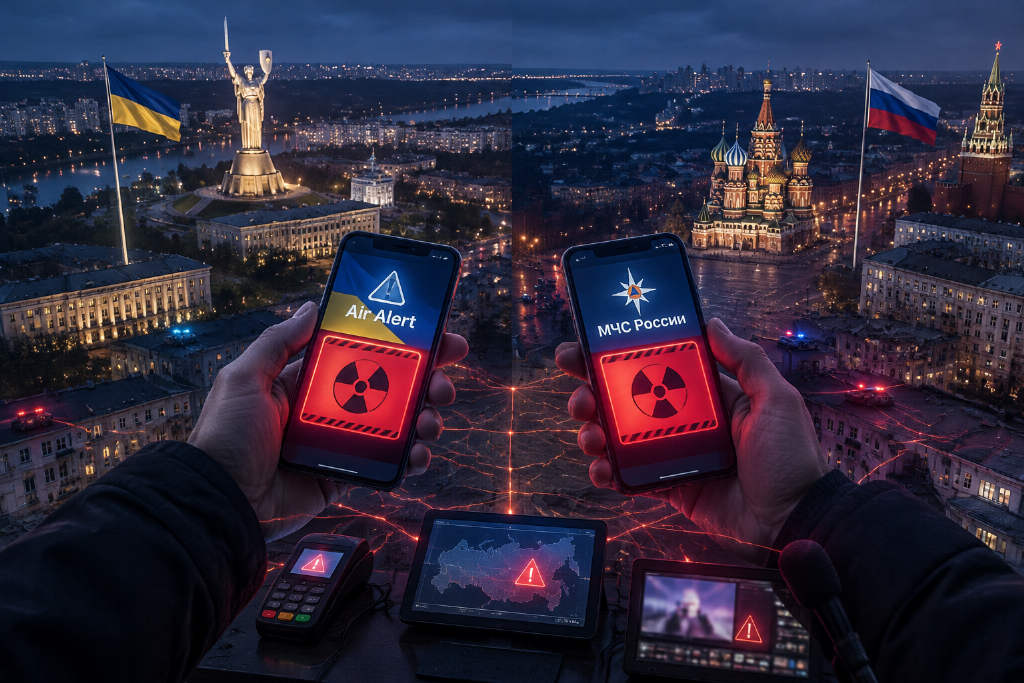
Emergency alert apps in Ukraine and Russia were compromised on the same night, sending false nuclear-related warnings to users in both countries.
In Ukraine, the Air Alert app began sending fake messages at 22:47 Kyiv time on Nov. 1. The messages mentioned radiation, chemical attacks and street fighting in Kyiv. One of them said, 「Hi! A nuclear alert will soon sound across all of Ukraine. Don’t worry, Oreshnik is on the way.」 Oreshnik is a Russian ballistic missile.
Volunteer map service alerts.in.ua said 122 fake alerts appeared within seven minutes.
About three hours later, Russia’s Emergencies Ministry app was hit as well. At about 02:45 Moscow time on Nov. 2, false messages were sent to 33 regions.
Ukraine disabled notifications and suspended the app
The Ukrainian Air Force said on Telegram at 23:02 that 「the Air Alert app may have been influenced by the enemy. There is no radiation threat.」
At 00:17, the app team said it had disabled push notifications and suspended the app. It also urged users not to click links inside the notifications. At 01:52, the team said service was being gradually restored.
Both sides said official alert systems were still functioning
Ukraine’s State Emergency Service said at midnight that the national alert system was operating normally. Air Force spokesperson Ihnat also said the app was only an auxiliary channel, did not belong to the Air Force, and had no effect on defense operations.
Russia’s Emergencies Ministry made a similar statement, saying the app was 「only an auxiliary information service」 and that sirens, SMS alerts and television broadcasts were functioning as usual.
False messages spread beyond the apps
The fake alerts did not remain inside the apps. After regional military administrations entered alerts into the system, other services automatically received the data through APIs.
According to Forbes Ukraine, the false messages also appeared in the EasyPay payment app and on alerts.in.ua.
On the Russian side, the fake messages also appeared in the ministry’s channel on the MAX messaging platform.
Authorities in Lviv region said that because of a malfunction in the Air Alert app, some terminal warning broadcast devices installed in the region played a 「radiation danger」 signal. The agency told residents to remain calm and said there was no actual radiation threat.
The bigger risk is damage to trust in real alerts
Because the fake messages were so implausible, many users on both sides treated them as a joke. One false message circulated in Russia said, 「Threat of unrest! Don’t worry! Across all regions of Russia ... nuclear warheads mounted on P1-SUN have been launched! Stock up on three weeks of food now.」 P1-SUN is in fact a Ukrainian interceptor drone.
The Associated Press said there were few visible signs of panic in Ukraine, with social media instead filling up with memes and AI-generated apocalyptic images.
The more serious issue is whether people stop trusting alerts altogether. When ballistic missiles are incoming, civilians often have only a few minutes to find shelter. A commentary by Speka said the outcome can go in two directions: users either panic, or they begin ignoring genuine warnings.
The report added that this incident did not lead to worse consequences partly because the content was too absurd. If the same level of access were used to target only one region and the message looked more believable, the result might not end as a meme.



