
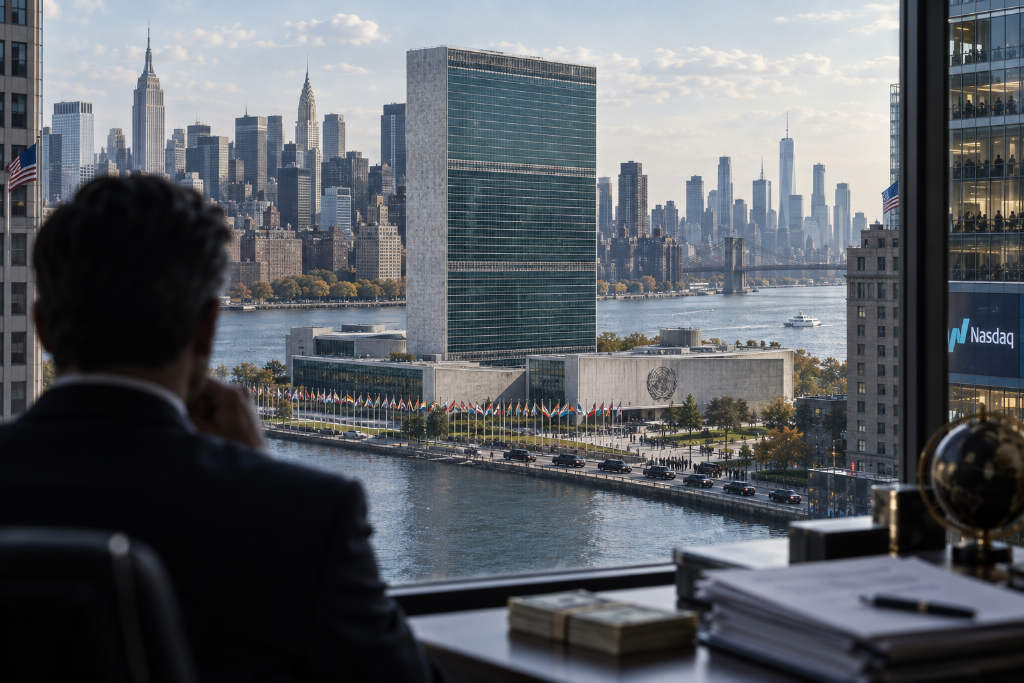
PANews said this week’s market setup is being shaped by four overlapping themes: geopolitical maneuvering ahead of the United Nations General Assembly, US-China trade talks in New York, a renewed repricing of Federal Reserve policy after last week’s rate hike, and continued momentum in AI-related trades.
On the final trading day of last week, US equities held up only narrowly under pressure from high rates and roughly $7 trillion in “triple witching” derivatives expiry. The Dow Jones Industrial Average fell 0.18% and lost 1.69% for the week. The Nasdaq gained 0.39% on the day and rose 0.72% for the week. The S&P 500 added 0.17% on the day and slipped 0.08% over the week.
Geopolitics before the UN gathering
Iranian Foreign Minister Araghchi has departed for New York to attend the 81st session of the United Nations General Assembly and is set to stop in Doha for consultations on the way. Qatar’s foreign ministry said several US officials want an agreement with Iran to end the conflict, and that Doha is working to bridge differences. Donald Trump said the Iran issue is at a “decision stage” and that “very significant things” may happen, while also saying he is open to contact with Iranian President Pezeshkian.
After Houthi attacks expanded to Aramco facilities in Riyadh and Yanbu, Washington and Tehran again exchanged harsh rhetoric. US military officials clarified that they would not launch “offensive strikes” on the Houthis and would provide intelligence support only. The Strait of Hormuz has still not returned to normal operations. Qatar’s energy minister also rejected US Treasury Secretary Bessent’s view that the strait could lose strategic value in two years, saying LNG and bulk commodity transport cannot be fully replaced by pipelines.
Oil prices pulled back sharply, with WTI near $93 and Brent below $98. Diesel prices, however, kept rising and reached fresh record highs near $6.5 a gallon.
US-China talks open in New York
US-China economic and trade consultations have formally started in New York. Vice Premier He Lifeng is leading the Chinese delegation in talks with US Treasury Secretary Bessent and US Trade Representative Greer. The two sides also held discussions on artificial intelligence. According to the report, the talks are guided by consensus reached by the two heads of state and are focused on prior understandings as well as bilateral trade and investment.
PANews described the overlap between the talks and the UN gathering as the biggest unscheduled market variable of the week.
Fed repricing and a heavier bill supply outlook
The Federal Reserve last week raised rates by 25 basis points for the first time since 2023, taking the target range to 3.75%-4.00%. Hawkish commentary followed. Minneapolis Fed President Neel Kashkari said on Sunday that inflation has spread across multiple parts of the economy, especially services, and remains too high even after excluding energy and food. Kansas City Fed President Schmid also backed further tightening, saying inflation is not just an oil story.
CME data now show the probability of another rate hike in October above 55%. Goldman Sachs and Bank of America have both revised expectations toward another move in October. Goldman strategists said market pricing for roughly four cumulative hikes looks “clearly too much,” and that two is more likely. They added that a meaningful drop in oil prices could open a window for a broad rally across assets.
Wall Street banks are also betting that net US short-term Treasury issuance over the next year will approach or exceed $1 trillion. Bank of America expects $1.07 trillion, JPMorgan sees $1.09 trillion, and Goldman Sachs projects $961 billion. The share of outstanding short-dated debt is expected to rise to 24.3%-24.9%, near pandemic highs and well above the official guideline of about 20%.
Mark Cabana, head of US rates strategy at Bank of America, warned that large-scale bill issuance would make interest expense “larger and more volatile.” The president of the Committee for a Responsible Federal Budget said refinancing risk is rising sharply. At the same time, the 10-year Treasury yield touched 5% on Friday, while the 2-year yield climbed to around 4.76%, a multi-year high. Average global sovereign yields also reached 5%, the highest level since 2002.
The report said Bessent is trying to cap the long end through expanded long-bond buybacks while still relying on bills to meet record funding needs, a mix that markets are questioning.
Asian holiday calendar tightens liquidity
Liquidity in Asia is set to thin out this week. Japanese markets are closed for three straight days starting Monday. Mainland China’s A-share market will be closed on Sept. 25 for Mid-Autumn Festival. South Korean equities will also be shut on Sept. 24-25 for the same holiday.
Semiconductor and AI positioning stays hot
Chip stocks led on Friday, with the Philadelphia Semiconductor Index up nearly 2.8%. Memory and optical communications names stood out. The market also saw reports of nearly $96 million in short-dated bullish options flowing into SanDisk, Micron, Intel and Marvell. CNBC host Jim Cramer said “Leopold is back,” suggesting Situational Awareness founder Aschenbrenner may be rebuilding positions. Nomura’s Charlie McElligott cautioned that rising stock prices alongside rising option prices can also signal a more crowded trade.
UBS added to the momentum with a new estimate that global AI capital spending will approach $1 trillion in 2026 and rise to about $1.4 trillion in 2027. Nearly 90% of the increase, the bank said, would come from sharply higher memory costs. Memory’s share of total AI spending is projected to jump from 14% to 64%. UBS said the AI spending cycle is still in its early stages and named Amazon, Texas Instruments and Palantir among its preferred picks.
Nvidia CEO Jensen Huang again pushed back on AI doomsday arguments, saying the probability of AI destroying the world before 2030 is zero and that the industry should move faster, not slower, while keeping safety boundaries in place. Trump said he would form an “AI force” and appoint a leader for it, adding that AI could account for 25% of US GDP and that he would not tolerate obstacles to the industry’s development.
Nasdaq-100 rebalance and stock moves
The Nasdaq-100 quarterly rebalance takes effect before Monday’s open. SpaceX’s weight will rise from about 1.28% to 2.82%, according to the report. Passive money tracking the index, including the more than $480 billion QQQ, will have to buy accordingly, which could narrow the gap between the company’s market value and index weight.
Even so, SpaceX fell 1.36% on Friday. The report also said Elon Musk traveled to Memphis and is staying in a trailer on site to oversee construction of xAI’s flagship Colossus supercomputer infrastructure.
- SanDisk rose 10.99% and Micron gained 3.92%. PANews said SanDisk was lifted by concentrated buying in about $41 million of call options with a 1600 strike price, along with support from its inclusion in the S&P 100. The broader memory complex also moved higher: the Roundhill Memory ETF (DRAM) rose 3.17%, Seagate gained 6.93%, Western Digital added 4.13%, and SK Hynix rose 2.46%.
- Lam Research and Applied Materials each climbed nearly 7%. JPMorgan said order visibility for ASIC/XPU and advanced memory has extended to 2027. In semiconductor equipment and foundry names, ARM rose 4.04%, ASML gained 3.08%, and AMD added 2.70%. The report said AMD has sent letters to customers raising prices for AI and consumer GPU chips by 10%. TSMC rose more than 1%, while Intel slipped 0.18%.
- Strategy jumped 16.39% as Bitcoin rose 5.9% to around $81,000, amplifying the equity sensitivity of companies holding BTC. Related names also rallied, with MARA up nearly 14%, Coinbase up nearly 12%, and Robinhood up more than 9%.
- Alibaba gained 4.33%, supported by expectations around the trade talks and the Apsara Conference. PDD rose 1.51%, JD.com added 1.05%, and the Nasdaq Golden Dragon China Index gained 0.76%.
- Netflix fell 4.67% and Xenon Pharmaceuticals dropped 30.7%. Wells Fargo cut Netflix to a lower rating over audience concerns and reduced its price target from $80 to $57. Xenon paused enrollment in a related study because of clinical side effects. Disney fell more than 2%, and a biotech ETF lost 1.21%.
- Within the Mag 7 group, Nvidia rose 1.34%, Amazon gained 1.00%, and Google added 0.64%, while Apple fell 0.26%, Tesla lost 0.53%, Microsoft slipped 0.80%, and Meta dropped 2.43%.
After-hours focus
Accenture rose more than 7% in after-hours trading after partnering with Anthropic on independent safety assessments for AI models. The report said Anthropic is targeting annualized revenue of $100 billion and could list as early as November.
Greenland-linked names also surged. Greenland Energy jumped more than 100% after hours, Greenland Mines rose 58%, and Critical Metals was at one point up 40%. The move followed Trump’s announcement of a security agreement with Denmark and Greenland, which the market interpreted as support for resource projects through a larger US presence.
WBD and PSKY both rose more than 5% after reports that merger talks had entered a late-stage settlement phase. Most chip names also traded higher after hours, with Intel and Arm up more than 3%.
What markets are watching this week
Monday, Sept. 21
- Japan is closed from Sept. 21 to Sept. 23, reducing liquidity in Asian hours and potentially amplifying FX and cross-market hedging swings alongside expectations of yen intervention.
- US-China trade talks continue from Sept. 19 to Sept. 23. Markets are watching for any concrete arrangements on tariffs, technology restrictions and investment access.
- At 16:00, the Nasdaq-100 and S&P index quarterly changes take effect. SpaceX rises from 1.28% to 2.82% in the Nasdaq-100. The S&P 100 adds Palo Alto Networks, Arista Networks, SanDisk and Dell. The S&P 500 adds Bloom Energy and Illumina.
- The AICC Artificial Intelligence Computing Conference and the Shanghai AI Application Ecosystem Conference are scheduled, with the latter running Sept. 21-22.
- Trump is set to deliver a Republican fundraising speech in New York, with markets focused on any comments on tariffs, AI, fiscal policy and energy.
- Novo Nordisk holds an investor day, with attention on drug development, M&A and plans to reduce dependence on weight-loss drugs.
Tuesday, Sept. 22
- The UN General Assembly general debate begins, and Trump is expected to speak. Markets will watch whether the US and Iran make contact and whether talks can resume, with implications for oil, gold and safe-haven assets.
- Trump is also expected to meet representatives from Gulf states including Saudi Arabia, the UAE, Qatar, Bahrain, Kuwait and Oman, with focus on energy infrastructure security and shipping through the Strait of Hormuz and Bab el-Mandeb.
- He is also expected to meet Volodymyr Zelensky and Sanae Takaichi, though final timing has not been confirmed.
- Stanley Druckenmiller is expected to visit South Korea. Markets will watch whether talks with Samsung, SK Hynix and Doosan lead to investment arrangements.
- Alibaba’s Apsara Conference runs Sept. 22-24, with attention on models, agents, Agentic Cloud and the company’s “five-layer full stack” announcements.
- The GMIF Global Memory Industry Innovation Summit runs Sept. 22-23, focusing on HBM, DRAM, NAND supply-demand trends and expansion plans.
- Apple’s new Mac mini and Mac Studio go on sale, with investors watching deliveries, inventory and demand for higher-end models.
- SpaceX’s 14th Starship test flight is tentatively scheduled. Materials cited in the report say the mission may involve a first orbital attempt, though the company has yet to confirm the exact window and objectives.
- A $69 billion 2-year Treasury auction is due, with demand and stop-out yield in focus.
Wednesday, Sept. 23
- Iranian President Pezeshkian is expected to speak at the UN, with markets watching his conditions for talks, ceasefire guarantees and any arrangement on reopening the strait.
- Meta Connect runs Sept. 23-24, with focus on smart glasses, XR devices and AI features.
- Qualcomm’s Snapdragon Summit runs Sept. 23-25 Beijing time, with attention on a 2-nanometer Snapdragon launch, power efficiency improvements and customer adoption.
- A $70 billion 5-year Treasury auction will test market views on the future rate path.
Thursday, Sept. 24
- South Korea’s stock market is closed Sept. 24-25. If major memory-sector news breaks, price action may show up more clearly in other markets first.
- A $44 billion 7-year Treasury auction is scheduled as the final key test in the week’s auction cycle.
- China’s domestic refined oil pricing window opens, with attention on how higher international energy prices feed into transport, logistics and manufacturing costs.
Friday, Sept. 25
- Mainland China’s A-share market is closed for Mid-Autumn Festival. Thinner pre-holiday turnover and accumulated overseas headlines could raise the risk of a gap move when trading resumes.