
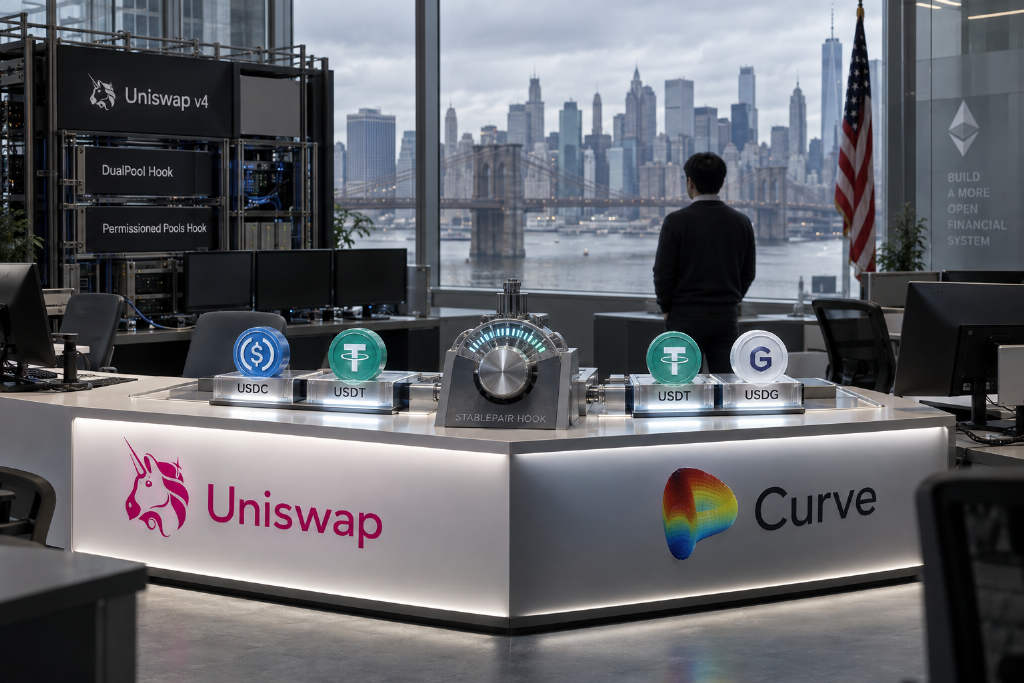
Uniswap is pushing deeper into stablecoin market structure, not just by matching trades but by building a broader stack around market making, capital efficiency, and compliance access.
On Sept. 10, Uniswap Labs rolled out StablePair Hook, the third official hook for Uniswap v4 and its first upgradeable dynamic-fee hook. The first deployments went live on Ethereum mainnet in USDC/USDG and USDC/USDT pools. The core change is simple: fees are no longer fixed. They now move in real time as a function of price deviation.
Placed in the wider battle for stablecoin DEX flow, the product looks much bigger than a routine iteration. In the article’s framing, it is a direct attempt to challenge Curve’s five-year hold over stablecoin trading by changing the economics of the pool rather than relying on liquidity subsidies.
A $43.4 billion stablecoin trading arena
Stablecoin swaps are one of DeFi’s biggest businesses, but also one of its least glamorous. When two tokens both track the U.S. dollar, spreads are usually tiny, often only a few basis points. Over time, that has produced a familiar split: arbitrage bots capture the best part of the trade, while liquidity providers collect a fixed fee and absorb the rest.
Uniswap cited data showing that stablecoin-to-stablecoin trading alone reached $43.4 billion in the second quarter of 2026, more than the combined volume of the second-, third-, and fourth-ranked on-chain exchanges. Over the past 30 days, total platform volume on Uniswap reached $70.6 billion, with Robinhood Chain contributing about $26 billion and Ethereum about $23 billion.
The article also points to total stablecoin circulation above $314 billion. On that view, stablecoins are no longer just quote assets inside trading pairs. They function as part of the payment rails underlying global digital finance.
That rail has a built-in weakness. In a stablecoin pool, both assets should trade at roughly the same value. When prices move slightly in external venues, whether centralized exchanges or OTC markets, the pool can drift from the so-called true exchange rate. Arbitrage bots then move quickly, buy the underpriced token from the pool, sell it elsewhere, and pocket the spread. The cycle can play out within seconds. LPs lose inventory value and receive only the fixed fee in return.
Academics refer to this as LVR, or loss-versus-rebalancing. In plain terms, the article says, LPs become the source of profits for arbitrageurs.
Traditional AMMs have had only one basic control for this problem: the fee level. Set it too low and arbitrageurs take most of the spread. Set it too high and ordinary traders leave because execution gets worse. Stablecoin pools have lived with that tradeoff for years.
How StablePair Hook changes pricing
StablePair Hook replaces the fixed-fee model with a dynamic one. The article describes it as a three-speed fee engine.
Mode one: fixed quoting in a narrow range
When the pool price stays within a tight band around a reference price, fees adjust automatically to maintain a constant bid/ask spread. For regular traders, that means more stable and predictable quotes, even when the broader market moves slightly.
Mode two: direction-based pricing after deviation
Once the pool moves outside the reference range, the fee logic changes. If a trade pushes the price even farther away from the reference point, making the pool more unbalanced, the fee falls to zero. The article notes that this is not a subsidy. The trader is already transacting at an unfavorable price, so the pool is effectively receiving a better quote and does not need to add an extra fee.
Mode three: a Dutch auction on reversion
The most important part comes when a trader wants to bring the price back toward the reference level, which is the classic arbitrage case. At that point, the system launches a Dutch auction. Fees start from a high initial level and decline block by block until an arbitrageur decides the remaining spread is attractive enough to execute.
The key idea is that LPs retain the gap between the starting fee and the fee level the arbitrageur is ultimately willing to accept. According to the article, that value historically went almost entirely to bots.
Part of a broader Uniswap v4 hook strategy
StablePair Hook does not stand alone. It is the third official hook released for Uniswap v4, and the first two help show the broader direction.
- DualPool Hook, launched in July with Spark, addresses idle LP capital. Stablecoin liquidity not being used for trading can be moved automatically into ERC-4626 yield vaults to earn lending income, then pulled back out when trades arrive. The article says Spark migrated $150 million in stablecoin liquidity to Uniswap v4 for this design, one of the largest single AMM liquidity migrations in DeFi history.
- Permissioned Pools Hook, built with Superstate, Securitize, and Dowgo, is aimed at compliant assets such as tokenized funds. It enforces issuer rules at the AMM layer so that each trade goes through permission checks.
- StablePair Hook focuses on how arbitrage value gets distributed in stablecoin pools.
Taken together, the three hooks form a modular on-chain market-making framework. DualPool adds lending yield on top of trading fees. StablePair seeks to redirect part of arbitrage value back to LPs in the exact area where they are usually most exposed. Permissioned Pools opens the same liquidity engine to compliant asset issuers and institutional users.
The article’s reading is that Uniswap v4 is being built to attract stablecoin issuers and institutional LPs, giving them reasons to deploy capital there instead of on Curve or inside their own closed systems.
A direct challenge to Curve
Curve has long held the throne in stablecoin DEX trading. Its StableSwap model was built for near-par assets and, according to the article, typically delivers 5 to 15 basis points lower slippage than Uniswap v3 on large trades. Even after concentrated liquidity improvements in Uniswap v4, Curve remains the preferred venue for stablecoin trades above $250,000, the article says.
StablePair Hook is not trying to beat Curve by reopening the math debate around pool curves. It is going after the economics instead.
Curve’s edge has come from two layers: low-slippage execution through StableSwap and liquidity incentives through the veCRV governance system, the dynamic once known as the Curve Wars. The article argues that the second layer no longer carries the same force it did three years ago.
Uniswap’s approach starts with LP revenue. If LPs on Uniswap v4 can recover part of the value that arbitrage bots used to extract through dynamic fees, while also earning lending yield during idle periods through DualPool, the case for remaining on Curve based mainly on CRV emissions becomes weaker.
One data point in the article stands out. Curve’s USDC/USDT pool has roughly $5 million in TVL, while comparable V3 and V4 pools on Uniswap total about $37 million. Even so, Curve generates about 75% of Uniswap’s volume with that much smaller liquidity base, which suggests materially higher capital efficiency per dollar of liquidity.
StablePair Hook is designed to pressure both sides of the market at once. For traders, it aims to deliver predictable quotes. For LPs, it uses the Dutch auction structure to keep more arbitrage value inside the pool. If both parts work, the article says, Uniswap will not need to compete with Curve by simply spending more. It can compete with better economics.
Why upgradeability matters
Another point the article highlights is upgradeability. StablePair Hook is the first dynamic-fee hook from Uniswap Labs that can be upgraded.
That means pool parameters and fee logic can be updated through Uniswap governance without forcing LPs to migrate liquidity into a new pool. The article presents this as a real pain point in DeFi. Every protocol upgrade can require users to move positions, pay gas, and spend time resetting capital.
With an upgradeable design, StablePair Hook becomes a system that can keep adapting. If the initial parameters prove suboptimal, governance can revise them. If market structure changes, fee logic can change with it. The article contrasts this with Curve’s design, where pool parameters are fixed at creation and changes often require a new pool.
USDG and the first-pool signal
The choice of launch pools also carries weight. USDC/USDT represents the largest existing stablecoin trading pair. USDC/USDG points toward a newer class of stablecoins trying to build distribution.
USDG is Paxos’s Global Dollar, launched in November 2024 and regulated by the Monetary Authority of Singapore, or MAS. The article lists Robinhood, Kraken, Galaxy Digital, Anchorage Digital, Mastercard, and Nuvei as founding members of the Global Dollar Network. USDG’s market capitalization currently stands at about $3.4 billion, up from $2.6 billion over the prior 90 days.
Its economic model is what makes it stand out in this telling. Paxos shares reserve interest income with partners that help drive adoption, instead of keeping the full amount, as the article says Circle does. That arrangement is attracting large exchanges and fintech firms to promote USDG.
By putting USDG into the first wave of StablePair Hook pools, Uniswap is sending a wider signal. The stablecoin market is shifting from a USDC-USDT duopoly toward a more competitive structure with more entrants. Those newer stablecoins need on-chain liquidity infrastructure to build depth, and Uniswap v4’s hook system offers customizable market-making logic for exactly that purpose.
The article ends on a broader claim: the larger story may not be StablePair Hook on its own, but Uniswap’s attempt to become an on-chain Nasdaq for the next generation of stablecoins, offering not just execution but a full infrastructure stack around market making, capital efficiency, and compliant access.