


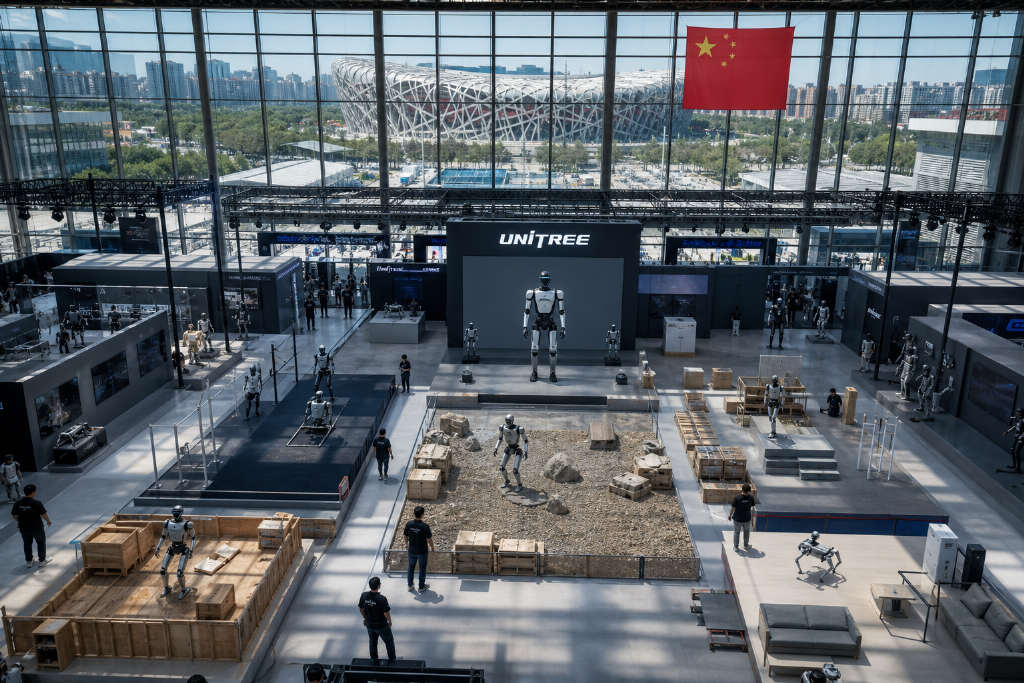
Unitree founder Wang Xingxing said embodied AI has not reached its “ChatGPT moment” yet, pushing back against some of the excitement surrounding humanoid robots.
Speaking on Aug. 20 at the 2026 World Robot Conference, Wang said in his first public speech after Unitree’s listing that the turning point could still be two to three years away at the fastest, or five to 10 years away on a slower timeline.
Humanoid robots have become one of the hottest technology products over the past two years. They have appeared on gala stages, at game company exhibitions, and at the entrances of malls and retail stores. The machines dance, walk, wave, and shake hands with visitors, moving quickly from labs into public view.
But public displays have not settled the harder question. Their actual capabilities still fall well short of what many people imagine when they think about future robots. The expectation is not limited to stage performances or marketing roles. The real test is whether robots can enter factories and homes to carry, sort, use tools, or take on some household and care work. The question has remained the same: when will robots really be able to work?
In large language models, ChatGPT offered a clear reference point. It was not the first language model, but it was the first to make a broad group of ordinary users feel that AI had crossed a meaningful capability threshold. The robotics sector is now asking when a similar shift might appear in embodied intelligence.
Wang Xingxing points to generalization in unfamiliar settings
At the conference, Wang said the biggest bottleneck for embodied AI remains a familiar one inside the industry: generalization.
He said many robot models can already push task success rates close to 100% in fixed environments after enough data collection and training. Once the object being handled changes, or the environment shifts even slightly, those success rates can drop in a visible way.
That gap, in his view, is the main barrier keeping robots from entering everyday life and homes at scale.
Wang offered a concrete benchmark. If a robot can be taken into a completely unfamiliar home or environment and complete about 80% of tasks using only voice or language instructions, then embodied AI would be close to its own “ChatGPT moment.” On timing, he said that could take another two to three years at the fast end, or five years and even 10 years on the slow end.
He stressed that the hardest part is not getting a robot to roughly understand what to do. The real difficulty lies in the last few centimeters, or even the last few millimeters.
He gave a simple example. A model may correctly plan the full motion needed to pick up an object, and the robotic arm may move into position near it. But if the final position error is not corrected properly, or the tactile feedback or gripping force is off, the whole task can fail.
This is one of the clearest differences from large language models. Inputs and outputs for language models stay in digital space. A robot, by contrast, has to sense and act in the physical world every time. Sensors introduce noise. Actuators introduce error. The position, material, and weight of objects can change. Those errors can accumulate during task execution. For embodied AI, moving from “basically able to do it” to “reliably doing it right” may be harder than learning the task in the first place.
Galaxy General’s Wang He puts the milestone in 2028
At nearly the same time, Galaxy General founder and CTO Wang He offered a more specific date.
He said embodied AI is expected to hit its “ChatGPT moment” in 2028 as data keeps accumulating and technical breakthroughs continue. His definition is that robots should be able to complete about 70% to 80% of daily tasks without task-specific training for any one assignment.
In practical terms, Wang Xingxing and Wang He are not far apart. Wang Xingxing is focused on task completion after a robot enters an unfamiliar environment. Wang He is focused on the direct generalization ability of a foundation model without specialized training. Both place the threshold around a 70% to 80% success rate on unfamiliar tasks.
That also means the “ChatGPT moment” they have in mind is not the motion capability humanoid robots already show today, and not a fixed demo trained heavily enough to post a success rate above 99%. The real change would come when robots begin to break their dependence on fixed scenes, fixed objects, and task-specific training.
A WAIC roundtable produced a tight two-to-five-year range
The same question was put to six founders and researchers in embodied AI one month earlier at the 2026 World Artificial Intelligence Conference, or WAIC.
On July 19, during the closing roundtable of the “Zhiji Qushen Forum” organized by AgiBot and MiFeng Technology, the moderator asked a direct question: how many years remain before robots get their ChatGPT moment?
- Yao Maoqing, partner at AgiBot and chairman and CEO of MiFeng Technology: 2 years
- Zhao Zihao (Tony Zhao), co-founder and CEO of Sunday Robotics: within 3 years
- Zhang Zhengyou, chief scientist at Tencent and director of the Robotics X Lab: 3 to 5 years
- Ma Yecheng, co-founder and chief scientist at Dyna Robotics: about 4 years
- Ren Zhiyi, research scientist at Physical Intelligence: 4 to 5 years
- Xu Danfei, professor at the Georgia Institute of Technology: 5 years
They came from different companies and research institutions and followed different technical paths, yet all six answers landed in the next two to five years.
Similar timelines, different reasoning
Yao Maoqing was the most optimistic. His forecast rests mainly on growth in data scale. He said the main constraints on physical AI can be summarized as three walls: data, representation, and closed-loop systems.
Unlike internet text and images, which can be collected in huge quantities at relatively low cost, real robot interaction data is expensive and constrained by differences in robot bodies, tasks, and settings.
Yao said a robot that truly works out of the box needs to understand open-ended natural language instructions and deliver a base success rate of roughly 70% to 80% on common tasks. To get there, embodied AI will need data on a scale far above current levels. He even suggested the future requirement could reach the level of hundreds of millions of hours.
Under that framework, the ChatGPT moment is largely a scaling problem. As real-world data, simulation data, internet video, first-person-view data, and post-deployment feedback data accumulate, model capability may cross a threshold.
Zhao Zihao put the timeline at within three years. Rather than focusing on ever more complex robot bodies, he is more concerned with when the robot “brain” becomes mature enough. Sunday Robotics has long focused on household robots and foundation models. His view is that if a strong enough robot foundation model can understand complex environments and tasks, then even a machine using a relatively simple and lower-cost gripper may be able to solve a large number of practical problems first.
Zhang Zhengyou was much more cautious. He gave a three-to-five-year window, but said that should not be read as a matter of simply waiting for a bigger model to appear. Large language models scaled quickly in part because the Transformer gradually became a fairly unified architecture. Robotics intelligence does not yet have that kind of clear technical paradigm.
A robot has to handle problems across different time scales at once, from high-level cognition, visual perception, and task planning to real-time motion control, bodily feedback, and safety response. Zhang said real progress may require data collection, simulation, real deployment, failure recovery, hardware, and models to improve together, rather than copying the scaling law story from large language models. He added that the industry still needs to “work on this in a grounded way.”
Ma Yecheng gave a timeline of about four years, drawing more from commercial deployment. In a lab demo, an 80% or 90% success rate may be enough to show a technical path works. For factories or service companies actually buying robots to do jobs, that level of reliability is often far from enough. In that sense, embodied AI’s ChatGPT moment is not only about understanding more tasks. It also requires reliability high enough for real business settings.
Ren Zhiyi gave a four-to-five-year estimate. He said that before joining Physical Intelligence, he once thought the process could take 10 years. After the development of robot foundation models over the past year, that expectation moved up in a noticeable way.
Physical Intelligence is one of the more representative companies pursuing the robot foundation model approach. Its goal is to use cross-embodiment and cross-task training data so that a single model gradually acquires broader manipulation ability. In that line of thinking, the key issue is whether robot capability can keep emerging as model and data scale increase, eventually producing something like zero-shot transfer in large language models.
Xu Danfei gave the most conservative answer, but it was still only five years. Rather than betting on one specific model route, he focused on three basic questions: whether a model can truly learn from data, whether what it learns can generalize to new environments and tasks, and whether inference speed can satisfy the real-time operating demands of robots in the physical world.
Put Wang Xingxing’s “as fast as two to three years,” Wang He’s “2028,” and the WAIC panel answers side by side, and a clear pattern appears. The embodied AI sector is compressing what used to look like a distant timetable for general-purpose robots into the next technology cycle.
A technical turning point may come before a social one
Even so, the forecasts are converging more than the definitions are.
Wang He is focused on a capability jump in the foundation model itself. In his definition, embodied AI crosses a ChatGPT-like threshold when a robot no longer needs task-specific retraining for each new assignment and can complete 70% to 80% of daily tasks using only the foundation model. The standard is really about whether the model moves from task-specific intelligence toward a more general intelligence with stronger transfer ability.
Wang Xingxing’s definition is closer to performance in the real world. He also treats an 80% task completion rate as an important threshold, but places the emphasis on whether a robot can enter an unfamiliar setting and still carry out most tasks based only on language instructions. His point is that many robots today can already do very well in fixed environments after extensive training. The hard part starts when the environment, object, or task changes.
The two definitions look similar, but they do not operate at exactly the same level. A model may already show decent zero-shot or cross-task ability, yet a robot running that model may still fall short of being a reliable production tool.
At the World Robot Conference, Wang said Unitree has already deployed robots in auto factories and in its own factories, where they can complete some simple assembly tasks. Even so, the company has not rolled them out at large scale. One important reason, he said, is that robot efficiency remains lower than human efficiency, and new tasks often still require retraining.
Xinghaitu CEO Gao Jiyang offered a two-layer view of the timeline. In an industry roadmap shown at this year’s World Robot Conference, Xinghaitu marked 2027 as a technical “GPT moment,” arguing that foundation model capability could cross an inflection point as scaling laws take effect, opening vertical applications at a faster pace. But it placed the actual “commercialization inflection point” in 2028, followed by deeper penetration in 2029 and broad deployment in 2030.
At the same time, when asked whether embodied AI would repeat a ChatGPT-style historical moment, Gao said he believes “there is probably not going to be such a moment.” His reason was that embodied AI will not spread instantly through a software product available to everyone. It is more likely to start in business-facing settings and unlock one industry and one task at a time.
That means technical breakthroughs and public awareness may not arrive together. GPT spread explosively because anyone could experience it directly on a phone or computer. Embodied AI is more likely to land first in factories, warehouses, and other production settings, where ordinary consumers do not get the same immediate experience. The industry’s inflection point may show up gradually, and by the time people broadly notice it, it may already be widespread.
Those two views are not necessarily in conflict. Gao is effectively separating a technical inflection point in model capability from a social inflection point in industrial diffusion. The first may appear relatively clearly in a given year. The second still has to pass through scenario validation, scaled manufacturing, cost declines, and more mature business models before it reaches the wider real world.
This is also one of the sharpest differences between robotics and large language models. After ChatGPT launched in November 2022, the change in model capability could be felt by users around the world almost immediately. For a software product, as long as servers and compute can carry the load, the marginal cost of adding one more user is relatively limited. A user opens a webpage, types a prompt, and sees the shift right away.
Robots have to enter the physical world through a real body. Even if a foundation model suddenly gains much stronger generalization tomorrow, that capability still has to be converted into action through chips, sensors, joints, dexterous hands, and actuators, while also meeting demands on precision, stability, safety, lifespan, maintenance, and cost.
For that reason, embodied AI may never produce a single, universally agreed historical timestamp like Nov. 30, 2022. It may arrive instead through a series of thresholds that appear one after another. Even if the industry later agrees that embodied AI has had its ChatGPT moment, it still may be hard to pin that change to one date accepted by everyone.