
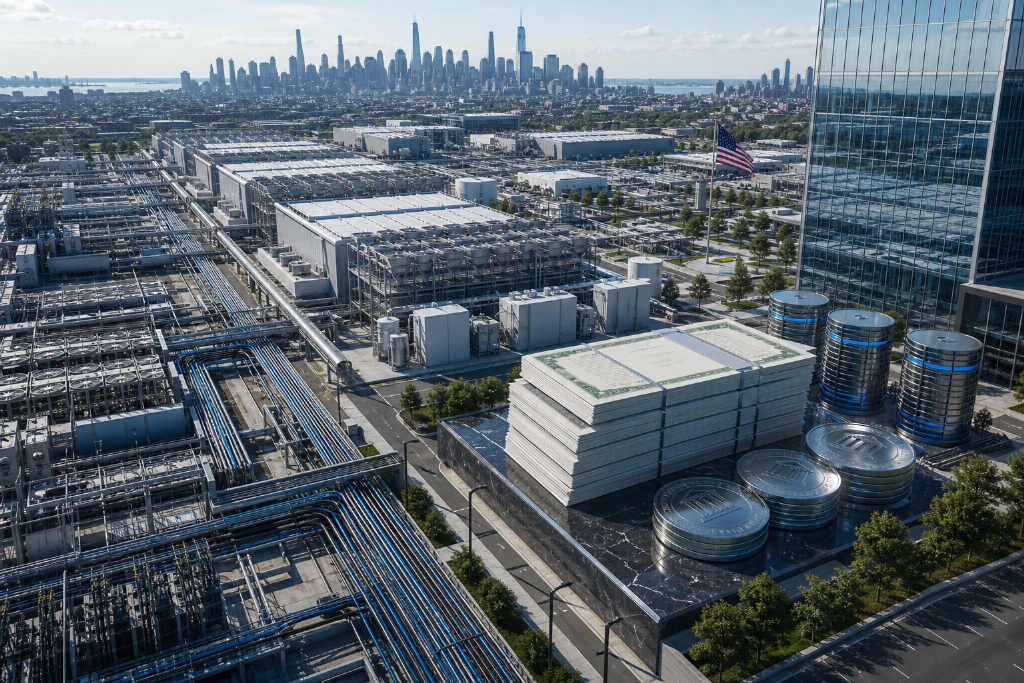
WuBlockchain’s WhiteLine Daily said in a market note published Aug. 22 that AI capital spending in the US is still expanding, but financing conditions have started to tighten. The report also pointed to fresh developments across fiber, optical modules, and NAND memory.
AI-related bond issuance by major US tech companies reaches about $220 billion
According to WhiteLine Daily, large US technology companies issued about $220 billion in AI-related bonds through Aug. 10, versus roughly $12.5 billion in the same period last year. Big tech groups that had previously relied mainly on internal cash flow to fund AI investment are now leaning more on bond markets to finance infrastructure such as data centers.
As new supply has increased quickly, average spreads on tech corporate bonds have risen to 89 basis points, the report said. That is 9 basis points above the broader US investment-grade bond market. Some large new issues are also beginning to offer higher yields to attract buyers.
WhiteLine Daily summed it up this way: AI CapEx has not yet run into a situation where funding is unavailable, but capital is getting more expensive. For companies such as NVDA and AVGO that depend on hyperscaler spending, the report said investors now need to watch not only orders, but also tech bond spreads and the pace of financing. If debt costs keep rising, return thresholds for new data center projects will rise as well.
Zayo locks in fiber supply, with more than 12,900 kilometers tied to NVIDIA cooperation
US digital network infrastructure company Zayo has expanded its long-term fiber supply agreement with Corning, locking in a substantial share of the fiber it expects to need for network expansion over the next several years.
Zayo plans to add about 24,000 kilometers of network by 2030. Of that total, more than 12,900 kilometers of long-haul fiber will be built in cooperation with NVIDIA to connect rapidly expanding AI infrastructure.
Corning reported second-quarter optical communications sales of $2.072 billion, up 32% year over year. Enterprise network revenue rose 65%, while sales tied to AI data centers nearly doubled, and orders were still accelerating.
WhiteLine Daily said increasingly distributed AI data center buildouts require larger long-distance connections between computing clusters. For GLW, the Zayo agreement adds support to the view that AI is driving real fiber demand. The next question, according to the report, is whether order growth can keep supporting Corning’s capacity expansion and optical communications revenue.
Eoptolink posts sharp first-half profit growth
Eoptolink reported first-half revenue of 41.778 billion yuan, up 182.49% from a year earlier. Net profit attributable to shareholders reached 13.651 billion yuan, up 241.70%.
The company said major AI customers continued increasing investment in computing infrastructure, while shipments of 800G and 1.6T products grew quickly and made up a rising share of the mix. Gross margin for optical communication transceiver modules reached 46.59%, up 6.63 percentage points year over year.
At the same time, net cash flow from operating activities was 1.8 billion yuan, down 44.08%. WhiteLine Daily said AI optical interconnect demand is already showing up directly in Eoptolink’s revenue, profit, and margins, but profit is running ahead of cash flow. For Eoptolink and high-speed optical names such as LITE and COHR, the next checkpoints are 1.6T shipments as well as whether margins and cash flow can keep pace with profit growth.
Changcun Holding plans 33 billion yuan fundraising in IPO push
On Aug. 21, the STAR Market IPO application of Changcun Holding, the parent of Yangtze Memory, was accepted by the Shanghai Stock Exchange. The company plans to raise 33 billion yuan, including 20.8 billion yuan for mass-production line technology upgrades and 12.2 billion yuan for research and development.
In the first quarter, the company posted revenue of 47.042 billion yuan and net profit attributable to shareholders of 33.379 billion yuan. WhiteLine Daily also noted that full-year net profit attributable to shareholders for 2025 was 14.211 billion yuan. During the same period, gross margin for NAND Flash products reached 78.73%. Its phase-two production line is already running at full capacity, while phase-three capacity is under construction.
Citing TrendForce data referenced in the prospectus, the report said Changcun Holding ranked third globally and first in China in first-quarter NAND sales revenue and shipment volume.
WhiteLine Daily said the latest round of NAND price increases has significantly amplified earnings leverage for memory producers. For MU, SK Hynix, and Samsung, the listing itself is not the main issue. What matters more is how long NAND ASP and the supply-demand gap can hold. If prices retreat, product gross margins now close to 80% will be difficult to sustain.
Main thread for the day
WhiteLine Daily’s core message was that AI CapEx is still expanding, but financing is getting more expensive. At the same time, fiber, 1.6T optical modules, and NAND are continuing to deliver revenue and profit. The next points to watch are whether higher financing costs begin to compress CapEx, and whether optical communications orders and NAND pricing can hold up.