
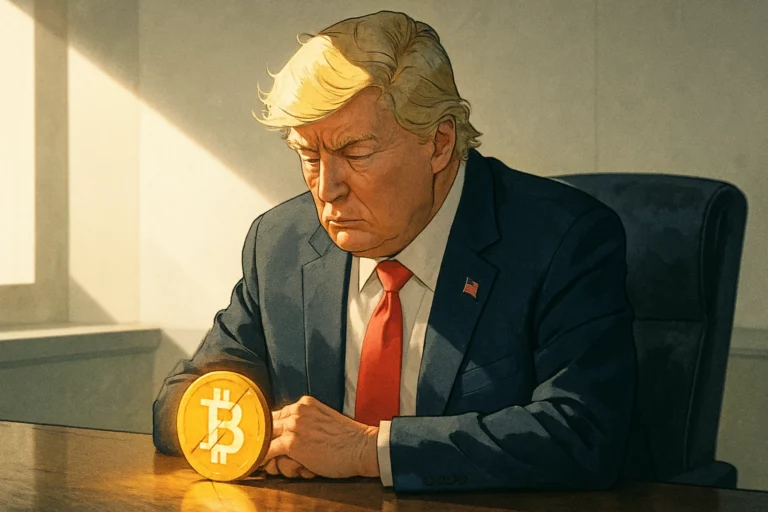
One year after the United States created its strategic Bitcoin reserve, the stockpile looks largely unchanged in size but much smaller in dollar terms. Wallets linked to the US government and identified by Arkham Research show crypto holdings worth about $22.39 billion at the time of writing, with Bitcoin alone accounting for roughly $22 billion. When the executive order was signed, the same pool of assets was valued at more than $30 billion, implying a decline of about 26%.
The reserve was built around seized assets, not open-market buying
On March 6, 2025, President Donald Trump signed an executive order creating both a “Strategic Bitcoin Reserve” and a “United States Digital Asset Reserve.” The Bitcoin reserve was limited to BTC, while the digital asset reserve covered other crypto tokens. Before the order was issued, Trump had said the reserve would include XRP, Solana and Cardano.
The order stated that no additional assets would be acquired for either reserve outside forfeiture proceedings. In practice, the move consolidated crypto assets that had previously been spread across multiple federal enforcement and regulatory bodies. The stated goal was centralized ownership, control and management, with unified oversight and more accurate tracking of the government’s crypto exposure. Washington has not published a full breakdown of the reserves, so outside analysis still relies heavily on onchain wallet identification.
Bitcoin holdings have stayed near 328,272 BTC
The most important number has not moved. Since the executive order was signed, the US government has continued to hold about 328,272 BTC, with no sign of direct accumulation in the market.
Beyond Bitcoin, the government’s better-known holdings include USDC, Ether, Wrapped Bitcoin (WBTC) and BNB. Ether remains the second-largest crypto asset in the government’s holdings, though its balance declined after the order was signed, suggesting transfers or conversions may have taken place. After April 2025, that position was reported to be broadly stable. Tether’s USDt, the largest stablecoin position held by the government, jumped by more than 200 million tokens in May 2025 and later fell back to levels seen before March 2026. Because transaction details have not been disclosed, the pattern behind those changes is still unclear.
The White House has not shifted course after the drawdown
The drop in valuation has not produced a visible policy change. White House deputy press secretary Kush Desai said recent price weakness does not alter the administration’s commitment to keeping the United States in a leading position in crypto and other frontier technologies, adding that the government does not set prices in a free market.
The current framework does leave room for future Bitcoin purchases, but only under strict conditions. Any acquisition would need to be “budget neutral.” David Sacks, the administration’s AI and crypto czar, said previously that such a plan could not increase the deficit, add debt or impose taxes on Americans. He also said Treasury officials could accumulate more Bitcoin if they found a way to do so without putting any burden on taxpayers. A year later, it is still not clear whether such a strategy exists or how it would be carried out.
Transparency questions remain around the reserve structure
Key details are still missing: how much of the government’s crypto is formally assigned to the reserve, whether transfers into the structure have been completed, and how the assets are managed in practice. Blockworks co-founder Jason Yanowitz said in an earlier interview with the BBC that a reserve holding multiple assets could distort markets and weaken public trust if it lacks a clear framework. He argued that independent audits and public reporting matter for transparency.
Over the past year, Bitcoin reserve strategies have gained attention across both governments and corporations. Data from BitcoinTreasuries.net shows that 10 countries, including the United States, China, Ukraine, El Salvador, the United Kingdom and North Korea, currently hold Bitcoin. In the US case, though, the reserve still looks less like an active national buying program and more like a centralized structure for assets already obtained through seizures.