
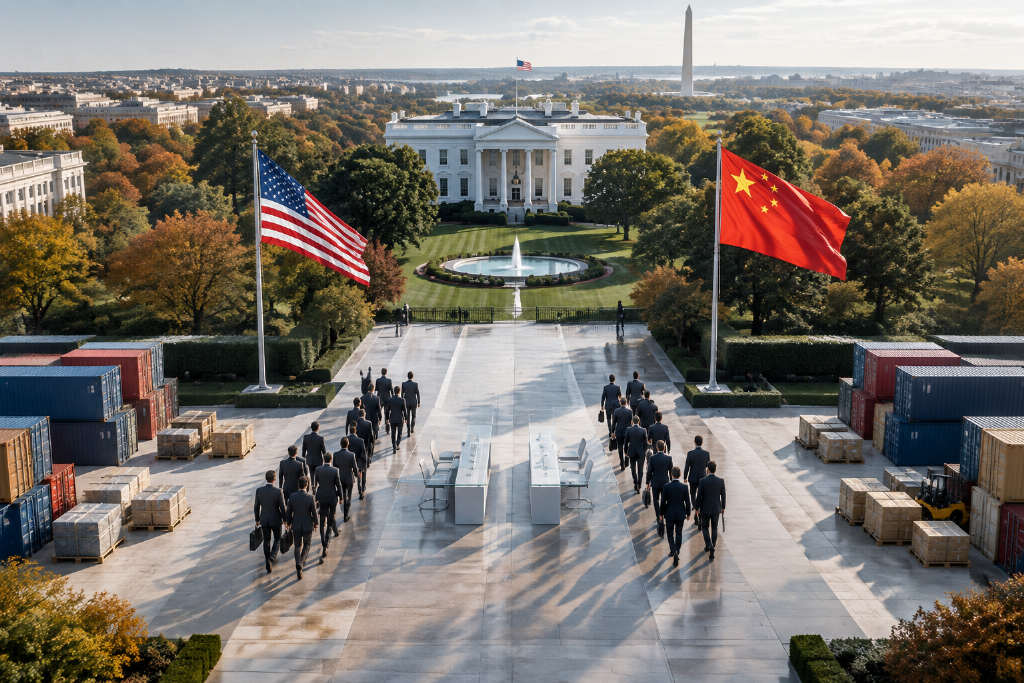
U.S. President Donald Trump and Chinese President Xi Jinping concluded a summit in Washington this week with several announced outcomes. According to a White House summary, the two sides will launch a "Super Intelligence Dialogue" and set up a communication channel for AI-related incidents. They also reached a consensus on giving more favorable tariff treatment to $30 billion in non-sensitive goods in each direction. China also committed to import at least 10 million tons of U.S. coal in both 2027 and 2028.
Several foreign media outlets, however, said the summit stopped short of a major breakthrough, with key differences still left for follow-up negotiations.
AI dialogue becomes a central outcome
The White House document referred to AI throughout as "Super Intelligence," or SI, a term the report said Trump has recently promoted. The two governments agreed to establish a "U.S.-China Super Intelligence Dialogue" to discuss the risks and benefits of SI and to create a bilateral SI incident communication channel. The next round of exchanges is due before November 2026.
Axios said the agreement amounts to an acknowledgment that both countries see each other as serious rivals in AI and need a hotline to reduce the risk of accidental escalation.
The timing also drew attention. The report noted that companies including OpenAI have recently disclosed incidents involving AI agents going out of control, pushing AI safety beyond a technical issue and into the realm of national security and diplomacy.
Trade understanding limited to non-sensitive goods
On trade, the two sides activated the U.S.-China Trade Committee and Investment Committee that were set up during the Beijing summit in May. The White House said the trade committee had reached a consensus on $30 billion in non-sensitive goods on each side and would recommend more favorable tariff treatment.
The White House listed U.S. export items as agricultural products, seafood, logs and wood products, cosmetics, and medical devices. U.S. imports under the arrangement would include small home appliances, toys, holiday decorations, and child car seats.
Fortune reported that the wording was a pledge to "continue working together" to push tariff reductions, and that the scope was limited to non-sensitive goods. The trade truce was also extended by another two months. More sensitive issues, including chips and export controls, were not addressed. The source article also noted that Chain News had previously reported that the trade truce had already been extended by two months before the summit.
Other outcomes and gaps between the two versions
Other announced outcomes included new Chinese export controls on two fentanyl precursor chemicals, continued efforts to address shortages of rare earths and other critical minerals, and agreement that Iran can never possess nuclear weapons and that no country should charge transit fees for international waterways.
Seoul Economic Daily compared the White House account with Xinhua's list of eight outcomes and found that the Chinese version did not mention coal purchases or rare earths, and did not include a detailed goods list. Instead, it added a military communication memorandum and mutual support for the APEC meeting in Shenzhen in November and the G20 summit in Miami in December this year.
Those differences suggest the two sides are still presenting the summit results in different ways.
Taiwan absent from the White House summary
Taiwan was one of the issues closely watched ahead of the summit, but it was not mentioned in the White House readout. Bloomberg reported that Trump said in an interview at the White House on Saturday that the two sides did not spend "a lot of time" on Taiwan in their talks. He added, "There is no problem right now, things are moving along, and he understands very well how I feel."
Bloomberg said Trump did not restate Washington's decades-old policy position on Taiwan during this appearance.
Overall, the summit centered on an AI dialogue channel and limited trade concessions. The next AI talks in November, the APEC and G20 meetings, and tariff negotiations before the trade truce expires are likely to remain the main points to watch.