
The United States and China on Monday published separate tariff-cut lists covering about $30 billion in goods, laying out the first detailed follow-up to the commitments made after the Trump-Xi summit.
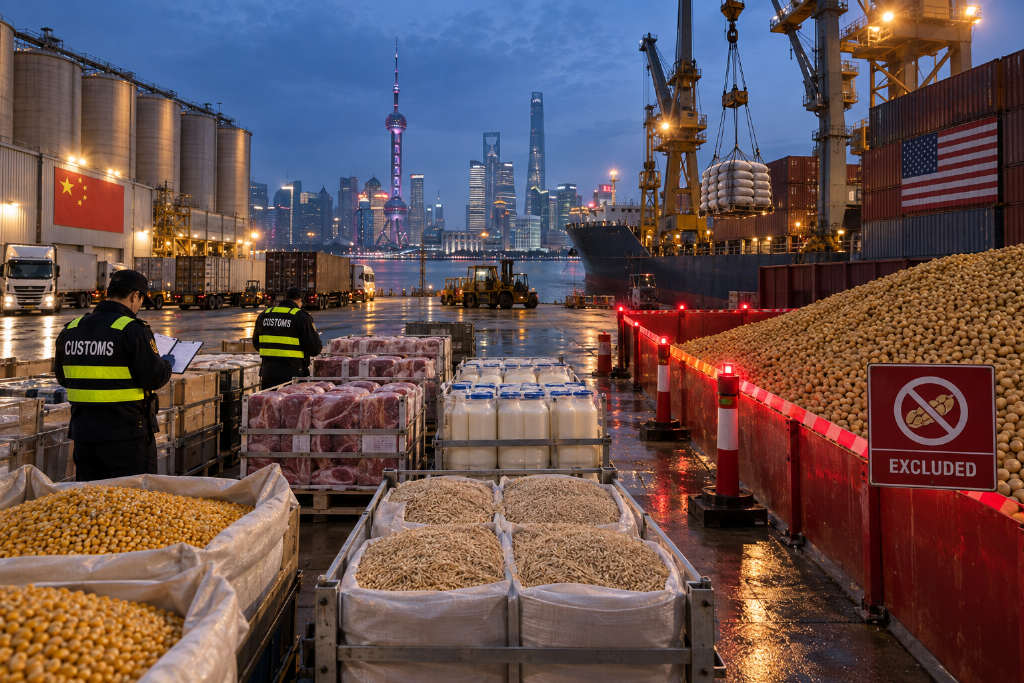
According to Bloomberg, China’s list from the Ministry of Commerce includes a broad set of US agricultural products, including corn, wheat, meat and dairy. Soybeans, however, were not included, even though they are the largest US farm export to China. Reuters reported that US soybeans still face an additional 10% tariff.
US list covers 77 product categories
Bloomberg said the US tariff-cut list contains 77 import items, including fireworks, household goods, sporting equipment and toys. That aligns with the White House’s earlier summit readout, which referred to small home appliances, toys, holiday decorations and child car seats.
China’s list is centered on agricultural goods.
China included multiple farm goods, but not soybeans
Reuters reported that China’s Ministry of Commerce list includes corn, wheat, sorghum, vegetable oils, soybean oil, soybean meal, meat and dairy products. Those categories accounted for about $17 billion in imports in 2024, roughly in line with China’s purchasing commitment after excluding soybeans.
Soybeans were left off the tariff-cut list. Reuters said the additional 10% tariff remains in place on US soybeans. Traders told Reuters that the rate is too high for China’s private crushing companies to absorb.
The report added that actual purchases have mainly been carried out by state-owned firms Sinograin and COFCO, which have so far bought more than 12 million metric tons of US soybeans. That is close to half of the 25 million metric tons per year that the White House said China had committed to buy through 2028.
Reuters says soybean buying still carries political weight
Reuters, citing a source, said soybean purchases carry major political significance and give Beijing leverage ahead of the US midterm elections.
Under that approach, China is using state-directed purchases rather than tariff cuts to buy soybeans, keeping control over how much to buy and when to buy it.
Market reaction was muted
Bloomberg reported that grain futures moved lower after the lists were released, with traders still waiting for signals of actual Chinese buying.
The two sides also agreed to establish a trade committee. Its first task will be to discuss reciprocal tariff reductions on the $30 billion in goods.
First concrete test of summit follow-through
ABMedia had previously reported that the Trump-Xi summit produced agreement on a "super-intelligence" dialogue channel and tariff reductions on $30 billion in goods, though the White House had only outlined broad directions at the time and did not publish a detailed item list.
The newly released lists now serve as the first concrete test of whether those summit outcomes can be carried out. So far, the tariff cuts are focused on non-sensitive consumer goods and selected agricultural products, while soybeans, the most politically sensitive item, remain outside the list.
Relative to the overall scale of US-China trade, $30 billion is not especially large, making the move more symbolic than substantial. The next points to watch are the pace of soybean purchases by Chinese state-owned firms, the first meeting of the trade committee, and whether the two sides can make progress on more sensitive issues such as chips and export controls during the November "super-intelligence" dialogue and later at APEC and the G20 before year-end.