
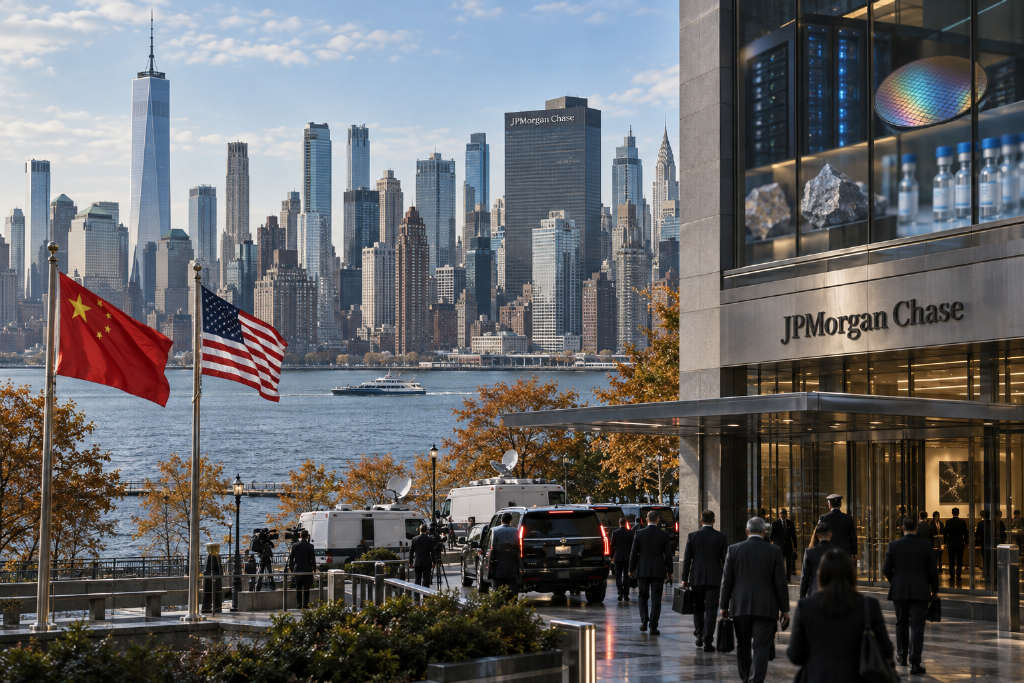
A new round of high-level US-China trade talks has begun in New York, and markets are treating the meetings, a possible follow-up summit, and business delegation activity as near-term trading catalysts. Based on the information released so far, the discussions cover artificial intelligence, technology export controls, tariffs, rare earths and critical mineral supply chains, and procurement lists. That has put AI infrastructure, semiconductors, and innovative drug developers on investors’ radar.

Talks begin in New York as attention shifts to a leaders’ meeting
China’s Ministry of Commerce said on Sept. 17 that Vice Premier He Lifeng would lead a delegation to the United States from Sept. 19 to 23. The first round of talks took place on the morning of Sept. 20 local time at JPMorgan’s headquarters in New York. The US side was led by Treasury Secretary Bessent, with Trade Representative Greer also participating. Both sides agreed to conduct dialogue under the guidance of the important consensus reached by the two heads of state.
The US side has also confirmed that a state dinner will be held at the White House on Sept. 24 for the Chinese leader. It would be the second meeting between the two leaders since May this year. For markets, the sequence matters: preliminary talks to set the framework first, then a leaders’ meeting to lock in a list of outcomes.
Tariffs and critical minerals stand out as the key markers
The agenda in this round is wider than before. It includes AI and AI safety, technology export controls, tariff extensions, rare earths and critical mineral supply chains, and trade procurement lists.
Markets are focused on two specific markers. The first is whether the tariff truce set to expire on Nov. 10 this year will be extended again. The second is whether export controls tied to rare earths and critical minerals can move toward a more stable and predictable arrangement.
The list of business figures linked to the meetings has also drawn attention. According to Reuters and other media outlets, China’s accompanying business delegation is still being finalized, but names that have emerged include BYD, Xiaomi, CATL, Gotion High-Tech, Hisense, Wanxiang Group, Bank of China, and COFCO. On the US side, guests confirmed for the White House dinner include NVIDIA CEO Jensen Huang, OpenAI CEO Sam Altman, and Qualcomm CEO Cristiano Amon. Apple CEO Tim Cook is also expected to attend.

Chinese ADRs and the yuan moved higher after the Sept. 17 announcement
After China’s commerce ministry announced the visit schedule on Sept. 17, Chinese ADRs and the offshore yuan both showed clear relative strength, suggesting that capital had started positioning ahead of the talks.
In equities, the three major US indexes were mixed last Friday. The Dow Jones Industrial Average fell 0.18%, the S&P 500 rose 0.17%, and the Nasdaq gained 0.39%. Against that backdrop, the Nasdaq Golden Dragon China Index climbed 0.76%, outperforming the broader US market. Core Chinese ADRs including Alibaba, Bilibili, and PDD mostly advanced despite the mixed tape.
The move was not broad-based. Flows were concentrated in AI and cloud-computing names, with gains clustered in Alibaba and IDC infrastructure stocks such as GDS and VNET. The market linked that strength to Alibaba’s upcoming Apsara Conference and a broader AI cycle tailwind. Consumer and e-commerce names were described as relatively muted.
Yuan strength and policy signals added support
On Sept. 18, both the onshore and offshore yuan rose past 6.70 against the US dollar, reaching their highest levels since February 2023. The report said strong export growth and corporate foreign-exchange settlement demand were supporting the currency. A firmer yuan, in turn, directly improved valuation flexibility for Chinese ADRs priced in US dollars.
Domestic policy and foreign broker research also landed at the same time. Beijing released what was described as the country’s first provincial-level "ten measures" for the token economy, including support for building "token factories." At the same time, Morgan Stanley raised its forecast for monetizable AI revenue on the consumer side in China. Together, those developments added a separate line of support for the AI compute chain.

Biotech licensing rules are also in focus
Beyond AI, trade, and manufacturing-linked names, innovative drug companies have become another area of market attention.
On Sept. 18, Reuters, citing three people familiar with the matter, reported that the US Treasury is drafting new rules on investment in China’s pharmaceutical sector. The proposal would preserve the ability of US drugmakers to complete most license-in deals involving Chinese medicines, with restrictions limited to cases involving pathogens or biotechnology that could be weaponized. Reuters said the framework would be far looser than proposals pushed by some members of Congress, and the dollar value involved could reach into the tens of billions.
Against that backdrop, innovative drug-related stocks have also been flagged by the market as a potential beneficiary group.
Disclosure in the source article
The original article said the material was for general information and market commentary only. It described the piece as a compilation and analysis of public information, not investment advice, not a recommendation, and not an offer or solicitation to buy or sell any securities or financial instruments. It also said the material did not take into account any specific recipient’s investment objectives, financial situation, or particular needs.