
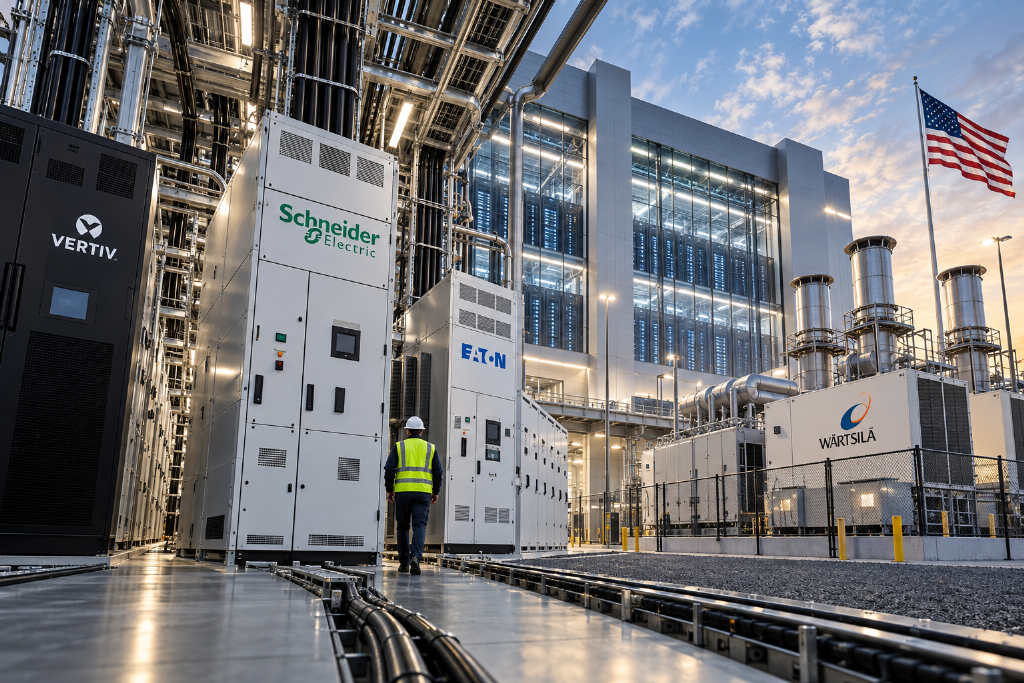
The battle over U.S. data center power is moving away from a simple race for generation hardware. The new prize is the control layer that ties generation, electrical architecture, automation, and compute loads together.

According to the latest tracking from Cleanview, 59 U.S. data center campuses have announced about 90 GW of behind-the-meter generation capacity. Roughly 82 GW of that total has been announced since the start of 2025. Yet only about 2 GW is currently in operation.
The report argues that this gap says more about how new the demand surge is than about project instability. Before 2025, on-site self-generation was largely treated as a backup option. Now it has become a hard requirement for data centers that need to energize and enter service on schedule. Construction timelines have become the binding constraint as North American data center development reaches record levels and traditional grid interconnection queues run out of room.
Enverus sees data centers driving most of the new behind-the-meter load
Enverus projects that from 2026 through 2030, 25.5 GW of new industrial power demand in the U.S. will be met through behind-the-meter generation. Data centers account for 22.5 GW of that figure, or about 36% of all new U.S. data center capacity expected during the period.
Serving that load would require 31.6 GW of new on-site generation equipment, including 29.6 GW of gas-fired generation. Reciprocating internal combustion engines make up 7.1 GW, small and mid-sized gas turbines account for 6.2 GW, and fuel cells represent 4.8 GW.
Those figures describe a large hardware buildout. They do not answer a more basic commercial question raised in the piece: if an entire power plant fails to start on time, who is accountable to the customer?
The author says that question sits at the center of the supplier announcements made around Yotta 2026. Technology pathways for generation equipment are becoming clearer. Commercial delivery structures are not. The unresolved issue is who integrates all the parts, who owns the customer relationship over the next two decades, and who is stepping away from that role.
Schneider, Wärtsilä, and Stanley Consultants introduced a “Generator-to-Chip” model
On Sept. 30, Wärtsilä, Schneider Electric, and Stanley Consultants launched what they described as a full-process power solution for U.S. data centers under the label “Generator-to-Chip.”
The division of labor was explicit. Wärtsilä would supply modular gas engine power plants. Schneider Electric would handle electrical architecture, automation systems, and digital energy management. Stanley Consultants would oversee engineering design, permitting, multi-party coordination, construction management, and commissioning oversight.
Schneider wrapped the offering into its “AI Energy Park” concept. Melton Chang, executive vice president of power systems at Schneider Electric, said the model starts from the compute load and integrates generation, electrical infrastructure, automation, and digital technology into one system. Risto Paldanius, vice president of Wärtsilä Energy Americas, said combining complementary capabilities from the start can simplify execution, reduce handoff losses, and shorten construction schedules.
The report stresses that this is not the same as a single turnkey wrap contract. It is better understood as a coordinated alliance among three separate companies, and the public announcement did not promise a single party would take full contractual responsibility.
The most important commercial details were left out
The announcement did not include a contract structure, megawatt figures, named customers, pilot campuses, or pricing. StorageReview, in its own coverage, said the release provided “no numbers, customers, or timeline.”
So far, Schneider’s public materials have focused on engineering and technical design: the generator-to-chip division of responsibilities, Yotta conference messaging, and switchgear white papers. The commercial terms that matter most — who signs with the end customer and who controls the long-term relationship — remain absent from the public record.
The report’s reading is that the industry has moved faster in productizing on-site power as an engineering package than in turning it into a settled commercial model. The second task is harder.
AlphaStruxure once answered those questions. Schneider no longer presents itself as the parent
For seven years, Schneider had a platform that directly addressed ownership, financing, and delivery questions. AlphaStruxure, formed in 2019 as a joint venture between Schneider and Carlyle, was built to design, finance, construct, own, operate, and maintain on-site energy infrastructure while offering fixed pricing and performance guarantees.

It took on the 11.4 MW microgrid project for JFK Airport’s New Terminal One, with phased construction running through 2029. In April 2026, it also completed what the report described as the largest bus depot microgrid in the U.S. for Montgomery County, Maryland, including 4.8 MW of solar, 2 MW of storage, and the ability to remain islanded during grid outages.
But Schneider no longer appears on AlphaStruxure’s website as a parent company. The report says that as late as April 19, 2026, the company’s homepage still stated, “Our parent companies are Carlyle and Schneider Electric.” By May 8, the wording had been changed to the singular form, “Our parent company Carlyle,” with Schneider removed while the surrounding text remained unchanged.
No formal transaction announcement accompanied that edit. The report says there was no press release, SEC filing, or trade media coverage confirming a deal, and Carlyle’s regular financial reporting does not list individual portfolio company holdings in a way that would settle the matter. Even so, the factual point the author draws is narrow: Schneider no longer presents itself as a parent of the vehicle that once sat directly in the ownership and commercial contracting layer.
The company appears to be choosing the control layer over asset ownership
The report frames that move not as a retreat from the market, but as a decision about which layer is worth owning over time. Schneider, in this view, is holding onto the electrical control and automation architecture layer and treating it as the real choke point in the value chain.
At Yotta, Schneider introduced software-defined medium-voltage switchgear and described it as a world first. According to Schneider’s own figures, the design cuts control wiring by 87%, terminal blocks by 91%, and copper use by 85% compared with conventional designs. It also claims up to a threefold improvement in order-to-manufacture speed and a 50% reduction in on-site commissioning time.
Pilot projects are expected to continue through 2027, with full market rollout planned for 2028. Some parts of the stack are arriving earlier. Prefabricated power modules built on the Galaxy VXL UPS platform in 2 MW, 2.25 MW, and 2.5 MW configurations are already on sale in Europe and are slated to reach North America by the end of 2026.
The report’s central argument is straightforward: whoever writes the one-line diagram and the control logic becomes the default lead for commissioning, service, and upgrades over a project life that can stretch to 20 years. Generator sets will be replaced. Server racks will turn over every three to five years. The underlying electrical topology and relay protection scheme tend to stay in place much longer, and so does the commercial relationship attached to them.
That position also scales across projects. The report points to an earlier example from March 2024, when Schneider partnered with Mainspring Energy to package its own control and integration systems around a third-party linear generator. The Wärtsilä alliance follows the same logic with larger engines. The same approach, the author says, could be applied to Caterpillar plants, Bloom fuel cell systems, or utility-backed generation assets.
Owning one energy park captures the economics of one site. Controlling the integration layer opens a path to participate across many sites.
Financial results are presented as support for that strategy
Schneider reported first-half 2026 revenue of €21.2 billion, up 14.0% organically. Second-quarter revenue came in at €11.5 billion, with 16.5% organic growth.
According to the report, pure data center orders posted triple-digit growth in the second quarter, while the broader data center and network end market delivered strong double-digit sales growth. Schneider’s “Systems” business model, which includes prefabrication and engineering wrap work, represented 35% of second-quarter revenue and grew 28% organically.
Two reasons the report stops short of a full endorsement
The piece also lays out two reasons for caution.
First, the performance claims for Schneider’s software-defined medium-voltage switchgear come from Schneider’s own White Paper 303. They have not been independently audited, have not been publicly confirmed by major customers such as Equinix, and are not backed by disclosed pilot data. Until a named reference customer validates the results, the report says claims about 87% less wiring, 91% fewer terminal blocks, 85% less copper, and multi-fold speed gains should be treated as vendor marketing statements.
Second, The Register raised a sharper concern that Schneider’s public materials have not directly addressed. A bad or malicious software update in a safety-critical electrical system is not comparable to a faulty desktop patch on an office computer. Moving medium-voltage protection and control logic into software may improve efficiency, but it also shifts operational risk.

The report notes that a data center built to bypass grid queues by physically separating from the public grid also gives up an external safety backstop. In that setting, the software protection layer becomes the barrier between a transient load event and a campus-wide blackout.
“X-to-Chip” is becoming a shared industry language
The similarity in naming across vendors is one of the report’s strongest signals that this is a structural shift rather than a one-off branding exercise.
In June 2025, Eaton and Siemens Energy paired a standardized 500 MW gas turbine package with energy storage and quantified the commercial upside this way: by bringing a facility online up to two years earlier, a typical 500 MW site could generate an additional $2 billion to $3 billion in revenue.
In November 2025, Vertiv and Caterpillar followed with their own alliance. Vertiv CEO Gio Albertazzi described it as a “Grid-to-Chip” framework.
Then in September 2026, Schneider and Wärtsilä arrived with “Generator-to-Chip.”
Within 15 months, three pairs of major industry players formed alliances, and two of them adopted nearly identical “X-to-Chip” language. The report says the market has effectively agreed that the unit of competition is no longer a single engine or a single switchboard. It is the full pathway from fuel source to compute load. What remains unsettled is who gets to sell and control that pathway.
Six integration paths, one underlying contest
The report also maps the commercial boundary lines around on-site power.
One model has an investor-owned utility fully owning the plant, buying generator sets directly from OEMs, keeping no OEM software layer in place, and selling power straight to the data center.
Another has a project developer funding, building, owning, and operating the plant, then selling power behind the meter to the customer. That is the model VoltaGrid uses, and one AlphaStruxure also pursued. The report notes that in May 2026, VoltaGrid raised $1 billion from Blackstone and Halliburton and crossed a valuation above $10 billion, supported by the economics of owning and operating plants and selling electricity directly.
Beneath those paths sits a baseline case in which the customer signs three separate procurement contracts and takes on all integration work itself. That produces six distinct ways to deploy the same megawatt capacity, with the integration layer landing in different hands each time. In Schneider’s version, the report says, the integration layer is placed firmly with the software party that writes the control logic.
FERC and PJM are making the commercial question more urgent
Regulatory change is pushing the issue forward.
Under Section 206 of the Federal Power Act, the Federal Energy Regulatory Commission issued an order on Dec. 18, 2025, finding that PJM’s tariff and interconnection rules for new generation serving co-located load lacked sufficient clarity and consistency. FERC imposed a regulatory definition.
PJM filed its compliance proposal on Jan. 20, 2026. On April 16, 2026, FERC issued a ruling that approved some parts and rejected others.
The portions FERC accepted were a direct positive for energy park models. Interconnection applicants serving co-located load can now request service based on actual load below a generator’s nameplate output, and PJM must calculate system upgrade requirements using the declared load rather than the machine’s maximum theoretical output. Customers can also use existing fast-track provisions to seek temporary interconnection service before full buildout is complete, provided grid impacts are limited, and can assert rights to surplus capacity service at an existing point of interconnection.

The report says those four mechanisms turn “grid flexibility” from brochure language into enforceable tariff treatment. They also explain why a campus that chooses islanded self-generation today may later be able to sell flexibility back to the wider grid in a compliant way.
The rejected portions show how unsettled the rules still are. FERC rejected PJM’s attempt to redefine the relevant point from “point of interconnection” to “point of ownership change” in the co-located load definition. It also rejected PJM’s proposed changes to the application process for behind-the-meter generation on the grounds that they fell outside the scope of the case and ordered further compliance work.
The deeper conflict is now out in the open. PJM’s Independent Market Monitor warned that the current framework does not clearly answer what happens if a large co-located compute load suddenly drops and the public grid must absorb unexpected reverse injections from a self-generation plant, or what happens if the behind-the-meter generators trip and the grid must provide backup supply.
FERC did not resolve those questions in that proceeding. Instead, they were pushed into a broader large-load docket. On June 18, 2026, FERC issued Section 206 orders to all six U.S. regional transmission organizations and independent system operators, requiring them to show that their existing rules for large loads and behind-the-meter generation are just and reasonable or else overhaul them. After an August extension, final formal responses were due in mid-November.
That leaves a major open issue: if an islanded campus later wants to interconnect and sell power to the grid, the reliability standards it will face are still being drafted across multiple regions, with no national consensus yet in place. The report adds that strict environmental review and permitting, not only FERC tariff changes, remain the deeper bottleneck for behind-the-meter gas generation.
Three signals to watch next
The report closes with three markers that it says will reveal the commercial endgame faster than any press release.
First is the first publicly named customer and the form of its contract. If the market produces a single wrap contract that assigns full responsibility to one party, that would suggest Schneider or a rival has captured the system integration layer. If customers continue to sign three separate equipment and engineering contracts, then customers themselves remain the final integrators and the ecosystem packaging is still mainly a schedule-management tool.
Second is whether project financing closes and whose balance sheet carries the burden. The report points to a September 2025 initiative launched by Schneider, Microsoft, and more than 20 partners to accelerate resilient infrastructure. Six project developers secured $7.5 billion of dedicated funding to deliver projects through energy-as-a-service contracts. Schneider explicitly cast itself as the strategic integrator connecting customers and developers while supplying the technical layer, and AlphaStruxure was one of the six developers. Seven months later, Schneider’s name disappeared from AlphaStruxure’s parent-company description. Whatever the underlying equity mechanics, the strategic direction described in the report is consistent: Schneider keeps the integrator seat and leaves heavy asset ownership to others.
Outside capital is also moving in quickly. In June 2026, Brookfield expanded its AI compute power infrastructure partnership with Bloom Energy by five times to $25 billion, specifically for investment in on-site power infrastructure. The report treats that as a sign of maturity. Data centers first turned to behind-the-meter generation because it was the fastest route to power. Now capital markets are building dedicated funding channels around it.
Third is whether the bet on the electrical control layer survives real project conditions. The report says Schneider’s standardization work predates the Yotta announcement by years. In 2023, it launched the EcoStruxure Microgrid Flex standardized microgrid offering. Through 2025, it kept expanding channel and financing partnerships. In March 2026, it opened a microgrid testing lab at its global R&D center in Andover. Schneider’s senior vice president for global microgrids said the goal was to use a more standardized approach to build tested, validated, and fully documented reference architectures that could speed deployment of robust microgrid control systems.
That timeline matters because it shows Schneider was already commercializing microgrid control architecture half a year before unveiling the AI Energy Park concept. The report treats that sequence as evidence that the move toward the control layer is deliberate rather than opportunistic.
It ends with comments from Jim Simonelli, senior vice president and chief technology officer for secure power at Schneider Electric, speaking at Nvidia GTC in April. “Three years ago, the limiting challenge was how to get heat out of the rack,” he said. “Today, the real challenge is how to get power into the rack and into the campus.” On dispatchable on-site power at AI scale, he was even more direct: “Other than natural gas, there really isn’t any practical alternative right now.”
In the author’s view, gas is already a mature commodity and internal combustion engines are catalog products. The only layer in the chain that can keep compounding technical and commercial value is system integration and electrical controls. The first supplier that gets a real paying customer to adopt its integration model will do more than win a project. It will show the market what this control layer is actually worth.



