
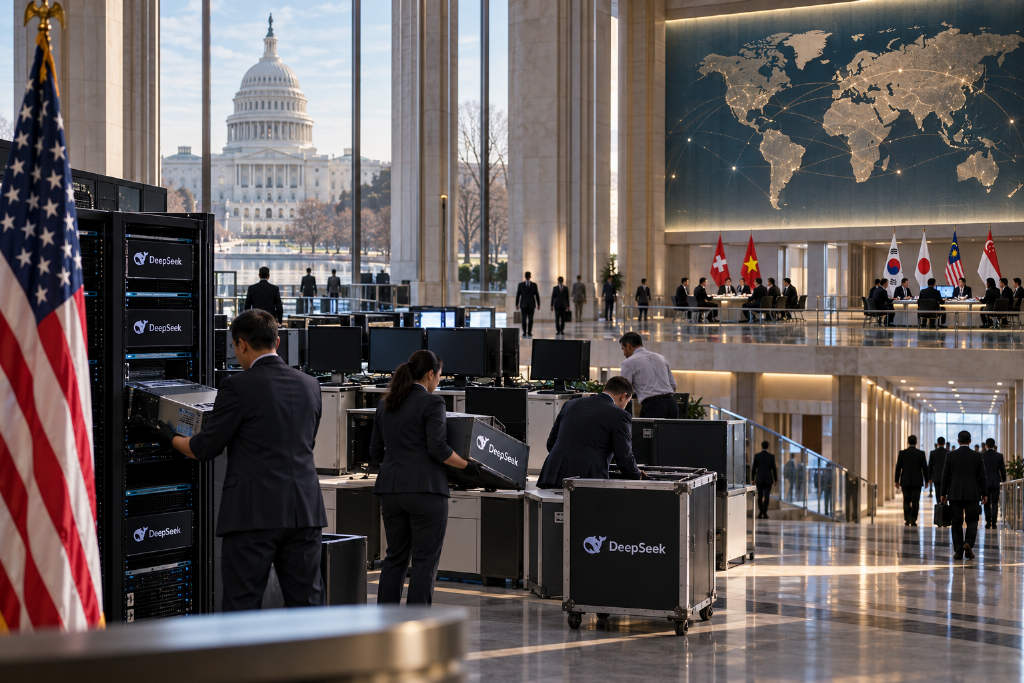
The US Department of Homeland Security has ordered federal civilian agencies to remove DeepSeek products from their IT systems, while a separate set of developments across Asia and Europe points to deeper activity in stablecoins, tokenized assets and Bitcoin exchange-traded products.
US expands pressure on AI-linked exposure and bars DeepSeek from civilian agency systems
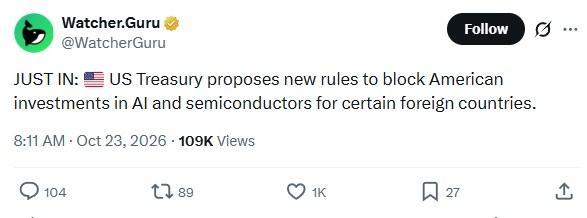
The US Treasury has proposed new rules that would block investment in artificial intelligence projects and certain high-risk semiconductors in some foreign countries. The measures are aimed mainly at China, but would also cover Russia, Iran, North Korea and Cuba.
According to the report, the rules would implement the COINS Act from December 2025 and broaden the Outbound Investment Security Program that took effect in January 2025. They build on earlier restrictions on sales of high-powered AI chips to China.
The Treasury also announced its first penalty under the program this month, fining Amidi, LLC $200,000 for failing to report an investment by its Chinese subsidiary into embodied AI and robotics company Shanghai Qiongche Intelligent Technology, also known as Noematrix.
Separately, the Department of Homeland Security filed an order on Monday directing federal civilian agencies to remove DeepSeek products from agency IT systems. The order also covers DeepSeek affiliates and third-party products and services developed using DeepSeek implementations, and it bars affected agencies from making new purchases.
DHS said use of DeepSeek by government employees and contractors could expose sensitive information to China, potentially revealing details about US citizens and federal programs.
Solana Shanghai event delayed after registrations surged
Solana Accelerate in Shanghai was postponed after pre-registrations exceeded the attendance cap set by local authorities, according to Solana Foundation President Lily Liu.
In a Friday post on X, Liu said registrations quadrupled overnight after publicity around the event. Organizers chose to postpone it to "comply with local requirements."
Earlier the same day, users on X had claimed the event was "abruptly suspended" and said law enforcement officers were stationed at the venue.

Binance founder Changpeng Zhao wrote that he was impressed Solana Foundation had been allowed to open a Shanghai office, adding that BNB Chain had not been able to do so.
Japan and South Korea test yen stablecoin payments as Seoul revisits crypto tax timing
Shinhan Card of South Korea signed an agreement with Japan’s SBI VC Trade and SBI XDC Network APAC to test yen stablecoin payments for travelers and for cross-border trade settlement.
Under the Tuesday agreement, the companies will test stablecoin card payments, wallet-to-wallet transfers and cross-border trade settlement. They will also assess anti-money-laundering and fraud-detection controls.
The report described Shinhan Card as one of South Korea’s biggest credit card companies. SBI was described as a major Japanese financial group with banking, brokerage, insurance and crypto exchange operations.
South Korean finance officials also reportedly met major crypto exchanges this week, days after a lawmaker introduced legislation that could delay the start of a new crypto tax by two more years.
The consultation on crypto taxation included representatives from Upbit, Bithumb, Coinone, DigitalX and Gopax, along with executives from the Digital Asset Exchange Alliance, or DAXA.
South Korean regulators have delayed the crypto tax three times. The latest delay pushed the start date to 2027 because of political disagreement and industry opposition.
Won stablecoin settlement, tokenized assets and payment rails move forward
Injective signed a memorandum of understanding with South Korean digital asset custodian BDACS to bring a won-backed stablecoin to its tokenized asset markets. The report said that could allow institutions to settle transactions without relying on US dollar stablecoins.

Kakao, KakaoBank and KakaoPay have also formed a stablecoin task force to build infrastructure for won stablecoin issuance, custody and payments. The initial focus is shopping and gifting.
In Malaysia, central bank Bank Negara Malaysia launched a distributed-ledger-based platform for issuing and holding tokenized bonds. The platform links digital securities records with a payment system designed to operate around the clock.
BNM said its next-generation Scripless Securities Depository System, or SSDS+, supports issuance, depository and safekeeping for tokenized debt securities, including Islamic bonds known as sukuk.
Metaplanet moves on Super League stake as Bitget eyes Thailand
Shareholders of Nasdaq-listed gaming and digital media company Super League approved a deal that would give Japanese Bitcoin treasury firm Metaplanet a 93.7% ownership stake through a 2,100 BTC transaction.
The report said the deal would pave the way for Metaplanet to expand into US capital markets through a publicly traded Bitcoin treasury company.
Metaplanet also announced a planned repurchase of about $160 million of its own shares.
Crypto exchange Bitget said it plans to acquire Thailand’s GMO-Z.com Cryptonomics as it looks to expand in Southeast Asia, weeks after a major hack affected its hot and warm wallets.
According to an announcement shared with Cointelegraph, the proposed transaction involves BTGT Management (Thailand), a company in which Bitget said it holds an interest. The acquisition would allow Bitget to introduce its trading platform to Thai users.

Thai police arrest Chinese suspect tied to alleged 500 million yuan network
Thai police arrested a 37-year-old Chinese man wanted by authorities in China for alleged involvement in an international crime network and money laundering.
Investigators said the network handled more than 500 million yuan, or $75 million, in transactions, according to Thai media outlet Khaosod English in a Saturday post on X.
Police alleged the suspect handled cryptocurrency and foreign-currency exchanges for criminal groups across more than 133 accounts. Investigators also said he tried to evade arrest by using forged documents to report his residence and by changing vehicle registration plates before police found him in a luxury house in Bangkok.
Vietnam expands crypto experimentation as Switzerland proposes Crypto Valley links
Da Nang, Vietnam’s fourth-largest city, is using a controlled sandbox that allows businesses to deploy crypto-related applications in tourism. The city welcomed 15.9 million visitors in the first nine months of 2026.
Vietnam also signed a free-trade agreement with the European Free Trade Association countries of Switzerland, Iceland, Norway and Liechtenstein.
After meeting with the Vietnamese prime minister, Swiss President Guy Parmelin proposed linking Switzerland’s Crypto Valley hub with Vietnam’s innovation ecosystem to deepen cooperation in blockchain, artificial intelligence and quantum technology.
Singapore-linked firms add stablecoin and Bitcoin ETF products
Singapore Gulf Bank said retail customers can convert between dollars and USDT or USDC through its mobile banking app. The report noted that the bank is actually licensed in Bahrain.
Singapore-backed BIT Asset Management has launched Switzerland’s first Bitcoin ETF. Formerly known as Matrixport, its Zurich arm received approval from the Swiss Financial Market Supervisory Authority to launch the country’s first spot Bitcoin ETF and what the report described as Europe’s only spot Bitcoin ETF.



