
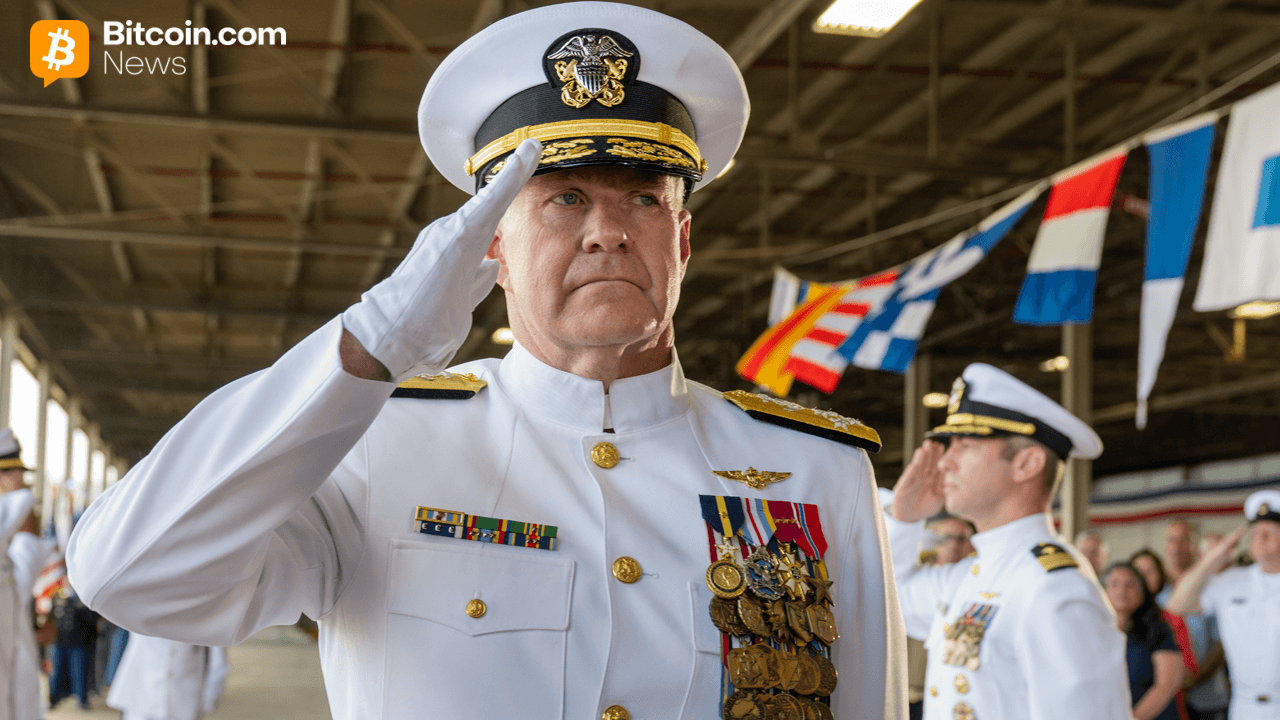
On April 21, Admiral Samuel J. Paparo Jr., Commander of U.S. Indo-Pacific Command, publicly confirmed before the Senate Armed Services Committee that INDOPACOM runs a full node on the Bitcoin network and is conducting multiple operational tests to secure military networks using the Bitcoin protocol. This marks the first time a U.S. military commander has openly acknowledged deploying the Bitcoin protocol as a cybersecurity tool.
Key Q&A at the Senate Hearing
Sen. Tommy Tuberville (R-AL) asked whether U.S. leadership in Bitcoin could strengthen leverage and deterrence against China. Paparo responded by framing Bitcoin strictly as a computer science tool, not an economic asset. "Our research into Bitcoin is as a computer science tool," he explained. "It's the combination of cryptography, a blockchain and proof-of-work, and through the proof-of-work protocols, it imposes more cost than just algorithmic securing of networks."
Paparo highlighted Bitcoin's peer-to-peer, zero-trust transfer of value as supportive of all instruments of U.S. national power. "Bitcoin is a reality," he stressed. "Anything that supports all instruments of national power for the United States of America is to the good."
Cost-Imposition Logic of the Bitcoin Protocol
The admiral outlined the core rationale: proof-of-work requires real computational resources to validate transactions, a property that can raise real-world costs for adversaries in cyber operations. He called Bitcoin "a valuable computer science tool as a power projection," adding that "outside of the economic formulation, it has got really important computer science applications for cybersecurity." Paparo confirmed INDOPACOM has "a node on the Bitcoin network" and is "doing a number of operational tests to secure and protect networks using the Bitcoin protocol." He also indicated some research details may remain classified.
Growing Congressional Interest in Strategic Bitcoin Reserve
Sen. Tuberville brought up the concept of a Strategic Bitcoin Reserve during questioning, but Paparo confined his remarks to technical applications within existing INDOPACOM research programs. Analysts noted the hearing signals a notable shift in U.S. military posture toward Bitcoin's protocol architecture, moving beyond previous concerns over illicit finance.