
U.S. Director of National Intelligence Jay Clayton sent a memo to Secretary of State Marco Rubio on Oct. 23 warning that Iranian plans for lethal attacks against Americans had entered an advanced stage. The U.S. government then told personnel across the Middle East to raise their alert level and reduced staffing at embassies and consulates in the region.
The Trump administration confirmed the memo later that night through a U.S. official. The document said intelligence showed Iran had "significantly intensified operations targeting U.S. personnel," and that planning for lethal attacks on American citizens had "entered advanced stages in the Middle East and in certain other countries."
Axios said the memo was one page and unclassified
Axios first obtained the document and reported that it was a one-page memo that was not classified. A copy was also sent to CIA Director John Ratcliffe. The memo did not name specific targets and did not identify the countries outside the Middle East referenced in the warning.
Officials said the threat is the highest since the war began in February
According to The New York Times, U.S. intelligence agencies assessed that the threat facing Americans in the Middle East and several other countries had risen to its highest level since the war started in February. Trump and senior aides have been receiving regular briefings, and one official said the threat now extends beyond the Middle East.
The report said analysts had spent the past three weeks reviewing intelligence on threats against U.S. officials, including ambassadors. One official said some information suggested Iran may already have deployed personnel inside the United States. Other officials said Iran’s plans also included potential targets in Europe.
Another official cautioned that Iran’s ability to carry out attacks inside the United States and in other overseas locations remained limited, and that its intent exceeded its actual capability. The White House did not respond to a request for comment from The New York Times, while the Office of the Director of National Intelligence and the CIA declined to comment.
State Department reduced staffing at embassies in five countries
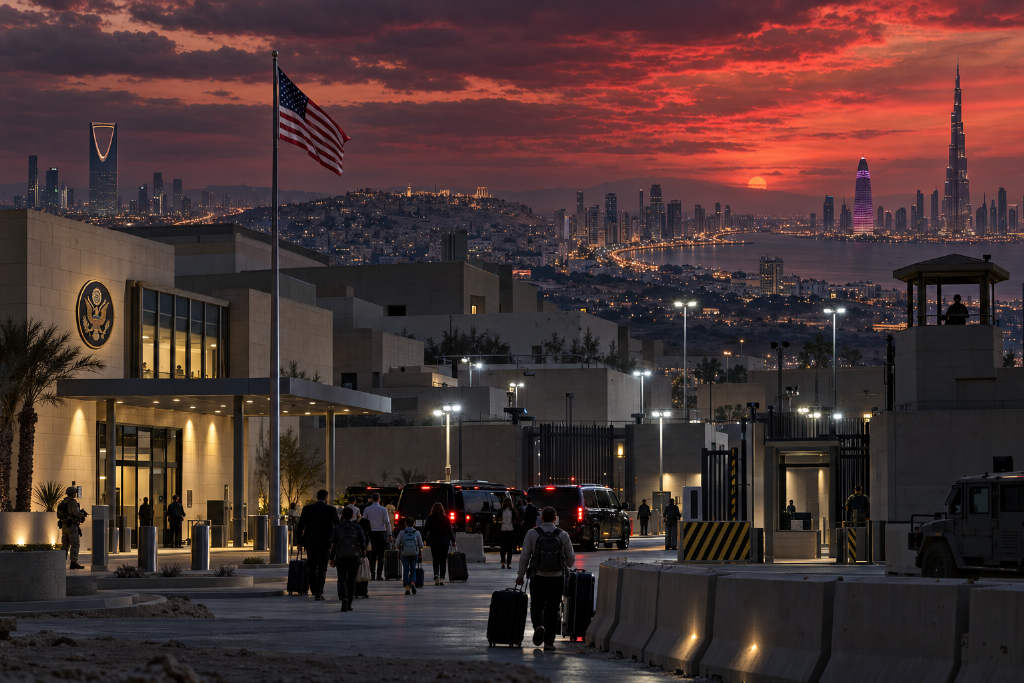
The Associated Press reported that on Oct. 21, the State Department ordered the departure of non-emergency personnel and family members from Saudi Arabia. U.S. embassies in Jordan, Lebanon, Qatar and the United Arab Emirates also reduced staffing this week.
Those four embassies remain open but are operating under restricted status. When the State Department announced the staffing reductions, it cited rising threats from Yemen’s Houthi forces and did not mention a direct Iranian threat. Three U.S. officials told the Associated Press that both Iranian and Houthi threats were tied to the personnel changes.
U.S. denied the drawdown was tied to another strike on Iran
U.S. officials denied that the embassy staffing cuts were related to any possible renewed U.S. or Israeli airstrikes on Iran. Earlier this week, The New York Times reported that the United States and Israel had prepared plans to strike Iran after the Nov. 3 midterm elections. That report helped push Brent crude to a close of $113.17 a barrel on Oct. 22, the highest closing price since May.
Trump also said at a rally in Florida, "We may do one little Epic Fury again." Epic Fury is the codename for a U.S. military operation against Iran.
Iranian state television reported that the Islamic Revolutionary Guard Corps Navy threatened to attack U.S. bases in the region if Washington continued helping commercial ships pass through the Strait of Hormuz. Iranian Foreign Minister Abbas Araghchi also wrote in the Financial Times that any further escalation around the Strait of Hormuz or elsewhere in the region would put civilian lives at risk.
The memo did not identify specific targets
Based on the details disclosed so far, the memo did not name specific targets. It said only that the plans had entered advanced stages in the Middle East and certain other countries. According to The New York Times, those under threat include U.S. officials and ambassadors, and there are also potential targets in Europe.



