
Prediction markets are not showing much faith that the latest U.S. ceasefire announcement involving Iran will hold for long.
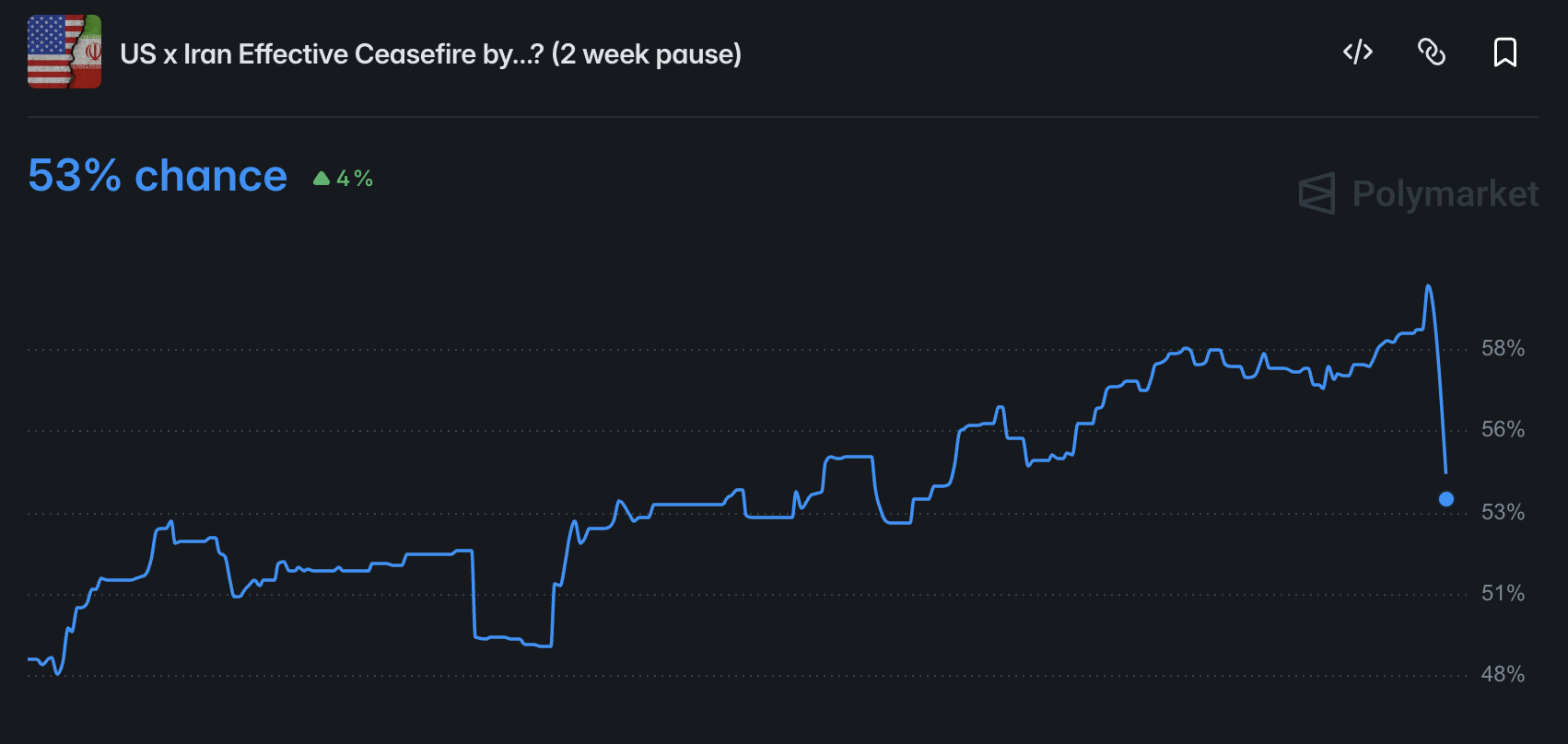
Polymarket odds slipped after the announcement
A Polymarket contract that requires a continuous 14-day period without a U.S. airstrike or surface-to-surface missile strike directly hitting Iranian territory fell from above 60% to around 53% today.
That distinction matters. A ceasefire, under the market’s framing, is not just an announcement that military commanders are pausing. It has to amount to a sustained halt in fighting over the full two-week window.
The result is a noticeable gap between the political message and the market price. Traders are assigning roughly 50-50 odds to the idea that the U.S. can avoid launching another direct strike for two full weeks.
Why traders remain cautious
The skepticism is tied to recent events. By Monday, the U.S. and Iran had gone a third day without exchanges of fire after 13 straight nights of U.S. strikes. But President Donald Trump told Axios he was prepared to return to “very strong military action” if talks fail.
Iran, for its part, denied that direct negotiations were taking place and said mediators were passing messages instead.
Myriad is tracking whether formal talks begin by July 31
Separately, Myriad, a prediction market developed by Decrypt parent company Dastan, is tracking whether the next formal senior-level round of U.S.-Iran peace talks begins by July 31.
Its rules are specific. Technical meetings, phone calls, and messages exchanged through mediators do not count unless they are part of a formally convened senior-level round.
Most of the money in that market is positioned for those conversations to be delayed until next month.
An earlier ceasefire drew similar doubt
Decrypt noted that a similar pattern played out before. An April ceasefire pushed Bitcoin and oil markets sharply higher, but analysts described that period as “fragile breathing room.”
Days later, prediction markets were still not convinced that shipping through the Strait of Hormuz would normalize, because ships were continuing to turn back.
The July 31 Polymarket contract can remain open into mid-August. The reason is procedural: the required 14-day no-strike period only needs to start by July 31, rather than end by that date.