
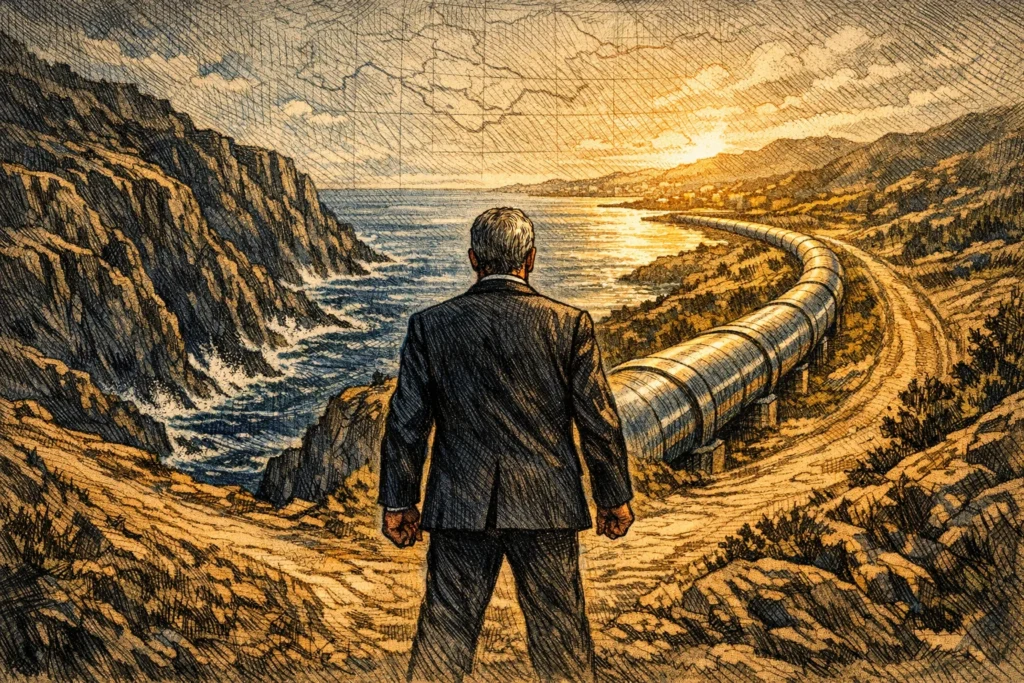
The United States is pushing a new oil pipeline plan that would send Iraqi crude through Syria, creating an export route that bypasses the Strait of Hormuz and cuts into Iran’s future leverage over global energy supply.
President Donald Trump said on July 14, during a White House meeting with Iraqi Prime Minister al-Chaidi, that a “massive” new oil cooperation deal could be announced this week or next.
Washington pushes to revive an Iraq-Syria pipeline
Thomas Barrack, the U.S. envoy for Syria and Iraq, has convened officials from both countries along with several companies, including Chevron, to discuss restarting a long-idled pipeline running from Iraq to Syria’s western coast. U.S. State Department officials are backing the effort and expect American companies to take part in related construction.
If restarted, the pipeline would carry crude from oil fields near Kirkuk to Syria’s western coast, giving Middle Eastern producers another route that reduces reliance on the Strait of Hormuz. Most of the line has been out of operation since it was damaged during the U.S.-led invasion of Iraq in 2003.
Baniyas, a Syrian port on the Mediterranean coast, is home to the country’s largest refinery and is now being viewed as a new gateway for Iraqi crude exports.
Chevron, TotalEnergies and others join discussions
According to the report, Chevron, TotalEnergies, Los Angeles-based investment firm TI Capital, and Qatar’s UCC Holding have all taken part in recent talks assessing Syria’s role as an energy export hub.
Chevron has recently signed memorandums of understanding with Iraq and Syria covering potential oil cooperation, but declined to comment on whether it would participate in rebuilding the pipeline.
Regional producers look for alternatives to Hormuz
Tensions in the Middle East have risen again in recent days, renewing focus on the urgency of building transport routes that do not depend on the Strait of Hormuz.
Iraq and Kuwait are among the countries studying whether they can follow the path taken by the United Arab Emirates and Saudi Arabia, which have used pipelines built years ago to reroute part of their crude exports away from Hormuz.
Before the war, Iraq was the second-largest oil producer in the Organization of the Petroleum Exporting Countries, or OPEC. But because its exports relied heavily on the Strait of Hormuz, the country was forced to cut crude production by about 60% during wartime, putting heavy pressure on government finances.
Security and political stability remain open questions
The pipeline project still faces substantial obstacles. Any route through Syria would need to cross Iraq’s Anbar province and eastern Syria, where Islamic State remnants are still active.
Whether companies are willing to invest will depend in part on whether Syria’s new government can stabilize the country after years of civil war. Chevron’s refusal to say whether it will join reconstruction efforts also points to continued caution over the risks on the ground.
White House sees energy and politics as linked
The report said Trump backed political newcomer al-Chaidi to become Iraq’s prime minister in April, in part because his main rival, former Prime Minister Nouri al-Maliki, was seen as too close to Iran.
The White House wants al-Chaidi to curb Iran-backed militias and open Iraq’s oil sector more broadly to U.S. companies.