
US inflation did not get worse in July, but it did not improve either. With markets focused on Jackson Hole, that alone was enough to lift expectations for another rate hike.
The Commerce Department said early Wednesday that the personal consumption expenditures price index rose 3.7% in July from a year earlier, unchanged from June. That marked the 65th straight month above the Federal Reserve’s 2% target. Second-quarter GDP grew at a 1.5% annualized pace, matching the previous estimate and slowing from 2.1% in the first quarter. Inflation-adjusted consumer spending was flat in July.
The New York Times summed up the report in one line: America’s inflation problem did not get worse in July, but it did not get better. Inside the Fed’s current debate, a lack of improvement is itself meaningful.
Why a flat reading raised hike expectations
Economists had expected some cooling. A Reuters survey had forecast July PCE at 3.6%, but the actual reading came in at 3.7%. On a monthly basis, headline PCE rose 0.2%, above the 0.1% estimate. June had shown a 0.1% decline, the weakest month since April 2020.
Core PCE, which strips out food and energy, rose 3.3% from a year earlier, unchanged from June. The monthly core reading accelerated to 0.2% from 0.1%.
After the release, fed funds futures showed the probability of a September rate increase rising from about 36% to around 44%. Traders also fully priced in one more increase before the end of the year.
Omair Sharif, founder of Inflation Insights, offered a short verdict: 「This is a hike-supportive report.」
Heather Long, chief economist at Navy Federal Credit Union, put it this way: 「The US still has an inflation problem. The latest data give Warsh time to wait, but he needs to be much clearer about what he is watching closely and what kind of developments would make him raise rates.」
Dollar gains after the data
The dollar posted its biggest gain in nearly four weeks on the day of the release, recovering about half of the losses it suffered after Treasury Secretary Bessent moved last week to support the bond market. The Bloomberg Dollar Spot Index rose as much as 0.3%, while the yen fell 0.2% to 159.45.
Inflation fell from its peak, then stalled at 3.7%
PCE peaked at 7.2% in June 2022. A steep tightening cycle, the sharpest since the 1980s, put inflation back on a path toward 2%. That path was interrupted last year. After Donald Trump returned to the White House, a new round of import tariffs pushed up prices across a wide range of goods.
At the end of February this year, the United States and Israel launched attacks on Iran. Before the conflict, PCE was 2.9%. The war disrupted about one-fifth of global oil supply, sending energy prices sharply higher and driving PCE to a three-year high of 4.1% in May.
Six months later, a final resolution still looks distant, but the intensity of the fighting has eased. Oil prices, and the wave of inflation tied to them, have retreated from late-spring highs.
They have retreated to 3.7% — and then stopped there.
Another source of pressure is already building. Last Friday, talks between the US and Canada, its second-largest trading partner, broke down. New tariffs on $20 billion of Canadian goods have already taken effect, and both sides have since announced additional retaliatory measures scheduled to begin over the coming months.
One report, two policy readings
The report leaves room for both sides of the Fed debate.
Those arguing for patience can point to the fact that inflation did not worsen, that high oil prices have barely spread through the broader economy outside categories such as airfares, and that the Bureau of Economic Analysis will change its pricing method for some services next month, including portfolio management services, software, and computer accessories. That adjustment could lower measured inflation.
Those favoring another hike can point to headline and core inflation both running hotter than forecasters expected in July, to services prices excluding housing rising faster than in June — a gauge some officials watch as a sign of underlying price pressure — to diesel prices near record levels, to AI-driven chip price increases, and to a renewed trade fight with Canada.
The most basic argument from that camp is not about one month of data. Inflation has been above target for more than five years. Their case is that a central bank that fails to act decisively risks losing credibility.
Consumer demand is cooling even as inflation stays high
Yet the economy is cooling, and that may be the most consequential part of the report.
Inflation-adjusted consumer spending was unchanged in July after strong gains in the prior two months. In nominal terms, personal income rose 0.4% and consumer spending rose 0.2%, both above expectations. Once inflation is stripped out, real growth disappears.
Income data tell a similar story. Real income was up just 0.2% from a year earlier, after being negative for several months before that.
That helps explain why consumers remain pessimistic about both the economy and their own finances in confidence surveys. Even if the annual inflation rate has come down, five years of cumulative price increases have continued to erode income.
GDP looked weak on the surface, but the details were stronger
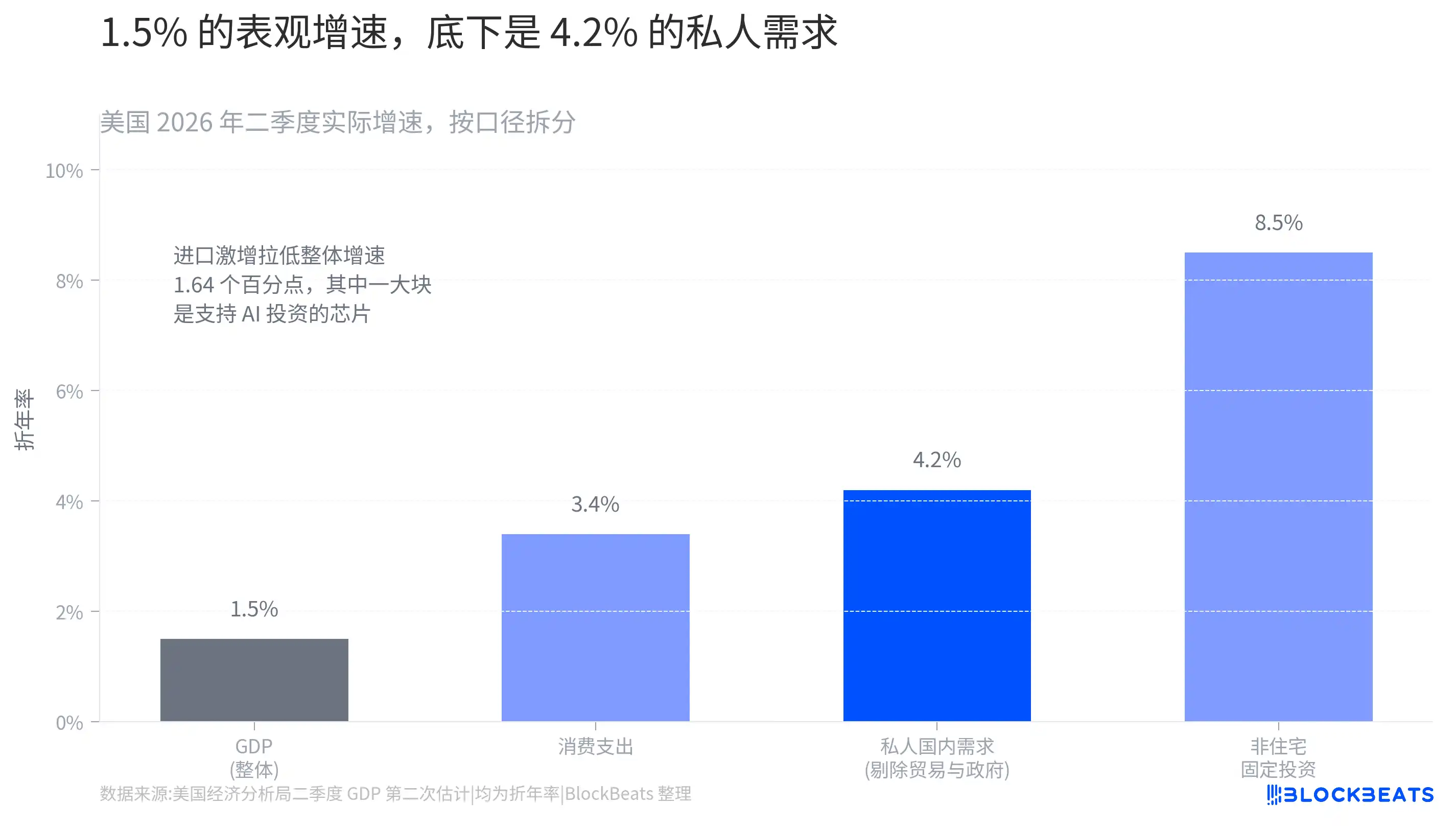
Second-quarter GDP growth of 1.5% looked mediocre. The composition underneath it did not.
Consumer spending, which accounts for more than two-thirds of US economic activity, grew at a 3.4% annualized pace, revised up from 3.2%. In the first quarter, that figure was just 0.5%. Business investment excluding residential construction rose 8.5%, reflecting the strength of AI-related spending. Final sales to private domestic purchasers, a measure often used to gauge underlying demand because it strips out volatile government spending and trade, increased 4.2%, the strongest in more than three years and up from an initial 3.9% estimate. In the first quarter, it was 1.7%.
Residential investment also rose, the first increase since late 2024.
What dragged headline GDP down to 1.5% was imports.
Imports surged at a 12.5% annualized rate in the second quarter, with computer chips and related products used for AI investment making up a substantial share. Because GDP measures domestic production, imports are subtracted, and this category alone cut 1.64 percentage points from growth. Government spending fell 1%, with a sharp decline in non-defense outlays adding to the drag.
The result was an unusual picture: chips brought into the country to build AI capacity ended up lowering the country’s headline growth number.
The third and final estimate for second-quarter GDP is due on Sept. 30.
All eyes turn to Jackson Hole and Warsh
All of that now feeds into Friday’s stage at Jackson Hole.
Federal Reserve Chair Kevin Warsh is set to deliver his first major speech since taking office. He has pledged to bring inflation back down, but so far he has offered no signal on whether he believes inflation can fall on its own without another rate increase. Wednesday’s data did not answer that question in the direction doves would prefer.
The policy rate has been held in a 3.5% to 3.75% range since December last year. At the July meeting, three officials dissented and favored a 25-basis-point increase.
Alex Cohen, a foreign-exchange strategist at Bank of America, said Warsh’s Jackson Hole speech carries clear two-way risk and remains an uncertain event.
There is also a political clock running alongside the economic one: the midterm elections are 10 weeks away. Gasoline prices remain elevated because of the Iran war. The president is threatening new tariffs on Canada and China. Spending on AI infrastructure is lifting prices for computers, gaming consoles, and semiconductors.
Prices are becoming a central issue in this election.