
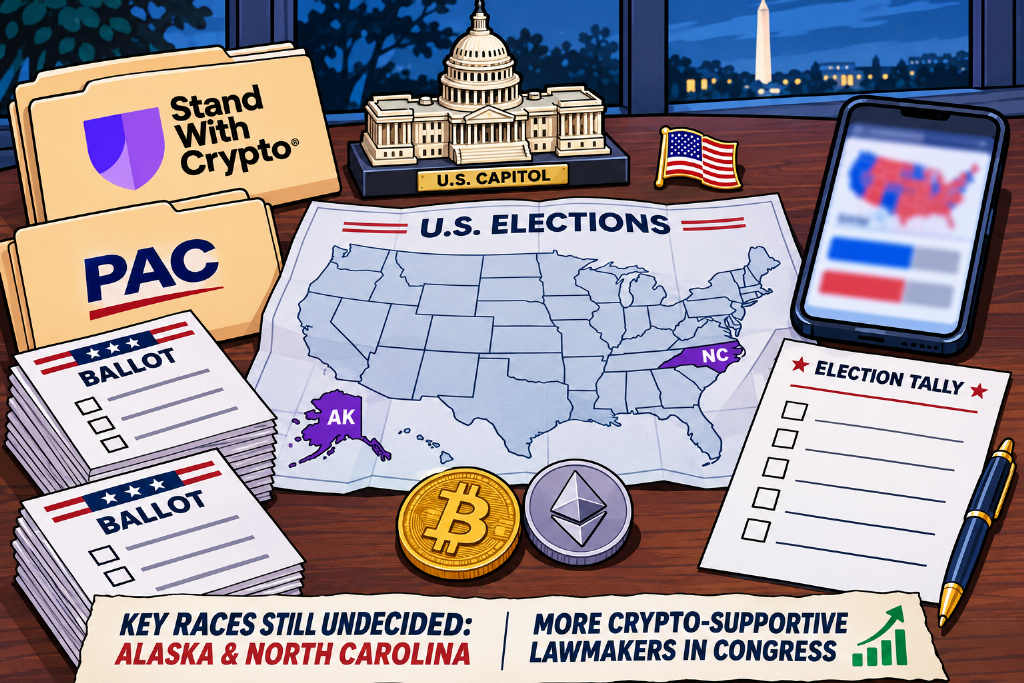
More than a week after the Democratic Party’s “blue wave” gave it control of both chambers of Congress, 14 US midterm election results remain unannounced. ChainCatcher, citing data from Stand With Crypto, reported that the results already released have increased the number of crypto supporters in the House and Senate. The remaining races could add more supporters.
Three PAC-backed candidates remain in undecided House races
Three candidates in unresolved House contests received support from crypto political action committees. Every candidate in those districts has been classified as either “strongly supports crypto” or “not stated.”
Alaska Rep. Nick Begich is currently leading his race. Defend American Jobs, a Republican-aligned affiliate under Fairshake, spent $508,000 on his campaign during the August primary.
The same PAC spent $150,600 on North Carolina Rep. David Rouzer, who is also leading. Louisiana state Sen. Blake Miguez will face Democrat Chauna Banks from the state’s 6th District in a runoff on Dec. 12. Fellowship PAC spent $250,000 on Miguez.
Stand With Crypto counts 246 House supporters
On Nov. 11, The Associated Press called the race for incumbent South Carolina Rep. Joe Wilson in the state’s 2nd District. Stand With Crypto rates Wilson as a “strong supporter of crypto.” Following his win, the organization counted 246 crypto supporters and 107 opponents in the House. Its Senate count stood at 50 supporters and 33 opponents.
Blockchain Association plans outreach to new lawmakers
Lindsay Fraser, chief policy officer at the Blockchain Association, said lawmakers who have not stated a position “represent an opportunity.” She said nearly one-quarter of the incoming Congress will consist of new members, many of whom have not spent much time thinking about blockchain technology. Fraser described that group as “a blank slate.”
According to Fraser, the association plans to organize visits with newly elected lawmakers next January. Its goal is to move more members into Stand With Crypto’s A and B ratings.
Fraser also said age may influence lawmakers’ crypto voting patterns more than party affiliation. Lawmakers under 55 are significantly more likely to support the industry, while the incoming Congress is younger overall. She said she hopes the industry will face two candidates who have thought deeply about the sector in the 2028 election, rather than having its fate depend on a single election result.



